
OpelBook.ru
Cars AvtoVAZ Cars Mitsubishi Cars BMW Cars Mercedes Cars Nissan Cars Toyota Cars Chevrolet
English Русский
Български
Беларускі
Український
Српски
Hrvatski
Română
Polski
Slovenský
Magyar
 |  Sitemap  |  Contacts  |    


Main Astra Corsa Insignia Kadett Omega Vectra Zafira Others Articles
Astra F (1991-1998, petrol) Astra G (1998-2004, petrol) Astra G (1998-2004) Astra H (2004-2009) Astra J (2009-2015, petrol)
  • Main
  • Astra
  • Astra H
  • Power unit
  • Power and exhaust system
  • Diesel Engine Control System. General Information

Diesel Engine Control System. General Information (Opel Astra H)

            0

Caution: When performing maintenance or replacing components of the fuel supply system, observe the appropriate safety precautions (see Section 1)!


1. The electronic engine management system provides the following capabilities:
  • a) Accurate fuel dosing in any operating mode, which ensures low fuel consumption at high power;
  • b) Reduction of harmful substances in exhaust gases due to precise fuel metering and the use of a catalytic converter;
  • c) Idle speed and maximum crankshaft speed limitation are set and adjusted automatically.

2. The engine control system elements maintain high performance for a long time and require virtually no maintenance. Only such elements of the fuel system as the air and fuel filters require regular replacement during vehicle maintenance.

3. When a diesel engine is running, clean air is sucked into its cylinders. which is compressed to high pressure. In this case, the air temperature rises to 600°C, which exceeds the ignition temperature of diesel fuel. The fuel is injected into the cylinder with some advance and ignites. Thus, spark plugs are not used to ignite the fuel.

4. When operating the vehicle in conditions of low outside air temperatures, the air temperature inside the cylinders after compression may be insufficient for the fuel to ignite spontaneously. In this case, it is necessary to preheat the incoming air flow. For this purpose, glow plugs are installed in the combustion chambers, heating them to the required temperature. The duration of the preheating depends on the outside air temperature and is regulated by the engine management system via the preheating relay. When the glow plugs are activated, the corresponding indicator lamp lights up on the instrument panel (see Chapter "Controls and Operating Techniques", Section 16).


5. Fuel is sucked from the fuel tank by an electric fuel pump and fed to the high-pressure fuel pump (HPFP). Before the fuel enters the HPFP, it is cleaned in the fuel filter from dirt and water. The HPFP creates very high fuel pressure in the injection system even at low speeds. From the HPFP, the fuel is fed to the cylinder injectors through the distribution line.

6. There are three fuel injection methods for diesel engines: swirl injection, pre-chamber injection and direct injection.

7. With the swirl-chamber and pre-chamber methods, fuel is injected into the preliminary chamber (pre-chamber) of the corresponding cylinder, where it mixes with air and creates a ready-made working mixture, with part of the fuel immediately igniting and burning. Due to the swirls of the air flow and heating during combustion of part of the fuel, the working mixture becomes more homogeneous and heated. This ensures complete combustion of the fuel when it enters the cylinder and a higher efficiency of the engine working cycle. The main disadvantage of these injection methods is the complication of the engine design. Direct injection continues to be the most common and most economical.

8. With direct injection, the fuel enters the combustion chamber directly through the nozzle atomizer. Each atomizer usually has 4-6 very fine holes drilled at different angles, through which the fuel is sprayed in specially specified directions. Usually, there is a swirl chamber in the piston crown. The swirl chambers can have different shapes, which correspond to the directions of fuel spraying, promote better mixture formation and more efficient combustion of the working mixture.


9. For direct injection on Astra/Zafira models, use "Common Rail" - common fuel distribution line for all cylinders (see accompanying illustration). It frees the injection pump from the fuel distribution function, which allows the pump to create higher pressure - on models with a working volume of 1.7 liters, the maximum injection pressure is approximately 1400 bar, and on other engines - approximately 1600 bar - this contributes to a very fine atomization of the fuel, due to which the process of mixture formation in the cylinders improves and the efficiency of combustion of the working mixture increases. Fuel distribution line (Common Rail) it is designed as a manifold, from which fuel is supplied to individual injectors.
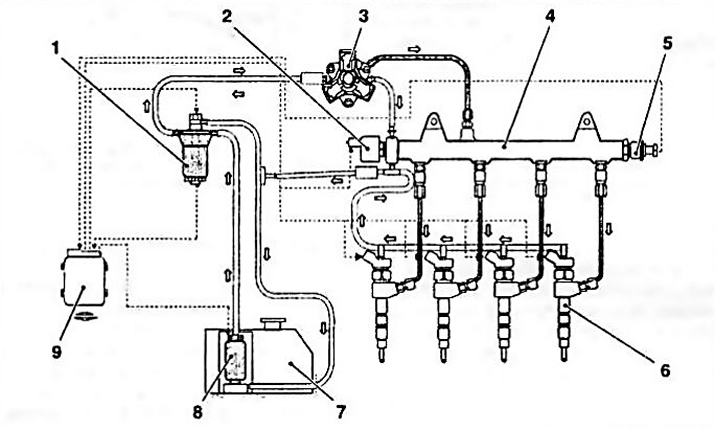
16.9 Common Rail Injection System (Z13DTH/Z19DT(H) Engines)

16.9 Common Rail Injection System (Z13DTH/Z19DT(H) Engines)
1 Fuel filter
2 Pressure regulator
3 High pressure fuel pump
4 Fuel distribution line (Common-Rail)
5 Pressure sensor
6 Nozzle
7 Fuel tank
8 Electric fuel pump
9 Electronic module of the engine management system
Dotted arrows indicate the direction of electrical signals
Short arrows - direction of fuel flow


10. The engine is fitted with injectors with electromagnetic control elements that receive signals from the engine management system, which regulates the amount of fuel supplied to the cylinder.

11. The high-pressure fuel pump does not require any special maintenance work. All moving elements of the fuel system are lubricated with diesel fuel. The high-pressure fuel pump is driven by the crankshaft via a toothed timing belt.


This article is available at russian, bulgarian, belarusian, ukrainian, serbian, croatian, romanian, polish, slovak, hungarian
Checking the article: Simonov Timofey

Share information:

Previous articles
Opel Astra H: Power and exhaust system
Next articles

Removal and installation of fuel injectors
The operating principle of fuel injection systems
Gasoline Engine Management System. General Information and Precautions
Removal and installation the fuel tank
Removal and installation glow plugs (diesel engines)
Removal and installation the fuel filter mounting clamp (diesel models)
Removal and installation fuel injectors
Removal and installation of fuel injection pump
Turbocharger and Intercooler — General Information
Particulate filter (engines with a working volume of 1.9 l)
Exhaust system. General information
Emission Control Systems — General Information


See similar ones from other Opel car manuals:
▶ Diesel Engine Control System Opel Corsa C (2000-2006)
▶ Diesel Engine Control System Opel Vectra C (2002-2008)
▶ Scheme 6. Fuel system and control unit of the diesel engine… Opel Frontera B (1998-2004)
▶ Diesel engine lubrication system Opel Insignia A (2008-2017)
▶ Possible malfunctions of the digital engine control system… Opel Kadett E (1984-1995)
Link to this page in different formats

Visitor comments


No comments yet


How much will 36 + 33 =


Astra J (2009-2015, petrol) 
  • General information
  • Vehicle device
  • User manual
  • Faults en route
  • Maintenance
  • Power unit
  • Engine repair
  • Cooling and lubrication system
  • Engine power system
  • Exhaust system
  • Transmission
  • Clutch
  • Car gearbox
  • Drive shafts
  • Chassis
  • Front suspension
  • Rear suspension
  • Steering
  • Brake system
  • Wheels and tires
  • Body
  • Exterior
  • Interior
  • Doors and windows
  • Body Care
  • Heating and air conditioning
  • Security systems
  • Electrical equipment
  • Equipment and devices
  • Lighting and signaling
  • Power devices
  • Electrical circuits
Astra H (2004-2009) 
  • General information
  • Introduction to the guide
  • Troubleshooting
  • User manual
  • Maintenance
  • Power unit
  • Engine repair
  • Cooling and heating
  • Power and exhaust system
  • Ignition system
  • Launch and charge system
  • Transmission
  • Mechanical gearbox
  • Automatic gearbox
  • Drive shafts
  • Chassis
  • Brake system
  • Car suspension
  • Steering
  • Body
  • Interior
  • Exterior
  • Electrical equipment
  • Equipment and devices
  • Electrical circuits
Astra G (1998-2004) 
  • General information
  • Introduction to manual
  • User manual
  • Maintenance
  • Power unit
  • SOHC gasoline engines
  • DOHC gasoline engines
  • Diesel engines 1.7 and 2.0
  • Engine repair
  • Cooling system
  • Supply system
  • Injection system (gasoline)
  • Injection system (diesel)
  • Exhaust system
  • Charge and launch system
  • Ignition system (gasoline)
  • Preheat system (diesel)
  • Transmission
  • Manual gearbox
  • Automatic gearbox
  • Clutch
  • Drive shafts
  • Chassis
  • Brake system
  • Wheel suspension
  • Steering
  • Body
  • Exterior
  • Interior
  • Doors and windows
  • Ventilation and heating
  • Electrical equipment
  • Equipment and devices
  • Electrical circuits
Astra G (1998-2004, petrol) 
  • General information
  • User manual
  • Car care
  • Maintenance
  • Power unit
  • Single shaft engines
  • Twin shaft engines
  • Engine repair
  • Cooling and heating
  • Fuel and exhaust systems
  • Starting and charging system
  • Ignition system
  • Transmission
  • Clutch
  • Mechanical gearbox
  • Automatic gearbox
  • Drive shafts
  • Chassis
  • Brake system
  • Car suspension
  • Steering
  • Body
  • Interior
  • Exterior
  • Electrical equipment
  • Equipment and devices
  • Wiring diagrams Opel Astra
  • Wiring diagrams Opel Zafira
Astra F (1991-1998, petrol) 
  • General information
  • Maintenance
  • Power unit
  • Engine in car
  • Engine removed
  • Cooling system
  • Heating and ventilation
  • Fuel supply (carburetor)
  • Fuel supply (injector)
  • Emission control
  • Ignition system
  • Transmission
  • Clutch
  • Mechanical gearbox
  • Automatic gearbox
  • Drive shafts
  • Chassis
  • Brake system
  • Car suspension
  • Steering
  • Body
  • Exterior
  • Interior
  • Electrical equipment
  • Equipment and devices
  • Electrical circuits
OpelBook.ru © 2017–2026 · Mobile version · · Sitemap: EN BG BY UA RS HR RO PL SK HU · Feedback · Site search
Astra F, petrol · Astra G, petrol · Astra G · Astra H · Astra J, petrol · Corsa B · Corsa C, petrol · Corsa C · Insignia A · Kadett D · Kadett E · Omega A · Omega B · Omega B2 · Vectra A, petrol · Vectra A · Vectra B, petrol · Vectra B · Vectra C · Zafira A, petrol · Frontera A, petrol · Frontera B · Ascona C · Vivaro A ·
We want your visit to be comfortable 🤝! We use cookies 🍪 to make that happen.