


Contents: General information ⬇ Removal and installation the starter ⬇ Checking the starter traction relay ⬇ Checking the condition and repairing…⬇
General information
1. The sole purpose of the starting system is to ensure that the engine rotates at a speed sufficient to start it - approximately 300 rpm.
2. The starting system consists of a starter, battery, ignition switch, traction relay and connecting electrical wiring.
3. Depending on the model, starters of different brands can be installed. Below is the general principle of operation of the starter.
4. The starter is a DC electric motor with mixed excitation and an externally mounted electromagnetic traction relay. The starter consists of a housing or stator with excitation windings, an anchor with an overrunning clutch, a cover with brush holders and a traction relay.
5. When the starter is turned on, current from the battery begins to flow through the winding of the traction relay. The relay armature is pulled in and the contacts are closed. At the same time, the relay armature, through the drive lever, ensures the extension of the gear with the overrunning clutch, while the hub of the clutch rotates on the helical splines of the starter armature shaft and also rotates the gear, which facilitates the entry of the latter into engagement with the toothed ring of the flywheel. Current flows through the closed contacts of the traction relay, feeding the stator and armature windings, and the starter armature begins to rotate together with the hub and the overrunning clutch.
6. After the engine is started, the rotation speed of the pinion exceeds the rotation speed of the starter anchor. In this case, the overrunning clutch rotates freely, and the torque is not transmitted from the engine flywheel to the starter anchor shaft. After releasing the ignition key, the power supply circuit of the traction relay windings through the ignition switch is opened, the anchor of the traction relay is pressed back to its original position by the spring, the relay contacts are opened and the drive pinion disengages from the toothed ring of the flywheel.
7. The starter with a solenoid relay is located parallel to the engine crankshaft and is attached to the power unit.
8. When performing maintenance, it is necessary to ensure a perfect connection of the electrical wiring, remove traces of corrosion from the clamp and lubricate the terminals with a special grease.
Removal and installation the starter
Engines Z16XE/Z18XE
9. Disconnect the cable from the negative terminal of the battery (see Section 8) and lift the car on a lift.
10. Disconnect the connector (see accompanying illustration) lambda probe wiring, unscrew 2 bolts and remove the exhaust system inlet pipe support bracket.
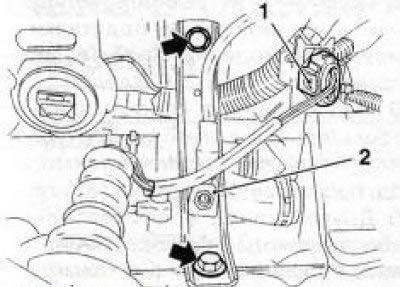
12.10 Bolts (indicated by arrows) support bracket fastenings (engines Z16XE/Z18XE): 1. Lambda probe wiring connector; 2. "Ground" cable
11. Loosen the 2 mounting nuts (see accompanying illustration) and disconnect the supply wiring from the starter, as well as the ground cable.
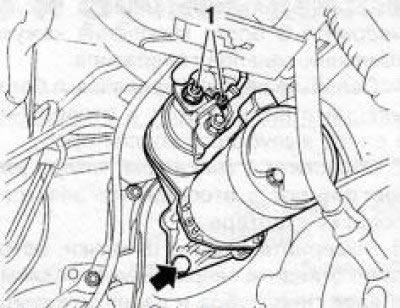
12.11 Nuts (1) for fastening the starter wiring (engines Z16XE/ Z18XE) - the arrow indicates the lower starter mounting bolt (the second one is not visible in the picture)
12. Remove 2 mounting bolts (see illustration 12.11) and remove the starter.
13. Installation is carried out in reverse order.
Z32SE Engine
14. Remove the generator (see Section 10).
15. Loosen the 2 mounting nuts and disconnect the starter wiring.
16. Remove 2 bolts and remove the starter from the engine compartment downwards.
17. Installation is carried out in reverse order.
Z19DT(H) Engines
18. Disconnect the cable from the negative terminal of the battery (see Section 8).
19. Remove the engine cover (see Chapter 2), raise the car on a lift and remove the crankcase guard (see Chapter 2, Section 5).
20. Loosen the 3 nuts (see accompanying illustration) and disconnect the wiring cables from the starter. Loosen the 2 nuts and disconnect the wiring harness holder, move the harness to the side.
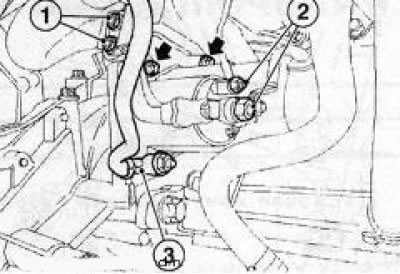
12.20 Starter mounting (Z19DT(H) engines) - the arrows indicate the upper mounting bolts: 1. Wiring harness holder mounting nuts; 2. Nuts for fastening electrical cables; 3. Grounding cable fastening nut; 4. Cooling system hose
21. On the Z19DTH engine, remove the starter studs.
22. Lower the car onto its wheels, disconnect the expansion tank and move it to the side.
23. On the Z19DTH engine, disconnect the 2 coolant hoses and disconnect the starter and generator wiring harness.
24. Remove the 2 upper mounting bolts (see illustration 12.20), separate the wiring harness and remove the starter from the engine compartment upwards.
25. Installation is carried out in reverse order.
Engines Y20DTH/Y22DTR
26. Disconnect the cable from the negative terminal of the battery (see Section 8).
27. Remove the upper starter mounting bolt and lift the car on a lift.
28. Remove the crankcase guard (see Chapter 2, Section 5) and the exhaust system (see Chapter 4).
29. Remove 2 bolts, loosen the mounting nut and remove the starter screen.
30. Disconnect the connector (see illustration 10.46) engine oil pressure sensor wiring, unscrew the 3 bolts securing the generator cable channel casing.
31. Loosen the upper mounting bolt, remove the lower bolt and disconnect the exhaust manifold support.
32. Loosen the 3 nuts (see accompanying illustration) and disconnect the starter wiring.
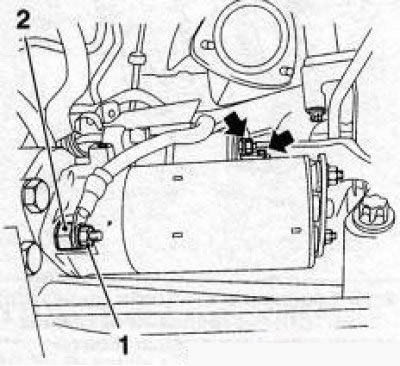
12.32 Starter wiring fastening nuts
33. Unscrew the lower studs, carefully move the generator cable channel cover upwards and remove the starter downwards from the engine compartment.
34. Installation is carried out in reverse order.
Y30DT Engine
35. The procedure for removing the starter is almost the same as the procedure for removing the generator described in Section 10, with the following exceptions: it is not necessary to remove the multi-rib belt, but it will be necessary to remove the front suspension subframe (see Chapter 10).
Checking the starter traction relay
36. The most common cause of starter malfunction is failure of the traction relay. As a result, the pinion does not engage with the flywheel ring gear and the starter does not turn the engine. The traction relay can be checked either on the engine or after the starter has been removed. Either method of checking requires a fully charged battery.
Checking on the engine
37. Switch off the ignition, set the selector lever to position "P" / engage neutral gear.
[Original source is on the website: Opelbook.ru]
38. Raise the vehicle on a lift and place it on stands. On diesel models, remove the protectioncrankcase.
39. Connect the auxiliary cable / wire to terminal" 50 " of the traction relay (a thin wire connected from the ignition switch is attached to the terminal
40. Briefly short-circuit the other end of the auxiliary cable/wire to terminal "30" (a thick cable running from the battery is attached to the terminal).
41. When the terminals are closed, the traction relay gear should move forward. If this does not happen, close the traction relay.
Checking after removing the starter
42. Remove the starter (see above).
43. Connect the starter housing with an auxiliary cable/wire to the negative terminal of the battery.
44. Connect one end of the second auxiliary cable/wire to the positive terminal of the battery, and briefly short-circuit the other end to terminal "50" of the traction relay.
45. When the terminals are closed, the traction relay gear should move forward. If this does not happen, replace the traction relay.
Checking the condition and repairing the starter
46. Carrying out a detailed diagnosis of the condition and restorative repair of the starter should be entrusted to specialists of the car service - first make sure that the cost of the repair will not exceed the price of a new starter.
Visitor comments