


Contents: Suspension type ⬇ General information ⬇
Suspension type
Front suspension - Independent, with MacPherson struts, gas-filled shock absorbers and anti-roll bar.
Rear suspension - Independent, multi-link type.
On the Station Wagon/Signum models, a rear ride height adjustment system is installed as an optional extra.
General information
Note: The suspensions of the Universal and Signum models are similar in design to those used on the Sedan and Hatchback models. The difference between the models is the wheelbase, which is 13 cm longer on the Universal/Signum models than on the Hatchback models.
Attention: When assembling suspension and steering components, it is imperative to comply with the tightening force requirements for threaded connections (see Specifications)!
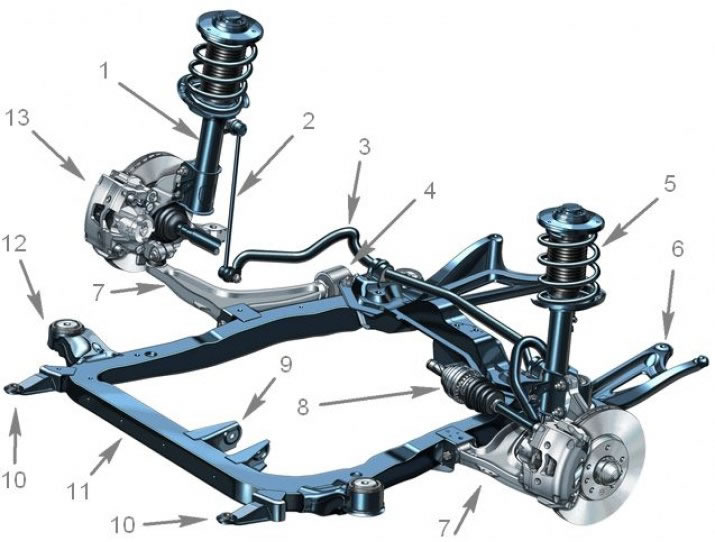
1.1 Front suspension design: 1. Shock absorber; 2. Vertical stabilizer bar; 3. Transverse stability stabilizer bar; 4. Hydraulic support of the control lever; 5. Coil spring of shock absorber strut; 6. Left reinforcement of the rear subframe holder; 7. Suspension control arm 8 Drive shaft; 9. Front engine mount bracket; 10. Lower radiator holders; 11. Subframe; 12. Damping rubber-metal subframe supports (4 pcs.); 13. Front brake caliper
1. The design of the independent front suspension with a subframe and lower control arms, MacPherson struts and anti-roll bar is shown in the accompanying illustration. The supporting element of the front suspension is a closed subframe, which is attached to the body at 4 points through damping supports. Additionally, 2 side supports are connected to the bottom of the body at the rear. The struts consist of telescopic shock absorbers and coil springs and are attached with their upper ends to reinforced supports on the mudguards of the front wings, and with their lower ends to the assemblies of the steering knuckles by means of bolted connections. The hub with the wheel bearing is made in the form of a single compact unit, non-adjustable bearings do not require maintenance. The hub assembly is installed in the steering knuckle. The lower parts of the steering knuckles are connected to the lower control arms of the suspension by means of ball joints. The levers are attached to the subframe by their inner ends, one of which (the rear one) has a hydraulic support installed to reduce noise and vibration when the car is moving. The levers are designed to limit the lateral and longitudinal movement of the front wheels. In addition, due to some displacement (bending) of the central axis of the coil springs, lateral movements are compensated. The anti-roll bar is included in the standard equipment of all models. The stabilizer is attached to the subframe and connected to the shock absorber struts of the suspension by means of two vertical struts. It is designed to compensate for the lateral roll of the car when cornering. The front suspension does not require maintenance during operation.
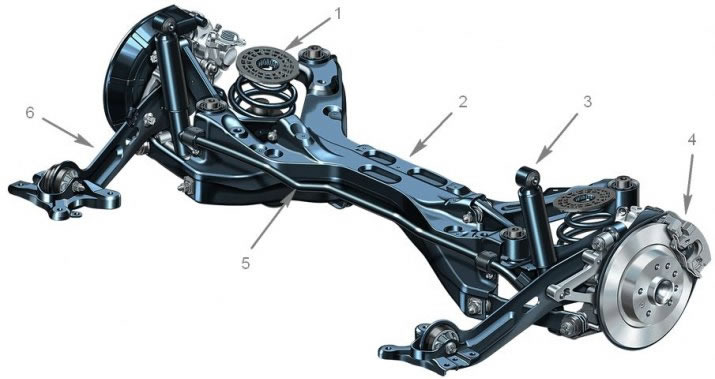
1.2 Rear suspension design: 1. Upper damping seat of the coil spring; 2. Rear suspension beam; 3. Shock absorber; 4. Rear brake caliper; 5. Transverse stability stabilizer bar; 6. Longitudinal arm with damping rubber-metal support
2. The rear suspension consists of 2 longitudinal arms connected to each other by means of three cross beams, and holders for the rear wheel hub assembly mounted on the arms (see accompanying illustration). The front ends of the levers are equipped with rubber-metal supports. Bolts are threaded through them, fixing the suspension arms in brackets bolted to the body side members. To reduce the weight of the rear suspension, some of the cross beam elements are made of aluminum. The rear suspension is also equipped with an anti-roll bar to reduce the roll of the car when cornering and to ensure more reliable traction of the rear wheels with the road surface. The rear suspension is sprung by two coil springs and two shock absorbers. The upper ends of the shock absorbers are attached to the supporting elements of the body bottom. The springs are installed separately from the shock absorbers (due to this, the luggage compartment space increases) and are fixed with two saddles, one of which is attached to the flange on the suspension, the other to the bottom of the car. Some models can be equipped with a rear ground clearance adjustment system. Just like on the front suspension, the rear wheel hubs with bearings are made as single units - the bearings do not require maintenance.
4. Often, when replacing suspension components, you have to deal with fasteners that are difficult to loosen. The fasteners "stick" because they are constantly exposed to external influences, are in contact with water, dirt, soot and other substances that promote corrosion. In order to facilitate the procedure of loosening such "stuck" fasteners, they should be soaked in plenty of penetrating oil or a special rust-corroding agent in advance. Cleaning the exposed threaded parts of the fasteners with a stiff wire brush also helps to loosen rusted nuts. In particularly difficult cases, you can use a chisel/punch and a heavy hammer to loosen a "stuck" bolt/nut. Make sure that the chisel/punch does not come off, try not to damage the threads with imprecise blows. In extreme cases, you can heat up the stubborn fastener and the components surrounding it with a blowtorch or gas burner. Due to its potential danger associated with the possibility of fire and the risk of burns, this technology should only be used if all other methods have failed. Various types of extensions, collars and pipe attachments are designed to increase the torque when releasing the fastener. Sometimes the nut/bolt begins to give in after it has been slightly tightened clockwise. All fasteners, the release of which required the use of extraordinary measures during assembly, are subject to replacement!
Note: After delivery, carefully check the condition of the fasteners and, if necessary, replace them with elements of the same size.
5. Since the maintenance procedures for suspension components are performed under the vehicle, you should take care in advance of the ability to lift the vehicle and secure it in a raised position (prepare a reliable jack and supports
Caution: Never carry out any work under a vehicle that is supported in a raised position only by a jack.
6. Optimum running characteristics and minimal tire wear are achieved with correct wheel angles. In case of uneven tire wear and unsatisfactory road stability, it is necessary to check the suspension geometry and wheel alignment. This will require a number of optical measurements, which can only be performed with special equipment.
(Text copied from an online resource www.opelbook.ru)
Visitor comments