


Caution: Use only a properly functioning tool to disassemble the shock absorber. Never loosen the shock absorber nut unless the spring is securely compressed with a special device! To avoid accidents, do not use wire to hold the spring in a compressed position! Make sure that the shock absorber is securely fastened in a vice and that the device cannot slip out!
1. Remove the shock absorber strut.
2. To avoid crushing the shock absorber support tube, clamp the strut assembly in a special device KM6066, and then clamp the device in a vice (see accompanying illustration). Using a screwdriver, remove the strut cap (arrow A) and install the special spring compressor tool (for example, Hazet 4900-2A with clamping plates Hazet 4900-12) so that at least 3 turns of the spring are subject to compression.
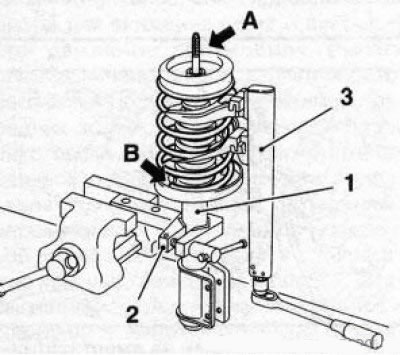
3.2 Coil spring compression: 1. Rack-mounted assembly; 2. Device KM-6066; 3. Hazet 4900-2A device
Note: At Opel service stations, the KM-6068 device with KM-6068-10 clamping plates is also used to compress the spring.
Compress the coil spring, completely removing the load from the support bearing. Ensure that the compression device is securely seated on the spring.
3. Holding the shock absorber rod with a wrench, unscrew the upper support bearing mounting nut.
4. Remember the installation position of the shock absorber assembly elements, if necessary, mark their position with a marker (see illustration 2.1) and disassemble the rack into its elements.
5. Inspect the components for mechanical damage, check the smoothness of the shock absorber rod. Replace the failed components.
6. Inspect the shock absorber for signs of leaks. Make sure that there are no signs of corrosion or mechanical damage along the entire length of the rod. Holding the shock absorber vertically, check its proper functioning, both at full and short (50 + 100 mm) stroke of the rod. In both cases, the resistance should be soft, even and constant. If signs of malfunction are detected, both shock absorbers should be replaced.
7. Remove the spring compression device and carefully inspect the spring for signs of deformation and mechanical damage. If necessary, replace both front suspension springs. Depending on the model, different springs may be installed. They are designated by color marking on one of the coils - the same springs must be installed on both struts. Springs that have sagged or do not develop the required force must also be replaced.
Note: New springs have a protective varnish coating against corrosion - try not to damage it during installation.
8. Check the condition of other rack assembly components. Replace any faulty parts.
9. Installation is performed in the reverse order of removal. When installing the spring, make sure that it is correctly positioned on the lower support washer (arrow B) (see illustration 3.2). Screw the new nut onto the shock absorber rod and, holding the rod from turning, tighten it to the required force.
Visitor comments