


Two types of generators
Opel installs generators from Bosch and Delco Remy. They differ from each other only in design, they are mounted on the engine in the same way.
Power
Depending on the model, Vectra is equipped with generators with a capacity of 70, 90 or 100 A. To determine the generator power, you need to multiply the value of the specified maximum current by the nominal voltage of 14 V. You get 980, 1260 or 1400 W.
You have already noticed: the generator actually supplies 14 V at 12 V in the on-board network. Because only with such a small difference in voltage can the current flow to the battery in order to charge it.
However, the transmission ratio from the crankshaft belt pulley to the generator belt pulley is selected so that already at idle speed about "⅔" of the generator power can be produced.
Generator Handling and Precautions
The three-phase alternator, in addition to its relatively high power, has a decisive advantage: it supplies current already at idle speed. In addition, its graphite brushes can withstand a mileage of significantly more than 80,000 km. As the name suggests, it produces alternating current, which we cannot use in a car, since the battery can, of course, only store direct current. Therefore, three diode rectifiers are built into the alternator, which convert the three-phase current into pulsating direct current. These diodes are sensitive to high voltages, and therefore you should consider the following points:
When the generator is running, you must not remove or connect any wire between the battery and the generator. This can cause the voltage to increase sharply (voltage peaks) and "overheat" the diode.
The alternator should not operate without a properly connected and functioning battery. The battery serves as a buffer for the alternator to some extent during voltage peaks.
All wire connections between the alternator, battery, and body metal or engine block (ground) must be solid. Even a loose connection can cause dangerous voltage surges.
When charging the battery at high speed (cannot be used for charging at home) and when performing electric welding work on the body, both wires must be disconnected from the battery in order not to damage the generator diodes.
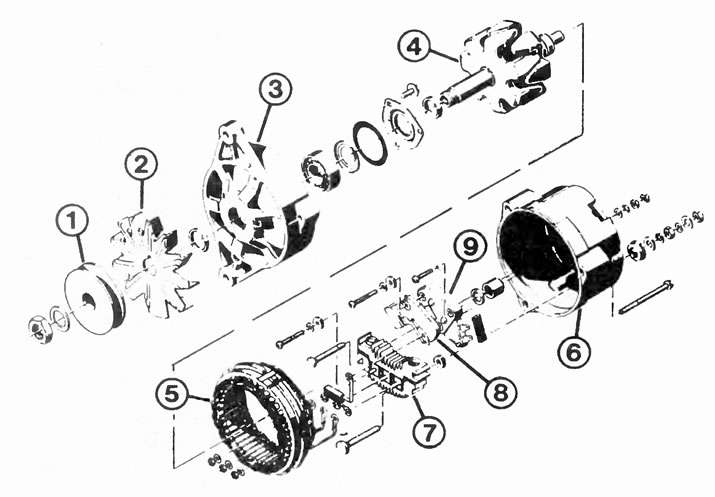
The most important design elements of the Bosch generator:
1 - belt pulley;
2 - fan;
3 - bearing shield;
4 - beak-shaped generator rotor;
5 - stator winding;
6 - body;
7 - diode bracket;
8 - brush holder;
9 - regulator.
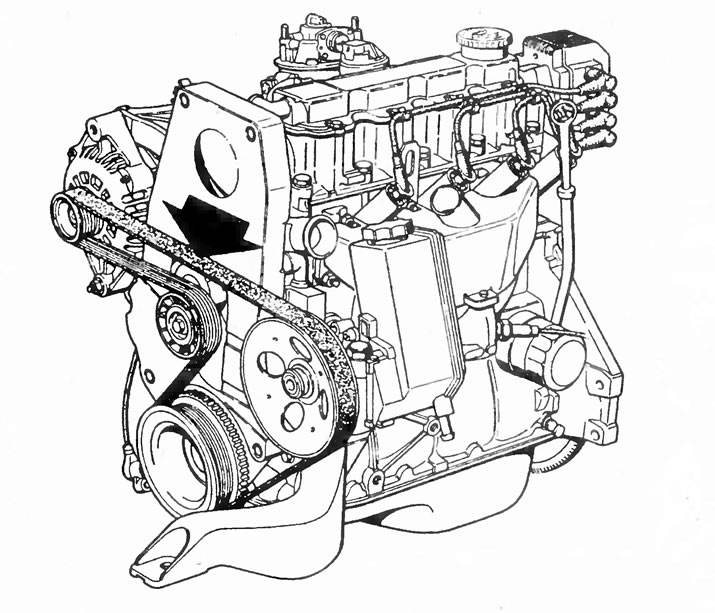
The figure shows the movement of the poly V-belt with an 8-valve 1.6 L engine. The poly V-belt, tensioned on the tension roller, serves as a drive for the generator and the power steering servo pump.
Visitor comments