


Connect the positive wire to the positive battery terminal, the negative wire to the negative battery terminal.
The battery cable is not removed with a regular charger.
The battery caps can remain screwed in. Gas generated during battery charging can be released through the ventilation holes in the caps.
The charging current should initially be approximately 10% of the battery capacity (for example, 4.4 A with a 44 Ah battery) and automatically decrease during the battery charging process.
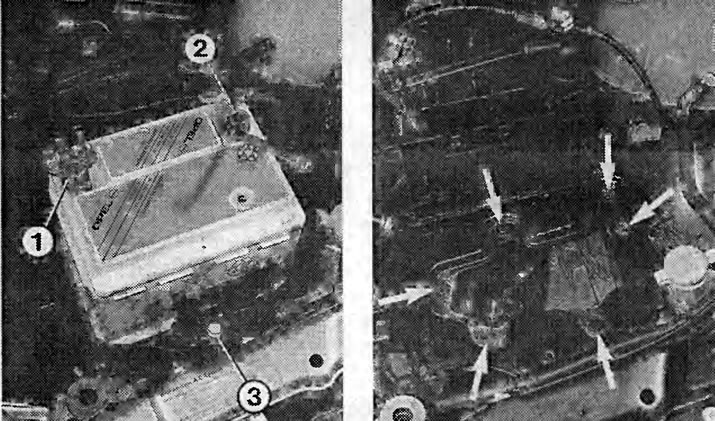
Left: the battery is located in the front left of the engine compartment. Removal: disconnect the ground wire (2), lift the positive pole cover and unscrew the positive wire (1). The battery itself is secured with a mounting plate and a hexagonal head bolt (3).
Right: the arrows in the photo show the 6 mounting bolts of the battery monoblock.
Connecting the charger
The battery is considered fully charged if the density of the acid in it does not increase within two hours.
During battery charging, distilled water partially decomposes. Gas bubbles of hydrogen and oxygen are formed - detonating gas, which has a high explosive capacity.
If charging is done with a high current, make sure the room is well ventilated.
When charging the battery, do not smoke near it or use open fire.
Oxygen gas can also be ignited by sparks caused by connecting and disconnecting the charger or wires.
Visitor comments