


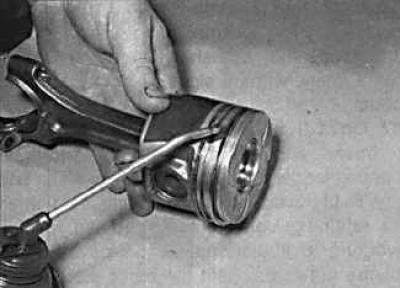
2. Lubricate pistons and piston rings and position piston ring seals as required.
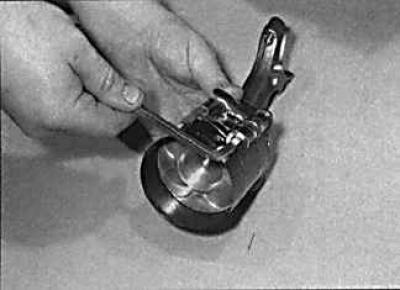
3. The installation of pistons should begin with the first cylinder. Compress the piston rings on the piston with a special device for compressing piston rings.
Petrol engines
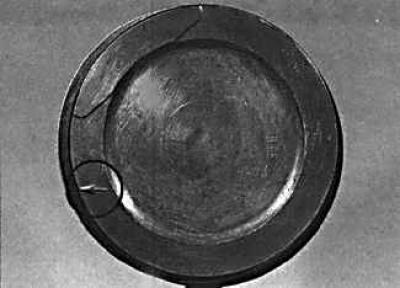
4. Insert the piston with the ring compressing device into the top of the first cylinder, with the arrow on the piston head pointing towards the timing belt.
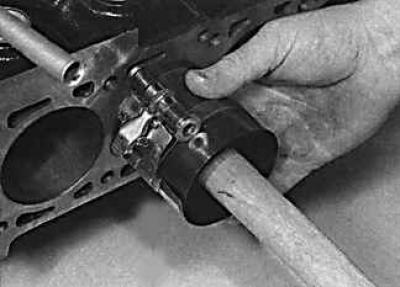
5. Using a wooden block or the handle of a hammer, push down on the piston and force it into the cylinder.
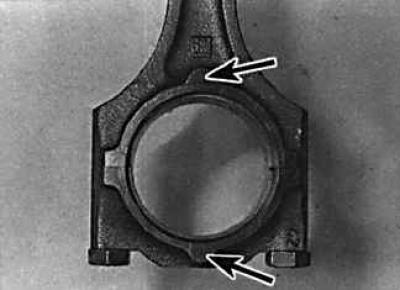
6. Check the alignment of the connecting rod lower head with the crankshaft journal. If necessary, tighten the piston with the connecting rod and install the connecting rod lower head with the liner on the crankshaft journal. The protrusion on the base of the connecting rod bearing cap should be directed toward the flywheel.
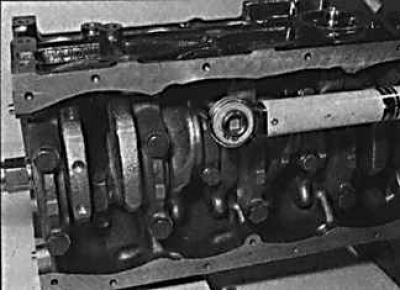
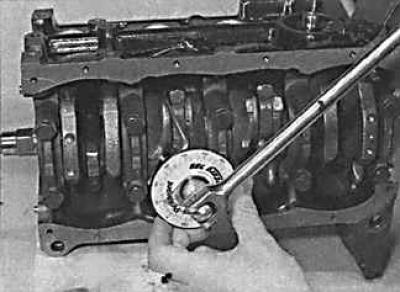
7. Tighten the connecting rod cap mounting bolts to the required torque (on the left – tightening the connecting rod lower head bearing cap mounting bolts to the required torque, on the right – tightening the connecting rod lower cap mounting bolts, turning them to a certain angle).
8. On 1.8L and 2.0L engines, install the main bearing cap and tighten the mounting bolts in a diagonal sequence from the center to the edge.
9. On all engines, install the oil pickup pipe, oil pan and cylinder head.
Diesel engines 1.7 l
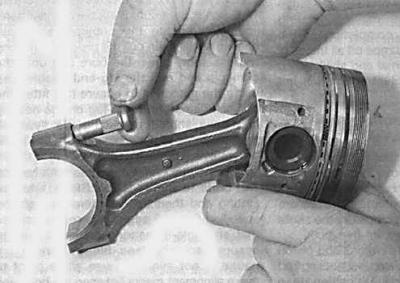
10. Remove the bolts from the connecting rod base and install new bolts into the connecting rod.
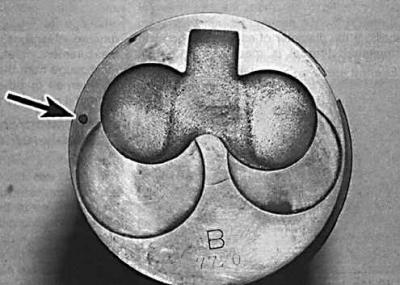
11. Insert the piston with the mandrel compressing the piston rings into the top of the first cylinder. The timing mark on the piston head should be directed towards the toothed belt.
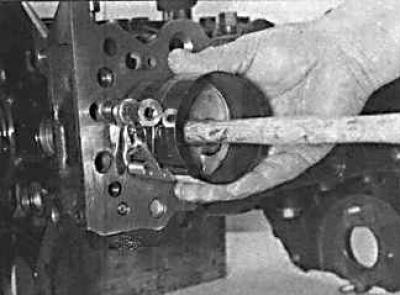
12.. Using a wooden block or the handle of a hammer, push down on the piston and force it into the cylinder.
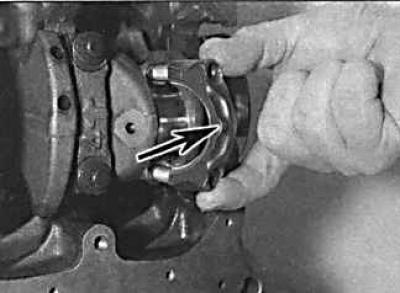
13. Check the alignment of the lower head of the connecting rod with the crankshaft journal and, if necessary, tighten the piston with the connecting rod and install the lower head of the connecting rod with the liner on the crankshaft journal.
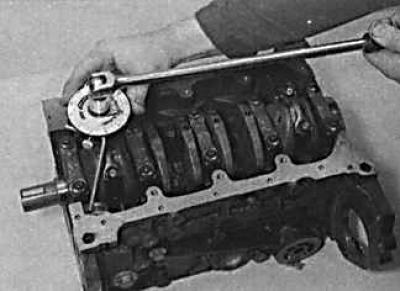
14. Install the connecting rod lower head cover and tighten the nuts to the required torque/tightening to a certain angle.
15. Install the remaining three pistons with connecting rods in the same manner.
16. Turn the crankshaft and check that it rotates freely and without binding. Install the partition at the bottom of the cylinder block and secure with bolts, tightening them to the required torque.
17. Install the oil pickup pipe, oil pan and cylinder head.
Diesel engine 2.0 l
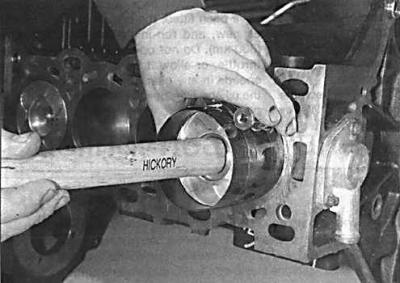
18. Insert the piston with the mandrel compressing the rings into the top of the first cylinder. The arrow on the piston head should point toward the timing chain. Using a wooden block or a hammer handle, push the piston into the cylinder.
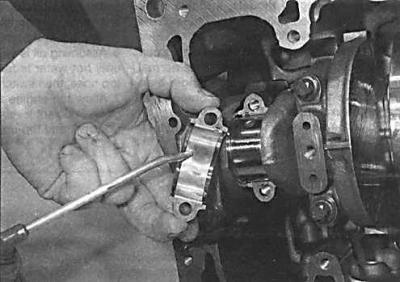
19. Check the alignment of the connecting rod lower head with the crankshaft journal and, if necessary, tighten the piston with the connecting rod and install the connecting rod lower head with the liner on the crankshaft journal. Install the connecting rod lower head cover with the liner. In this case, the protrusion on the connecting rod cover should be directed toward the flywheel.
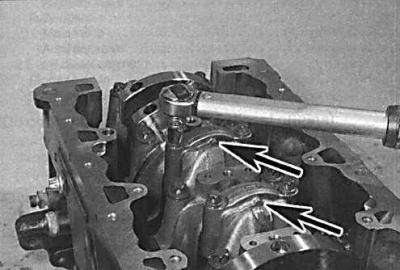
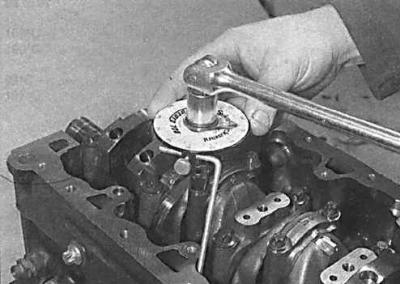
20. Tighten the mounting bolts to the required torque in several stages (on the left – tightening the mounting bolts of the lower connecting rod head cover with a torque wrench, on the right – tightening the mounting bolts of the lower connecting rod head cover by turning them to a certain angle).
21. Install the remaining three pistons and connecting rods in the same manner.
22. Turn the crankshaft and check that it rotates easily and without binding.
23. Install the oil pickup pipe, oil pan and cylinder head.
Visitor comments