


2. Select the appropriate piston with connecting rod assembly for a specific cylinder.
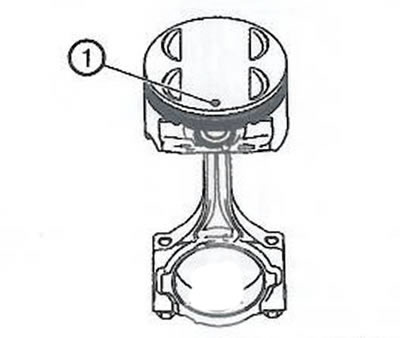
Note: The piston is not symmetrical and must therefore be installed in the cylinder block in the correct position: the dot (1) on the piston crown must point towards the front of the engine.
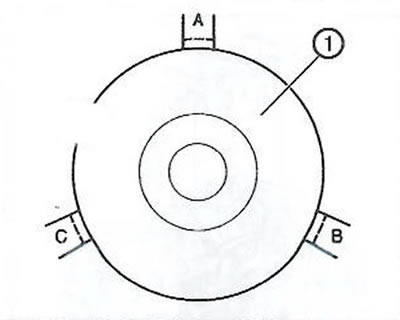
Note: Make sure that the piston ring locks are positioned as shown in the diagram (A, B, C).
3. Install the connecting rod bearing into the connecting rod.
Note: If connecting rod bearings have been used on an engine that has been runaway, they must be replaced with new ones during assembly.
4. Install the connecting rod guide pins EN 46121 into the connecting rod bolt holes.
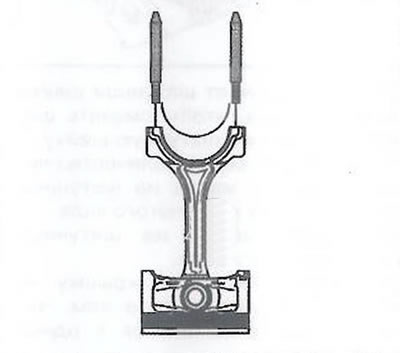
5. Compress the piston rings using the special tool EN 8037 or equivalent.
6. Using both hands, slowly insert and press the piston with connecting rod assembly into the cylinder from above. Avoid contact of the connecting rod with the cylinder bore.
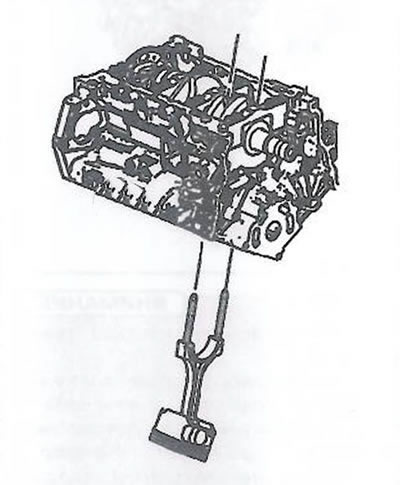
Caution: Extreme care must be taken when installing the piston with the connecting rod so as not to damage the cylinder bore, oil jets or crankshaft journal.
7. Once the piston ring compressor EN 8037 has touched the cylinder block surface, carefully push the piston into the cylinder with the hammer handle. Guide the connecting rod onto the crankshaft journal using the guide pins EN 46121, carefully pushing the piston with the hammer handle.
8. Remove the EN 46121 guide pins from the connecting rod bolt holes.
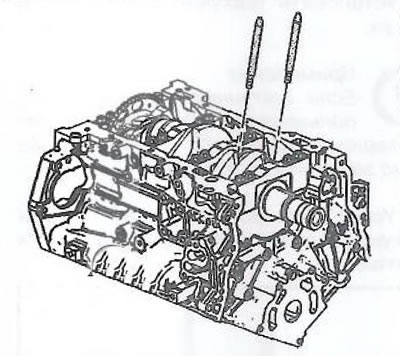
9. Move the connecting rod away from the crankshaft journal to lubricate the connecting rod bearings and the crankshaft journal.
10. Apply a moderate amount of clean engine oil to the connecting rod bearing and crankshaft journal.
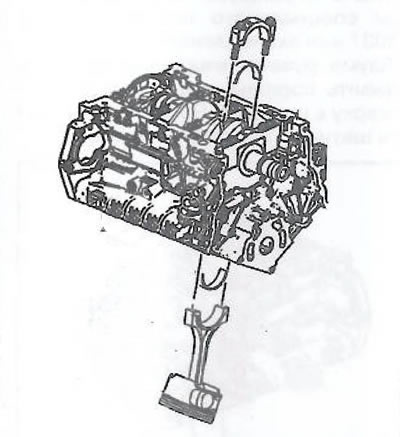
11. Install the connecting rod onto the crankshaft journal.
12. Install the connecting rod cap in its place and make sure that the stop tabs are on the same side of the connecting rod.
Attention.
- Do not use old connecting rod bolts.
- Do not lubricate new connecting rod bolts as they are pre-coated with graphite grease. Applying grease to the connecting rod bolts will cause excessive stress on the connecting rod bolts when tightening them, which will result in inadequate tightening torque, causing engine damage.
13. Install new connecting rod bolts into the connecting rod cap and tighten to 30 Nm.
14. Loosen the connecting rod bolts completely.
15. Retighten the connecting rod bolts in two stages:
- Tighten the bolts to 25 Nm.
- Using the EN 45059 tool, tighten the bolts a further 110°.
16. During and after installation, make sure that all pistons are installed in their correct cylinders and in the correct direction. The dot on the bottom of each piston should be at the front of the engine.
17. Install all other pistons with connecting rods in a similar manner, turning the crankshaft using the EN 48589 tool.
Visitor comments