
OpelBook.ru
Cars AvtoVAZ Cars Mitsubishi Cars BMW Cars Mercedes Cars Nissan Cars Toyota Cars Chevrolet
English Русский
Български
Беларускі
Український
Српски
Hrvatski
Română
Polski
Slovenský
Magyar
 |  Sitemap  |  Contacts  |    


Main Astra Corsa Insignia Kadett Omega Vectra Zafira Others Articles
Vectra A (1988-1995, petrol) Vectra A (1988-1995) Vectra B (1995-2002, petrol) Vectra B (1995-2002) Vectra C (2002-2008)
  • Main
  • Vectra
  • Vectra A
  • Power unit
  • Fuel system (carburetor)
  • Carburetor — General Description

Carburetor — General Description (Opel Vectra A)

            0

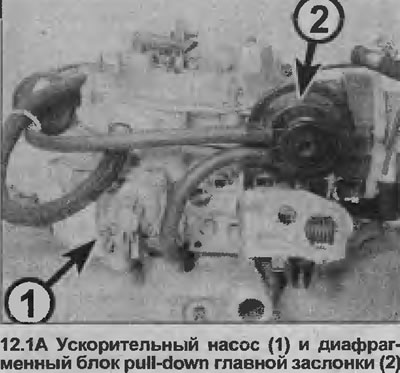
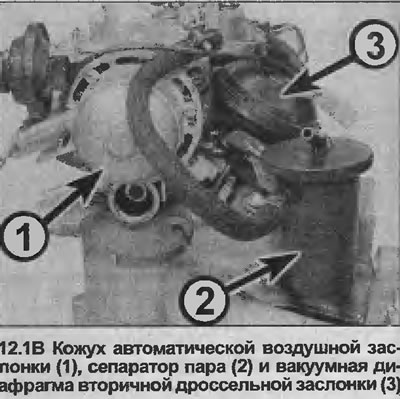
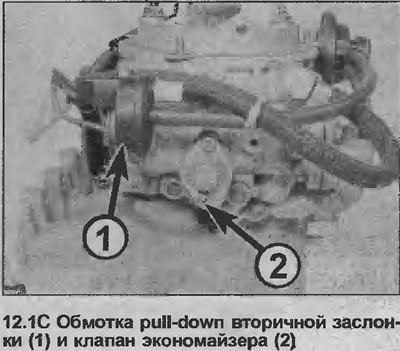
1. Carburetor Pierburg 2E3 - two-chamber, with fixed jets and a sequential throttle valve. Only one primary throttle valve operates (except at high engine speed and high load conditions, when the secondary throttle valve begins to be used) to full throttle, when both valves are fully open. This design provides good fuel economy during light acceleration and smooth cruising, and provides maximum power at full throttle. The secondary throttle valve is vacuum-controlled, depending on the vacuum in the primary throttle body. The primary throttle body and throttle body diameters are smaller than the secondary ones. The carburetor is a complex device that has many subsystems designed to improve overall vehicle handling, fuel economy, and emissions (see illustrations).

1. Carburetor Pierburg 2E3 - two-chamber, with fixed jets and a sequential throttle valve. Only one…


1. Carburetor Pierburg 2E3 - two-chamber, with fixed jets and a sequential throttle valve. Only one…


1. Carburetor Pierburg 2E3 - two-chamber, with fixed jets and a sequential throttle valve. Only one…


2. The idle system operates independently of the main jet system and is controlled by the mixture adjustment screw.


3. The main jets are calibrated to allow the engine to operate normally at half throttle. To ensure the required amount of fuel at full throttle, a vacuum economizer valve is used. The valve supplies additional fuel at low pressure, at fully open throttles.

4. To enrich the mixture during acceleration, the accelerator pump supplies additional fuel to the primary main diffuser. The accelerator pump is mechanically controlled by a cam from the throttle linkage.

5. The system uses a fully automatic air damper, controlled by a cooling and electrically heated bimetallic spring. When the engine is cold, the bimetallic spring is fully wound, holding the damper in place (in the primary chamber) in the closed position. As the engine warms up, the bimetallic spring heats up and unfolds, gradually opening the valve. The vacuum controls the pull-down system, as a result of which, if the engine operates in a mode with the valve almost closed, but only with uniform movement (i.e. under light load), the valve is open against the bimetallic spring. The pull-down system prevents over-enrichment of the mixture (due to over-enrichment of the mixture, fuel consumption increases and wear of the cold engine increases). The secondary pull-down winding is used in combination with the main diaphragm unit to modify the pull-down characteristics and improve fuel economy.

6. The 1.8 litre models are equipped with an idle cut-off valve. This is an electrically controlled valve that cuts the idle mixture circuit when the ignition is switched off.


This article is available at russian, bulgarian, belarusian, ukrainian, serbian, croatian, romanian, polish, slovak, hungarian
Checking the article: Chernov Alexander

Share information:

Previous articles
Opel Vectra A: Fuel system (carburetor)
Next articles

Throttle Cable — Removal, Installation and Adjustment
Gas pedal — removal and installation
Fuel vapor separator (1.6 and 1.8 liter models) — removal and installation
Fuel level sensor unit — removal and installation
Fuel tank — removal, inspection and installation
Fuel pump — removal and installation
Carburetor — removal, overhaul and installation
Idle speed and mixture — adjustment
Needle and float — removal, inspection and installation
Secondary Throttle Valve Vacuum Diaphragm — Checking, Removing and Installing
Economizer valve diaphragm — removal and installation
Accelerator pump — checking, removal and installation


See similar ones from other Opel car manuals:
▶ General information about carburetor engines Opel Astra F (1991-1998, petrol)
▶ Carburetor — General Information Opel Kadett D (1979-1984)
▶ General information about technical monitoring Opel Corsa B (1993-2000)
▶ General information Opel Insignia A (2008-2017)
▶ General description Opel Omega A (1986-1993)
Link to this page in different formats

Visitor comments


No comments yet


How much will 15 + 10 =


Vectra C (2002-2008) 
  • General information
  • User manual
  • Vehicle device
  • Maintenance
  • Troubleshooting
  • Power unit
  • Engine repair
  • Cooling system
  • Power and control system
  • Engine electrics
  • Transmission
  • Clutch
  • Car gearbox
  • Drive shafts
  • Chassis
  • Car suspension
  • Steering
  • Brake system
  • Body
  • Exterior
  • Interior
  • Doors, locks and windows
  • Heating and ventilation
  • Electrical equipment
  • Equipment and devices
  • Headlights and lighting
  • Electrical circuits
Vectra B (1995-2002) 
  • General information
  • User manual
  • Weekly checks
  • Maintenance (gasoline)
  • Maintenance (diesel)
  • Troubleshooting
  • Power unit
  • SOHC gasoline engine
  • DOHC petrol engine
  • Diesel engine 1.7 liter
  • Diesel engine 2.0 liters
  • Engine repair
  • Cooling system
  • Fuel system (gasoline)
  • Fuel system (diesel)
  • Charging system
  • Launch system
  • Ignition and preheat
  • Transmission
  • Clutch
  • Mechanical gearbox
  • Automatic gearbox
  • Drive shafts
  • Chassis
  • Brake system
  • Wheel suspension
  • Steering
  • Body
  • Exterior
  • Interior
  • Doors and windows
  • Heating and ventilation
  • Electrical equipment
  • Equipment and devices
  • Electrical circuits
Vectra B (1995-2002, petrol) 
  • General information
  • Maintenance
  • Help with malfunctions
  • Power unit
  • Engine repair
  • Exhaust system
  • Cooling system
  • Fuel system
  • Multec injection system
  • Four point injection
  • Transmission
  • Clutch
  • Gearbox and drive
  • Chassis
  • Wheel suspension
  • Steering
  • Brake system
  • Wheels and tires
  • Body
  • Exterior
  • Interior
  • Electrical equipment
  • Fuses and electronics
  • Power devices
  • Ignition system
  • Lighting and signaling
  • Equipment and devices
  • Heating and ventilation
  • Electrical circuits
Vectra A (1988-1995) 
  • Power unit
  • Engine repair
  • Ignition system
  • Lubrication system
  • Cooling system
  • Injection system
  • Fuel system (carburetor)
  • Fuel system (diesel)
  • Exhaust system
  • Transmission
  • Clutch
  • Car gearbox
  • Chassis
  • Front suspension
  • Rear suspension
  • Steering
  • Brake system
  • Wheels and tires
  • Body
  • Exterior
  • Interior
  • Electrical equipment
  • Electrical circuits
Vectra A (1988-1995, petrol) 
  • General information
  • User manual
  • Maintenance
  • Power unit
  • SOHC engine
  • DOHC engine
  • Cooling and ventilation
  • Fuel system (carburetor)
  • Fuel system (injector)
  • Exhaust converter
  • Transmission
  • Clutch
  • Mechanical gearbox
  • Automatic gearbox
  • Drive shafts
  • Chassis
  • Brake system
  • Car suspension
  • Steering
  • Body
  • Body elements
  • Electrical equipment
  • Power devices
  • Equipment and devices
  • Electrical circuits
OpelBook.ru © 2017–2026 · Mobile version · · Sitemap: EN BG BY UA RS HR RO PL SK HU · Feedback · Site search
Astra F, petrol · Astra G, petrol · Astra G · Astra H · Astra J, petrol · Corsa B · Corsa C, petrol · Corsa C · Insignia A · Kadett D · Kadett E · Omega A · Omega B · Omega B2 · Vectra A, petrol · Vectra A · Vectra B, petrol · Vectra B · Vectra C · Zafira A, petrol · Frontera A, petrol · Frontera B · Ascona C · Vivaro A ·
We want your visit to be comfortable 🤝! We use cookies 🍪 to make that happen.