


Warnings:
- Do not remove the radiator cap when the engine is hot, as escaping fumes may cause severe burns.
- Do not use additional rust inhibitors or anti-corrosion additives as they may be incompatible with antifreeze.
Note: If the repair resulted in the installation of a new cylinder head, its gasket, radiator, heater or engine, then it is mandatory to fill in new coolant.
This is due to the fact that the anti-corrosion additives present in the liquid settle on new parts made from light metal alloys and form a protective film on them. The previous liquid no longer contains enough of such additives.
Cars with 2.2L petrol engines (X 22 SE and Y 22 SE) and 2.2 l diesel engines (X22 DTH and Y22 DTH)
Remove the radiator cap and unscrew the coolant drain plug.
Drain the coolant into a suitable container.
Screw the coolant drain plug back into place.
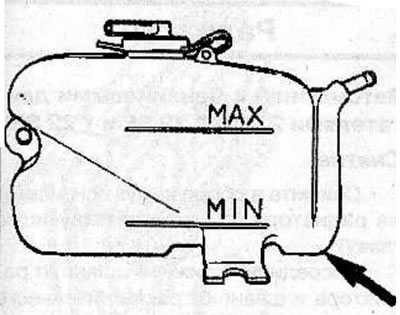
Fill the cooling system with Opel/Vauxhall antifreeze-based coolant to a level between the MIN and MAX marks on the expansion tank.
Start the engine and warm it up until the thermostat opens, i.e. until the coolant temperature reaches 92°C.
Turn off the engine and wait until it cools down completely. Check the coolant level in the expansion tank when the engine is cold; it should not fall below the MIN mark.
Note: Air is removed from the cooling system automatically during engine warm-up.
Car with 3.2L petrol engine (6VD1-W)
Remove the radiator cap and unscrew the coolant drain plug.
Drain the coolant into a suitable container.
Screw the coolant drain plug back into place.
Fill the cooling system with GM antifreeze based coolant.
Fill the cooling system with GM antifreeze-based coolant to a level between the MIN and MAX marks on the expansion tank.
With the radiator cap removed, start the engine and let it run for 30 minutes at a crankshaft speed of 2500-3000 min⁻¹.
Monitor the coolant temperature and make sure the thermostat has opened.
If air comes out of the radiator filler neck and the coolant level drops, add coolant.
With the radiator cap removed, restart the engine and let it run at 2500-3000 rpm.
Once the coolant level stops dropping, replace the radiator cap and turn off the engine.
After the engine has cooled down, run it at 2500-3000 rpm and make sure that there is no sound of coolant flowing from the radiator.
If you hear the sound of coolant flowing from the radiator, repeat the steps to remove air from the engine cooling system.
Visitor comments