


Contents: Removal ⬇ Installation ⬇
Removal
When performing the work described below, a distinction must be made between vehicles produced before mid-1995 and later models.
Cars produced before mid-1995
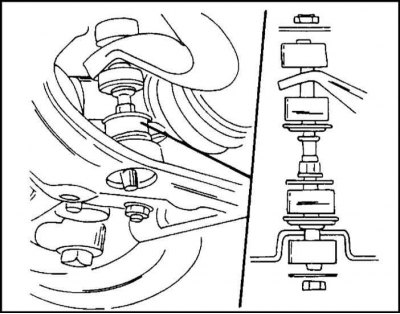
Fastening of the anti-roll bar of a car produced before mid-1995. On the left to the anti-roll bar, on the right to the transverse arm
1. Loosen the bolts and remove the oil pan shield.
2. Loosen the bolts and disconnect the stabilizer mounts and remove the rubber bushings from the front crossmember and stabilizer.
3. Unscrew the stabilizer joint bolts, remove the rubber cushions and cups.
4. Perform work on both sides of the car. The location of the listed elements is shown in the illustration.
5. Tighten the mounting clamps on the chassis to a torque of 28 Nm.
6. Tighten the nuts of the hinge bolts on the wishbone to a torque of 10 Nm.
Cars produced since mid-1995
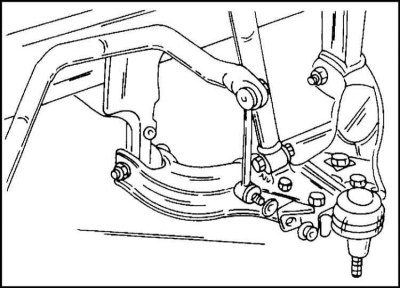
Fastening the anti-roll bar to the transverse arm of a vehicle manufactured since mid-1995.
Connecting rods with ball joints are used.
Each end of the stabilizer is attached to the transverse arm by a connecting rod.
1. Remove the oil pan shield.
2. Disconnect the connecting rods between the stabilizer and the lower wishbone by unscrewing the nuts, and press out the ball joint pins from the top and bottom.
3. Remove the stabilizer from the chassis. To do this, unscrew the mounting clamp bolts and remove the clamps. Remove the stabilizer. Remove the rubber pads from the ends of the stabilizer.
Installation
The stabilizer is installed in the reverse order of removal. Note that a washer is inserted from the bottom between the connecting rod and the wishbone. The mounting clamp bolts are tightened with a torque of 20 Nm, tighten the connecting rod nuts with a torque of 50 Nm.
Other work is performed in the reverse order of removal. Install the wheels according to the markings.
[Original source is on the website opelbook.ru]
Visitor comments