
OpelBook.ru
Cars AvtoVAZ Cars Mitsubishi Cars BMW Cars Mercedes Cars Nissan Cars Toyota Cars Chevrolet
English Русский
Български
Беларускі
Український
Српски
Hrvatski
Română
Polski
Slovenský
Magyar
 |  Sitemap  |  Contacts  |    


Main Astra Corsa Insignia Kadett Omega Vectra Zafira Others Articles
Frontera A (1991-1998, petrol) Frontera B (1998-2004) Ascona C (1981-1988) Vivaro A (2001-2014)
  • Main
  • Opel
  • Frontera A
  • Chassis
  • Front suspension
  • Removal and installation the torsion bar

Removal and installation the torsion bar (Opel Frontera A)

            0

Contents: Removal ⬇ Installation ⬇
To perform the work described below, lift the vehicle at the front and place it on stands.

To install the torsion bar correctly, it is necessary to mark its position relative to the height adjustment lever and the lower wishbone. You cannot use a center punch or chisel for this.
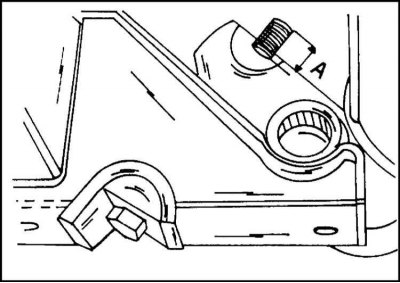
In addition, it is necessary to measure the protruding portion of the torsion bar adjusting bolt…


In addition, it is necessary to measure the protruding portion of the torsion bar adjusting bolt thread according to the illustration.

When installing, ensure that the resulting value of the bolt thread protrusion is maintained.

Removal


1. Remove the torsion bar adjusting bolt.

2. Disconnect the height adjustment lever from the clamp and remove the torsion bar from the lining on the lower control arm.

[Material copied from the portal: opelbook.ru]
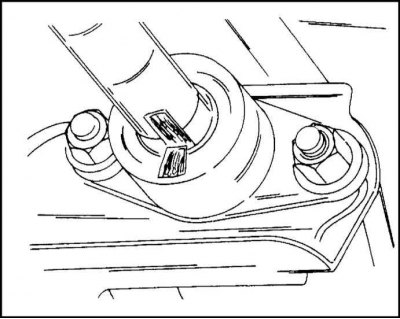
The torsion bar mount is shown in the illustration. The illustration also shows the color coding of…


The torsion bar mount is shown in the illustration. The illustration also shows the color coding of the torsion bar position.


Note: Torsion bars are marked to prevent confusion. The right torsion bar has an "R" marking on its end, and the left torsion bar has an "L" marking. In addition, each torsion bar must be installed with the marked side facing the rear.


The torsion bar splines must be lubricated with a universal grease before installation.

During assembly, the torsion bar is installed in the transverse suspension arm, observing the markings.

Installation


1. If installing a new torsion bar, place the lever on the torsion bar splines with the bottom side parallel to the top side of the compensation switch.

2. Tighten the adjusting bolt until the threaded end protrudes by the amount measured earlier.

3. Lower the car onto its wheels and "squeeze" the front of the car several times.

4. After this, adjust the clearance as described above. Please note that design differences may occur depending on the year of manufacture.


This article is available at russian, bulgarian, belarusian, ukrainian, serbian, croatian, romanian, polish, slovak, hungarian
Checking the article: Meshcheryakov Damir

Share information:

Previous articles
Opel Frontera A: Front suspension
Next articles

Front Wheel Suspension and Front Axle — General Information
Suspension and steering specifications
Removal and installation shock absorbers
Removal and installation the anti-roll bar
Removal and installation the lower wishbone
Removal and installation the upper wishbone
Removal and installation the ball joint
Removal and installation the steering knuckle


See similar ones from other Opel car manuals:
▶ Rear suspension torsion beam / trailing arms — removal and… Opel Astra F (1991-1998, petrol)
Link to this page in different formats

Visitor comments


No comments yet


How much will 27 + 14 =


Vivaro A (2001-2014) 
  • General information
  • User manual
  • Power unit
  • Petrol engine F4R
  • Diesel engine F9Q
  • Diesel engine G9U
  • Transmission
  • Clutch and drive shafts
  • Manual gearbox
  • Chassis
  • Front suspension
  • Rear suspension
  • Brake system
  • Body
  • Exterior
  • Interior
  • Electrical equipment
  • Heating and ventilation
  • Air conditioner
  • Equipment and devices
  • Electrical diagrams
Ascona C (1981-1988) 
  • General information
  • Maintenance
  • Power unit
  • Gasoline engines
  • Diesel engines
  • Cooling system
  • Fuel and exhaust system
  • Contact ignition system
  • Contactless ignition system
  • Transmission
  • Clutch
  • Mechanical gearbox
  • Automatic gearbox
  • Drive shafts
  • Chassis
  • Steering
  • Brake system
  • Car suspension
  • Body
  • Exterior
  • Interior
  • Doors and windows
  • Electrical equipment
  • Equipment and devices
  • Power devices
  • Electrical circuits
Frontera B (1998-2004) 
  • General information
  • User manual
  • Maintenance
  • Power unit
  • Petrol engines 2.2 l
  • Petrol engines 3.2 l
  • Diesel engines 2.2 l
  • Cooling system
  • Fuel system (petrol)
  • Fuel system (diesel)
  • Ignition system
  • Transmission
  • Clutch
  • Manual gearbox MUA5C
  • Automatic gearbox 4L30E
  • Chassis
  • Suspension and axles
  • Steering
  • Brake system
  • Body
  • Exterior
  • Interior
  • Doors, locks and windows
  • Heating and air conditioning
  • Electrical equipment
  • Power devices
  • Equipment and devices
  • Lighting and signaling
  • Electrical diagrams
Frontera A (1991-1998, petrol) 
  • General information
  • Introduction to guide
  • User manual
  • Maintenance
  • Power unit
  • Engine repair
  • Lubrication system
  • Cooling system
  • Power and exhaust system
  • Engine electrics
  • Transmission
  • Clutch
  • Mechanical gearbox
  • Cardan shafts
  • Chassis
  • Brake system
  • Front suspension
  • Rear suspension
  • Steering
  • Body
  • Repair and care
  • Electrical equipment
  • Equipment and devices
  • Electrical circuits
OpelBook.ru © 2017–2026 · Mobile version · · Sitemap: EN BG BY UA RS HR RO PL SK HU · Feedback · Site search
Astra F, petrol · Astra G, petrol · Astra G · Astra H · Astra J, petrol · Corsa B · Corsa C, petrol · Corsa C · Insignia A · Kadett D · Kadett E · Omega A · Omega B · Omega B2 · Vectra A, petrol · Vectra A · Vectra B, petrol · Vectra B · Vectra C · Zafira A, petrol · Frontera A, petrol · Frontera B · Ascona C · Vivaro A ·
We want your visit to be comfortable 🤝! We use cookies 🍪 to make that happen.