


Contents: Removal ⬇ Installation ⬇ Replacing the bushings of the…⬇ Lower ball joint of the control arm ⬇
When performing the work described below, it is necessary to raise the front of the vehicle and place it on supports. Please note that there may be design differences depending on the year of vehicle production.
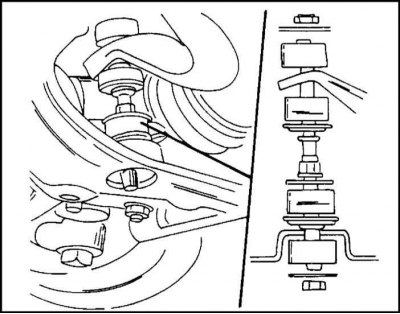
Fastening of the anti-roll bar of a car produced before mid-1995. On the left to the anti-roll bar, on the right to the transverse arm
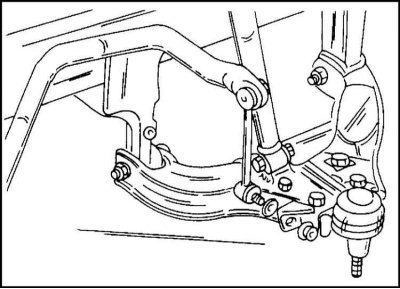
Fastening the anti-roll bar to the transverse arm of a car produced since mid-1995
Connecting rods with ball joints are used.
Each end of the stabilizer is attached to the transverse arm by a connecting rod.
The following works are described in the corresponding subsections.
Removal
1. Remove the torsion bar.
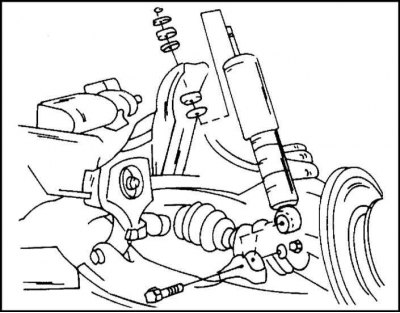
2. Disconnect the shock absorber from the lower control arm.
3. Disconnect the tie rods from the lower control arm. This is done depending on the year of manufacture of the vehicle in accordance with Section 4. The fastening details are shown in the illustrations "Fastening the anti-roll bar of a vehicle manufactured before mid-1995" and "Fastening the anti-roll bar to the control arm of a vehicle manufactured since mid-1995".
4. Remove the nut from the lower ball joint pin at the steering knuckle and disassemble the joint using a puller.
5. Remove the two bolts and nuts securing the torsion bar to the lower wishbone.
6. Disconnect the lower control arm from the chassis. Each control arm rubber bushing is secured with one bolt and nut.
Installation
The installation is performed as follows:
1. Install the lower control arm to the chassis and secure both ends of the arm with a bolt and nut.
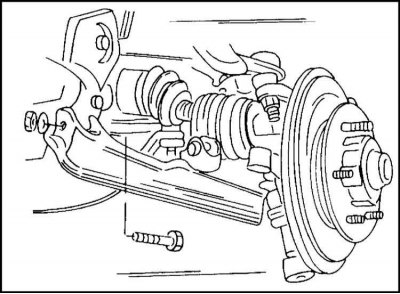
2. Pre-tighten the lever mounting bolts by hand.
3. Attach the guide joint to the lower wishbone and tighten the nut to 140 Nm.
4. Align the hole in the bolt with the slot in the castle nut and install the cotter pin.
5. Install the torsion bar support on the lower wishbone and secure with two bolts and nuts.
6. Tighten the bolts to a torque of 116 Nm.
7. Install the stabilizer bar and shock absorber as described above. Keep in mind the year of manufacture of the car. Note the attachment of the connecting rod to the bottom.
8. Install the torsion bar on the wishbone and chassis.
9. Now tighten the wishbone mounting bolts/nuts.
10. In this case, first perform the following measurement. Raise the wishbone so that the dimension shown in the illustration is 15 mm for a vehicle manufactured before mid-1995 and 25 mm for a vehicle manufactured after mid-1995. Measure carefully. The rubber support must be properly clamped.
11. Tighten the bolts and nuts securing the front axle of the suspension arm to a torque of 160 Nm, the rear axle of the suspension arm to a torque of 200 Nm.
12. Perform other work in the reverse order of removal. Finally, check and adjust the ground clearance if necessary.
Replacing the bushings of the transverse control arm
The control arm bushings can be replaced. However, removing and installing bushings requires a special tool. It is recommended that this work be done in a car repair shop. You can also press out the bushings using the appropriate pipe, washer and bolt. The bushings should not be hammered in, they should be pressed in.
Lower ball joint of the control arm
To disconnect the lower joint from the steering knuckle, remove the cotter pin, unscrew the lock nut and press the joint out of the steering knuckle using a puller. The hinge is attached to the transverse arm with four bolts and nuts. The new ball joint does not require lubrication. The joint is already greased at the factory.
1. When installing the ball joint on the lower control arm, carefully pull the protective boot over the edge of the joint housing to ensure a tight connection.
2. Tighten the hinge mounting bolts evenly to a torque of 105 Nm.
3. Press the joint into the steering knuckle.
4. Tighten the hinge mounting nut to a torque of 105 Nm.
Visitor comments