


Contents: Checking the camber, caster angle,…⬇ Adjusting the front suspension…⬇ Adjusting the camber angle of the…⬇ Adjusting the longitudinal angle of…⬇ Wheel alignment ⬇ Checking the front wheel steering…⬇
Below is a description of the inspection and adjustment work carried out on the front suspension.
Checking the camber, caster angle, toe-in and clearance
Before carrying out any measuring work, the following conditions must be met:
The profile wear of all tires should be approximately the same.
The tire pressure must correspond to the vehicle's full load.
All wheel rims must be in perfect condition.
The ball joints of the steering rods and suspension must not have any gaps.
The car must have a set clearance (see following description).
When measuring the geometry of the front wheels, the vehicle must be on a level surface that has the same height in the area of the front and rear wheels. A difference in height of more than 6 mm is not allowed. The fuel tank must be full and the vehicle must not be loaded with anything.
During the measurement process, the steering wheel should be straight.
The measurement must be carried out using optical instruments. The following description only covers cases of measurements in emergency situations.
Adjusting the front suspension height (clearance)
The front suspension height is adjusted using the torsion bar adjusting bolt. The location of the bolt is shown in the illustration. Turning the bolt clockwise increases the suspension height.
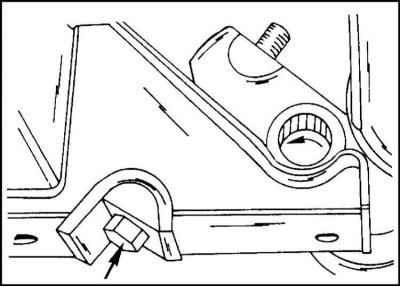
Ride Height Torsion Bar Adjusting Bolt
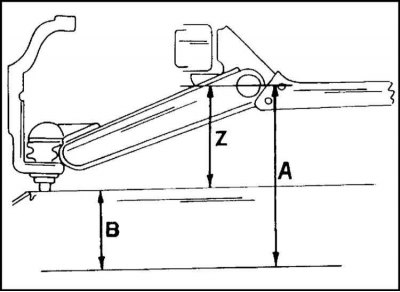
The height is measured as shown. The dimension "Z" is defined as the difference between the dimensions "A" and "B". The obtained value must be compared with the specified value: The maximum difference between both sides of cars produced since mid-1995 is 5 mm.
Adjusting the camber angle of the wheels
Camber angle can be measured mechanically, but an optical instrument is required for accurate measurement. If the camber is outside the set values, it can be adjusted.
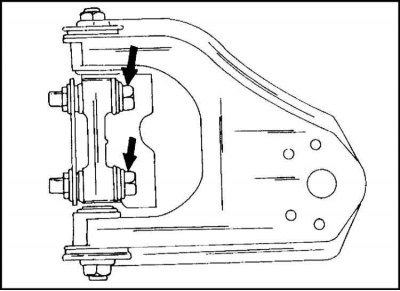
Adjustment is achieved by changing the thickness of the washers between the upper suspension arm axle and the crossmember bracket.
The adjusting washers have slots. Once both bolts have been removed, they can be removed and replaced.
The camber of the cars must have the values specified in Specifications.
The maximum permissible difference between the parties is specified in Specifications.
To adjust, loosen the suspension arm mounting bolts and nuts and remove the washers as shown in the illustration. The washers are placed on both bolts securing the upper arm axle. They should not be confused with the caster washers.
To reduce camber, the number of washers increases; to increase it, the number of washers decreases. It is important to remember that the total thickness of the washers for adjusting the camber and caster angle should not exceed 10.8 mm.
After adjustment, tighten the mounting nuts to a torque of 155 Nm, holding the bolts from turning.
The adjustment control is carried out by optical means.
Adjusting the longitudinal angle of the wheel pivot axis
The longitudinal angle of inclination of the steering axis is adjusted by changing the thickness of the set of adjusting washers between the axis of the upper suspension arm and the cross member bracket.
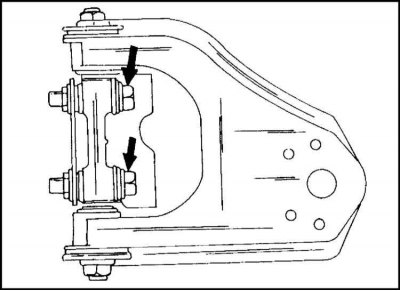
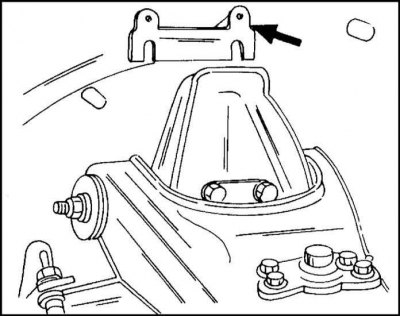
The washers are located in the location shown in the illustration, above both mounting bolts.
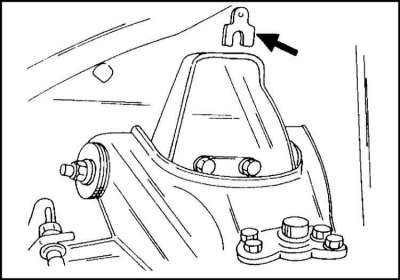
The washers have a slot.
Like camber angle, caster angle can be measured mechanically. However, optical methods are preferable.
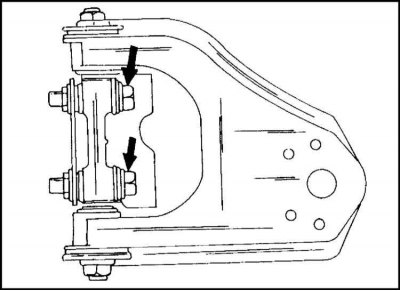
To adjust the longitudinal tilt angle of the steering axis, loosen the bolts and nuts shown in the illustration and remove or add adjusting washers.
Reducing the longitudinal angle of inclination of the pivot axis. The number of washers on the front bolt increases, or the number of washers on the rear bolt decreases.
Increasing the longitudinal angle of inclination of the pivot axis. The number of washers on the front bolt is reduced, or the number of washers on the rear bolt is increased.
The difference in thickness of the front and rear bolt washers should not exceed 3.2 mm.
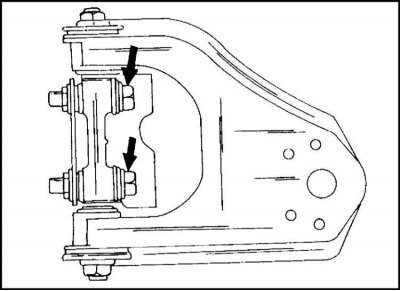
Since the camber adjusting washers are also located in the location shown in the illustration, a set of washers is formed, the total thickness of which should not exceed 10.8 mm.
After adjustment, tighten the bolt connection to a torque of 155 Nm.
Wheel alignment
The toe-in of the front wheels is adjusted by changing the length of the steering rods by the same amount. This ensures that the position of the steering wheel spokes is maintained. The Frontera's front wheelbase is shorter than its rear (until mid-1995 release) or equal to each other (since mid-1995).
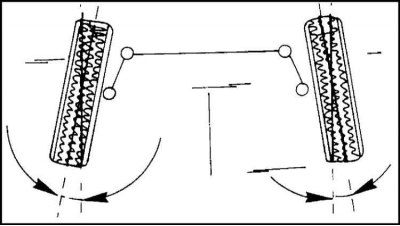
The wheel installation diagram is shown in the illustration.
Wheel alignment adjustment using a special template is performed as follows:
1. Check that the tire pressure is correct and that the vehicle is parked on level ground. The vehicle must not have any load. The fuel tank must be full.
2. Press firmly on the front edges of the vehicle several times to ensure that the suspension components are in their working position.
3. Set the steering wheel straight.
4. Set the template to zero and apply it to the front of the wheels at hub height.
5. Place the measuring rods of the template on the edges of the wheel rims and clamp them.
6. Mark the position of the measuring rods on the wheels with chalk.
7. Double check that the template is set to zero.
8. Move the car forward so that the wheels turn half a turn and the chalk lines are again at the height of the hubs, but on the other side of the wheels.
9. Apply the template to the wheel rims again, but now under the car. If the template cannot be applied to the wheel rims, this indicates that the rear size needs to be increased. The tolerance for the measured distance is ±2 mm.
10. Reposition the measuring rods of the template so that it can fit between the wheel rims, clamp the rods and remove the template to take a reading. If the template reading is outside the set limits, appropriate adjustment is required.
11. Raise and support the front of the vehicle on stands.
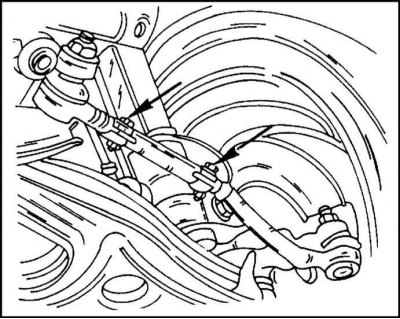
12. Loosen the clamps on both steering rods
13. Turn the steering rods on both sides by the same amount. It should be turned in steps of a quarter turn.
14. Check the toe-in adjustment as described above and, when the desired result is achieved, tighten the clamps to 120 Nm. It is necessary to ensure that the lengths of both steering rods are the same. The difference in lengths should not exceed 5 mm.
15. After adjustment, check that the steering wheel is in the center position. This is checked when the car is moving on a straight road.
Checking the front wheel steering angle
The front wheel steering angle is checked after adjusting the toe-in. Above the ball joint pin of the lower suspension arm there is an adjusting bolt, with which the turning angle of the front wheels is adjusted. A graduated washer is required to control the rotation angle. Therefore, it is recommended that the work in question be carried out in a car repair shop. It should be borne in mind that the turning angle of the inner wheels is 21°50' if the turning angle of the outer wheels is 20°.
Visitor comments