
OpelBook.ru
Cars AvtoVAZ Cars Mitsubishi Cars BMW Cars Mercedes Cars Nissan Cars Toyota Cars Chevrolet
English Русский
Български
Беларускі
Український
Српски
Hrvatski
Română
Polski
Slovenský
Magyar
 |  Sitemap  |  Contacts  |    


Main Astra Corsa Insignia Kadett Omega Vectra Zafira Others Articles
Astra F (1991-1998, petrol) Astra G (1998-2004, petrol) Astra G (1998-2004) Astra H (2004-2009) Astra J (2009-2015, petrol)
  • Main
  • Astra
  • Astra F
  • Chassis
  • Car suspension
  • Rear suspension torsion beam / trailing arms — removal and installation

Rear suspension torsion beam / trailing arms — removal and installation (Opel Astra F)

            0

Contents: Removal ⬇ Installation ⬇

Removal


Place chocks under the front wheels, then use a jack to lift the rear of the car and secure it on stands under the axle. Remove the rear wheels.

On models with manual rear suspension level control, relieve pressure in the system by releasing air through the valve in the luggage compartment.

On models with a catalytic converter, remove the bolts and exhaust center section heat shield.

Note the length of the threaded portion of the handbrake cable adjuster, then move the adjuster nut so that the cable bracket can be disconnected from the handbrake actuator.

Disconnect the handbrake cables from the brackets located on the lower part of the body.

In the engine compartment, remove the brake fluid reservoir cap, then secure a piece of plastic film over the filler neck and replace the cap. This will minimize fluid loss.

Disconnect the flexible hoses from the rigid brake lines at the front of each trailing arm. Fluid may leak, so plug the ends of the tubes and hoses.

Where required, disconnect the plug connectors from the ABS sensors and remove the wire from the brackets on the trailing arms.

On station wagon and van models, disconnect the brake pressure regulating valve spring from the bracket on the torsion beam.

Loosen, but do not remove, the nuts and bolts securing the front ends of the trailing arms to the bottom of the vehicle body (fig. 10.16).
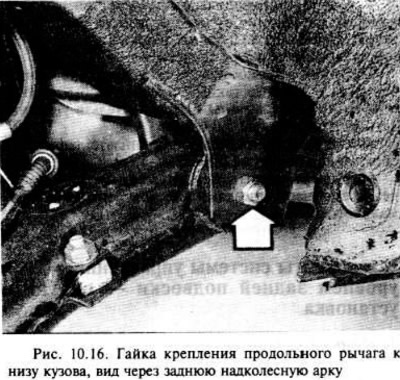
Loosen, but do not remove, the nuts and bolts securing the front ends of the trailing arms to the…


After placing the wooden blocks, place the jack under the center of the torsion beam.


On sedan and hatchback models, unscrew and remove the bolts securing the lower ends of the shock absorbers to the trailing arms.

On station wagon and van models, after securing the shock absorber rods, unscrew the nuts securing the lower ends of the shock absorbers to the trailing arms.

Carefully lower the jack holding the torsion beam so that the coil springs can be removed. Remove the coil springs.

Make sure the torsion beam is properly secured, then remove the nuts and bolts securing the front ends of the trailing arms to the bottom of the car body.

Remove the torsion beam/trailing arm assembly from underneath the rear of the vehicle.

If desired, you can remove the brake components from the trailing arms (see the relevant section chapters 9). The hub assemblies can also be removed, and where required, the anti-roll bar rod.

If necessary, the trailing arm bushings can be removed as described in the next section.

Installation


Begin assembly by installing any removed parts that were removed from the torsion beam/trailing arm assembly.

Secure the torsion beam/trailing arm assembly to a wheel jack and position it under the rear of the vehicle.

Raise the jack and install the bolts and nuts that secure the front ends of the trailing arms to the underbody. Do not tighten the fasteners completely.

Install the coil springs.

Raise the rear extensions of the trailing arms and install the bolts and nuts where required securing the lower ends of the shock absorbers to the trailing arms. Tighten the fasteners as required, clamping the shock absorber rod on wagon and van models. Remove the jack from under the rear of the vehicle.


Where required, connect the ABS wheel sensor wire and install the wire to the trailing arm brackets.

Remove the plugs from the brake pipes and hoses and connect the fittings.

Install the handbrake cables to the underbody brackets, then connect the handbrake cable bracket to the handbrake actuator.

Install the handbrake cable adjusting screw and tighten the nut on the rod, observing the position marked before removal. Check the handbrake adjustment as indicated in chapter 9.

On models with a catalytic converter, install a heat shield in the center section of the exhaust system.

On station wagon and van models, connect the brake pressure regulating valve spring to the torsion beam bracket.

Install the road wheels and lower the vehicle to the ground.

On models with manual rear suspension level control, increase the system pressure to 0.8 bar.

Remove the chocks from under the front wheels.

Make sure the car is on a level surface, then with a weight of approximately 70 kg on each front seat, rock the car to set the suspension.

Without changing the position of the vehicle, place chocks in front and behind the front wheels to secure the vehicle.

Working under the rear of the vehicle, tighten the front ends of the trailing arms to the underbody as required.

Finally, check the handbrake cable adjustment again, then remove the plastic sheet from under the brake fluid reservoir cap and bleed all hydraulic circuits of the brake system as indicated in chapter 9.

On station wagon and van models, check the setting of the valve that regulates the pressure in the brake system.


This article is available at russian, bulgarian, belarusian, ukrainian, serbian, croatian, romanian, polish, slovak, hungarian
Checking the article: Trifonova Emilia

Share information:

Previous articles
Opel Astra F: Car suspension
Next articles

Rear Anti-Roll Bar — Removal and Installation
Rear Suspension Coil Spring — Removal and Installation
Rear shock absorber rubber bushings — replacement
Rear shock absorber — removal, inspection and installation
Rear hub — removal and installation
Front Suspension Subframe — Removal and Installation
Rear Suspension Trailing Arm Bushings — Replacement
Rear Suspension Level Control System — General Information
Rear Suspension Level Control System Components — Removal and Installation


See similar ones from other Opel car manuals:
▶ Rear suspension trailing arms Opel Frontera B (1998-2004)
▶ Replacing the rear suspension trailing arm Opel Insignia A (2008-2017)
▶ Removal and installation the rear suspension beam Opel Kadett E (1984-1995)
▶ Rear suspension beam — removal, replacement and installation Opel Zafira A (1999-2005, petrol)
▶ Removal and installation the rear suspension spring (Corsa… Opel Corsa B (1993-2000)
Link to this page in different formats

Visitor comments


No comments yet


How much will 43 + 18 =


Astra J (2009-2015, petrol) 
  • General information
  • Vehicle device
  • User manual
  • Faults en route
  • Maintenance
  • Power unit
  • Engine repair
  • Cooling and lubrication system
  • Engine power system
  • Exhaust system
  • Transmission
  • Clutch
  • Car gearbox
  • Drive shafts
  • Chassis
  • Front suspension
  • Rear suspension
  • Steering
  • Brake system
  • Wheels and tires
  • Body
  • Exterior
  • Interior
  • Doors and windows
  • Body Care
  • Heating and air conditioning
  • Security systems
  • Electrical equipment
  • Equipment and devices
  • Lighting and signaling
  • Power devices
  • Electrical circuits
Astra H (2004-2009) 
  • General information
  • Introduction to the guide
  • Troubleshooting
  • User manual
  • Maintenance
  • Power unit
  • Engine repair
  • Cooling and heating
  • Power and exhaust system
  • Ignition system
  • Launch and charge system
  • Transmission
  • Mechanical gearbox
  • Automatic gearbox
  • Drive shafts
  • Chassis
  • Brake system
  • Car suspension
  • Steering
  • Body
  • Interior
  • Exterior
  • Electrical equipment
  • Equipment and devices
  • Electrical circuits
Astra G (1998-2004) 
  • General information
  • Introduction to manual
  • User manual
  • Maintenance
  • Power unit
  • SOHC gasoline engines
  • DOHC gasoline engines
  • Diesel engines 1.7 and 2.0
  • Engine repair
  • Cooling system
  • Supply system
  • Injection system (gasoline)
  • Injection system (diesel)
  • Exhaust system
  • Charge and launch system
  • Ignition system (gasoline)
  • Preheat system (diesel)
  • Transmission
  • Manual gearbox
  • Automatic gearbox
  • Clutch
  • Drive shafts
  • Chassis
  • Brake system
  • Wheel suspension
  • Steering
  • Body
  • Exterior
  • Interior
  • Doors and windows
  • Ventilation and heating
  • Electrical equipment
  • Equipment and devices
  • Electrical circuits
Astra G (1998-2004, petrol) 
  • General information
  • User manual
  • Car care
  • Maintenance
  • Power unit
  • Single shaft engines
  • Twin shaft engines
  • Engine repair
  • Cooling and heating
  • Fuel and exhaust systems
  • Starting and charging system
  • Ignition system
  • Transmission
  • Clutch
  • Mechanical gearbox
  • Automatic gearbox
  • Drive shafts
  • Chassis
  • Brake system
  • Car suspension
  • Steering
  • Body
  • Interior
  • Exterior
  • Electrical equipment
  • Equipment and devices
  • Wiring diagrams Opel Astra
  • Wiring diagrams Opel Zafira
Astra F (1991-1998, petrol) 
  • General information
  • Maintenance
  • Power unit
  • Engine in car
  • Engine removed
  • Cooling system
  • Heating and ventilation
  • Fuel supply (carburetor)
  • Fuel supply (injector)
  • Emission control
  • Ignition system
  • Transmission
  • Clutch
  • Mechanical gearbox
  • Automatic gearbox
  • Drive shafts
  • Chassis
  • Brake system
  • Car suspension
  • Steering
  • Body
  • Exterior
  • Interior
  • Electrical equipment
  • Equipment and devices
  • Electrical circuits
OpelBook.ru © 2017–2026 · Mobile version · · Sitemap: EN BG BY UA RS HR RO PL SK HU · Feedback · Site search
Astra F, petrol · Astra G, petrol · Astra G · Astra H · Astra J, petrol · Corsa B · Corsa C, petrol · Corsa C · Insignia A · Kadett D · Kadett E · Omega A · Omega B · Omega B2 · Vectra A, petrol · Vectra A · Vectra B, petrol · Vectra B · Vectra C · Zafira A, petrol · Frontera A, petrol · Frontera B · Ascona C · Vivaro A ·
We want your visit to be comfortable 🤝! We use cookies 🍪 to make that happen.