


Contents: Removal ⬇ Installation ⬇ Removal the timing chain drive ⬇ Checking the crankshaft ⬇ Installation ⬇ Installation of the valve timing…⬇
Removal
Remove the camshafts.
Remove the spark plugs using the special tool KM-194-E.
Raise the car.
Remove the right engine splash shield.
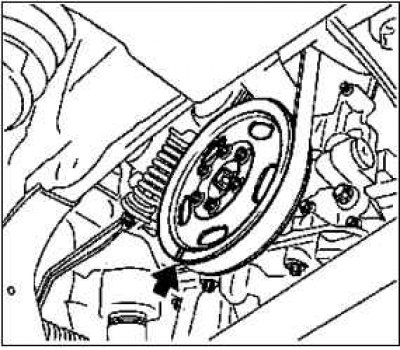
Make a timing mark on the crankshaft pulley (arrow in the picture).
Note: Shift 180° relative to the mark, TDC of cylinder No.1.
Prepare the MKM-6086 lever to remove the valve spring.
Adjust the supports with the special tool MKM-6086-6.
Adjust the support heads to the center of the support legs and tighten.

Preparing a special tool for removing the valve spring: 1 – support head; 2 – support legs; 3 – thrust part
Extend the MKM-6086-7 lever arm with the MKM-6086-8 joint and the MKM-6086-10 removable head.
Install the MKM-6086-200 block kit.
Install the thrust part MKM-6086-200-10.
Attach the MKM-6086 valve spring lever.
Attach the MKM-6086-6 supports.
Insert the block shaft into the supports.
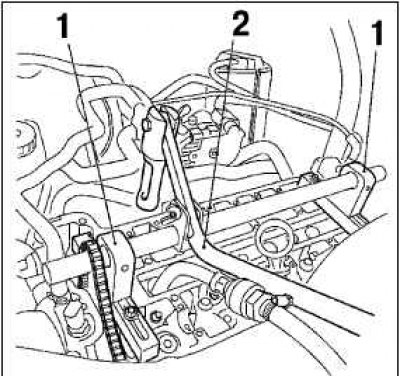
Installing the lever and supports for removing the valve spring: 1 – supports; 2 – lever
Note: Align the block shaft with the center of the spark plug hole
Tighten the 4 mounting bolts.
Install the MKM-6086-7 lever.
Note: The removable head must face the inlet side.
Secure the mounting shaft and tighten the 2 mounting bolts.
Install the compressed air adapter.
Screw into spark plug thread, cylinder #1.
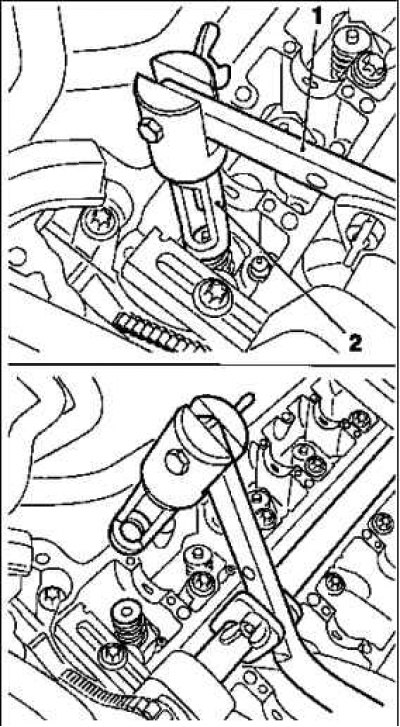
Valve spring compression procedure: 1 – lever; 2 – removable head
Apply compressed air to cylinder #1.
Remove 2 intake valve springs from cylinder #1.
Carefully push the valve springs down with a lever.
Note: The removable head must be placed vertically above the valve stem.
Attention! Ensure correct installation.
Remove the valve crackers and heads, valve springs.
Note: Do not use magnetic tools for this purpose.
Replace the valve stem seals.
Place the new valve stem seal onto the valve stem.
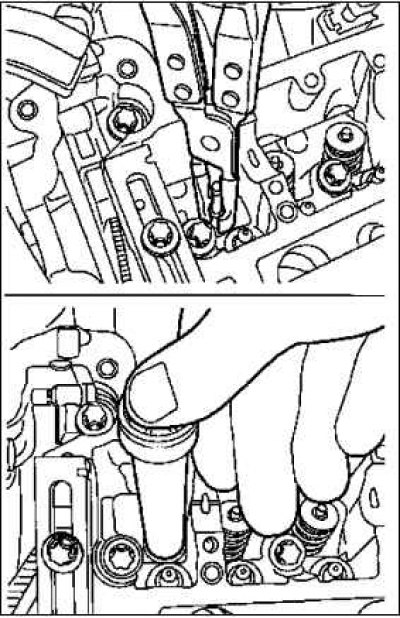
Push on until it stops using KM 958.
Install intake valve springs, cylinder #1.
Install the valve springs and valve heads.
Install the valve crackers into the cylinder head.
Slide the plastic clamping sleeve in the direction of the lever arm attachment.
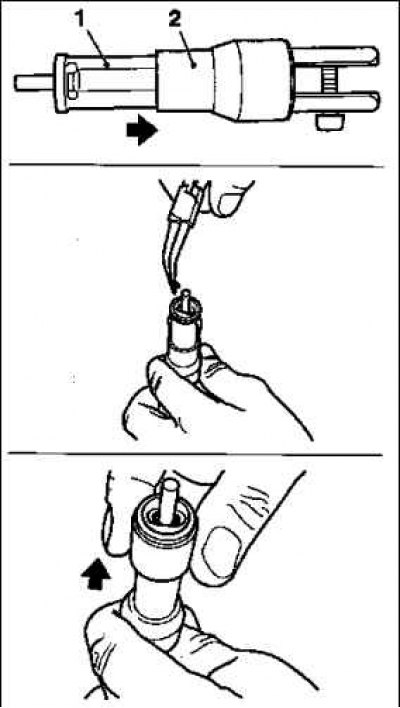
Installing the valve crackers into the head of the installation block: 1 – valve cracker; 2 – plastic clamping sleeve
Attention! Install the crackers with the cone-shaped end facing the valve
Slide the plastic clamping sleeve in the direction of the valve (arrow in the picture.
Attach the installation head to the lever.
Attention! The head must be positioned vertically above the valve stem. The crackers must enter the seat with a click.
Gently push the valve springs down using a lever (arrow in the picture).
Warning! Do not make a second attempt without making sure that both crackers are installed in the cylinder head. Check the reliability of the crackers. Make sure that the compressed air is supplied.
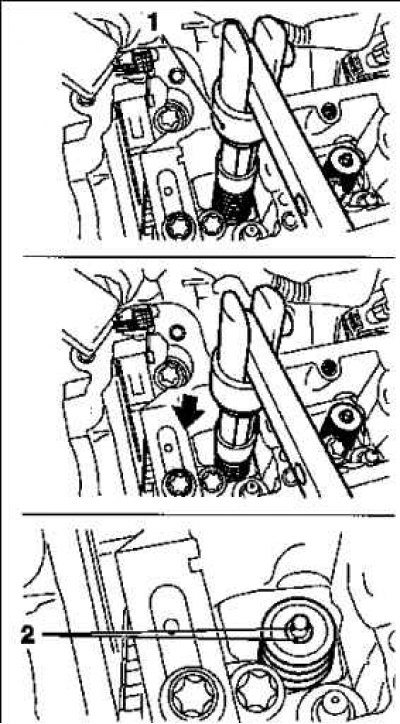
Installing valve crackers and valve springs: 1 – head; 2 – crackers
Move the lever and remove it.
Repeat the above procedure for all cylinders.
Shut off the compressed air supply line.
Remove the crankshaft lock.
Set the piston of cylinder No.3 to the TDC position.
Pull the timing chain upward.
Turn the crankshaft evenly (180°).
Note: The mark on the crankshaft pulley must align with the protrusion on the timing mechanism housing.
Lock the crankshaft using the special tool KM 952.
Reposition the compressed air supply adapter.
Shut off the compressed air supply line.
Unscrew the adapter from the spark plug thread, cylinder no. 4.
Screw into spark plug thread, cylinder no. 2.
Apply compressed air to cylinder #2.
Replace valve stem seals, cylinder #2.
Reposition the compressed air supply adapter.
Shut off the compressed air supply line.
Unscrew the adapter from the spark plug thread, cylinder No.2.
Screw into spark plug thread, cylinder no. 3.
Apply compressed air to cylinder #3.
Replace valve stem seals, cylinder #3.
Shut off the compressed air supply line.
Disconnect the valve spring lever.
Remove the compressed air adapter.
Release the crankshaft.
Place the gear shift lever in neutral position.
Release the parking brake.
Raise the car.
Block the crankshaft.
Pull the timing chain upward.
Turn the crankshaft evenly until the special device KM 952 stops.
Install special tool KM 952.
Lower the car.
Installation
Install the spark plugs using the special tool KM-194-E and tighten to a torque of 25 N·m.
Visually inspect the components - camshafts, camshaft bearing cap, cylinder head, valve lifters, hydraulic valve lifters.
Install hydraulic lifters and valve lifters.
Removal the timing chain drive
Loosen the camshaft pulley bolts.
Hold the camshafts by the hex keys.
Lock the chain tensioner.
Install special tool KM-955-1.
Move the chain tensioner back and lock it using the special tool KM-955-1.
Remove the guide by unscrewing the 2 mounting bolts.
Remove the guide by unscrewing the 2 mounting bolts.
Remove the tension guide by unscrewing the mounting bolt.
Remove the timing chain, drive sprocket and timing case gasket.
Disconnect the crankshaft pulse sensor wiring harness connector.
Remove special tool KM 952.
Remove the crankshaft pulse generator by unscrewing the mounting bolt.
Disconnect the cylinder block base from the cylinder block by unscrewing the 22 mounting bolts.
Remove the connecting rod bearing cap.
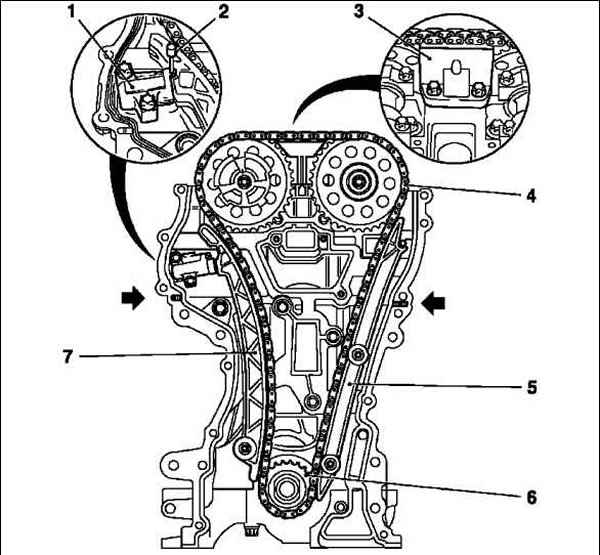
Removing the timing chain drive: 1 – chain tensioner; 2 – special tool; 3 – guide; 4 – timing chain; 5 – guide; 6 - asterisk; 7 – tension guide
Note: The contact surfaces of the connecting rods and connecting rod bearing caps are individually selected and must not be interchanged or damaged. To avoid damage, do not place the connecting rods and caps on the contact surfaces.
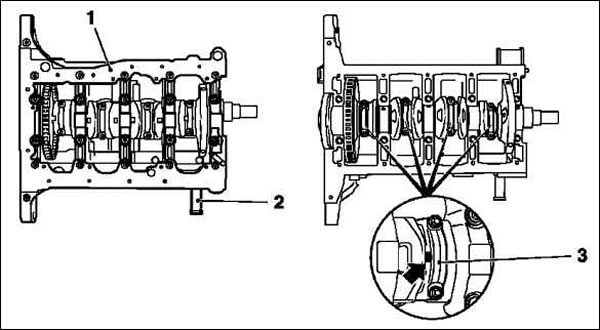
Removing the connecting rod cover: 1 – cylinder block base; 2 – special tool; 3 – connecting rod bearing caps
Mark the connecting rod bearing caps.
Mark the sequence of cylinders.
Unscrew the 8 mounting bolts and remove the connecting rod cover.
Remove the crankshaft.
Disconnect the cylinder block base.
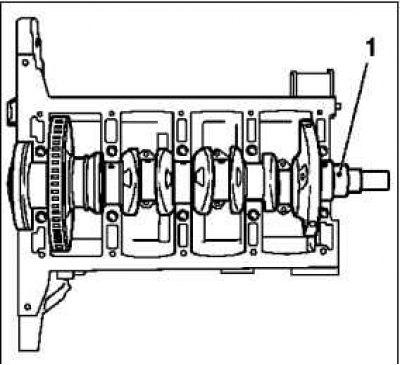
Removing the crankshaft: 1 – crankshaft
Note: Separate the base evenly with a mounting spatula.
Remove 22 bolts.
Remove the rear crankshaft oil seal.
Remove the crankshaft and place it on wooden blocks.
Remove the crankshaft bearing clamps.
Note: Follow the correct sequence
Remove the connecting rod bearing shells and mark them in the correct order.
Check all components for wear and replace if necessary.
Checking the crankshaft
Check the crankshaft for out-of-roundness. Check the axial free play of the crankshaft.
Disconnect the crankshaft pulse sensor disc by unscrewing the 3 mounting bolts.
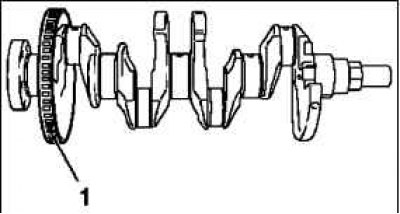
Crankshaft pulse sensor disk: 1 – disk
Installation
Attach the crankshaft pulse sensor disc and tighten the 3 mounting bolts to 15 Nm.
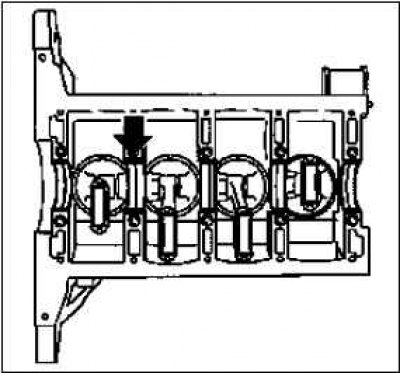
Install the crankshaft bearing shells into the cylinder block and into the cylinder block base.
Coat them with motor oil.
Mark the position of the thrust bearings (arrow in the picture).
Install the connecting rod bearing shells into the connecting rods and connecting rod bearing caps.
Coat them with motor oil.
Carefully install the crankshaft into the cylinder block.
Note: The position of the crankshaft can be adjusted by tapping the crank cheek with a rubber hammer.
Coat the crankshaft journals with engine oil.
Attach the cylinder block base to the cylinder block with new bolts.
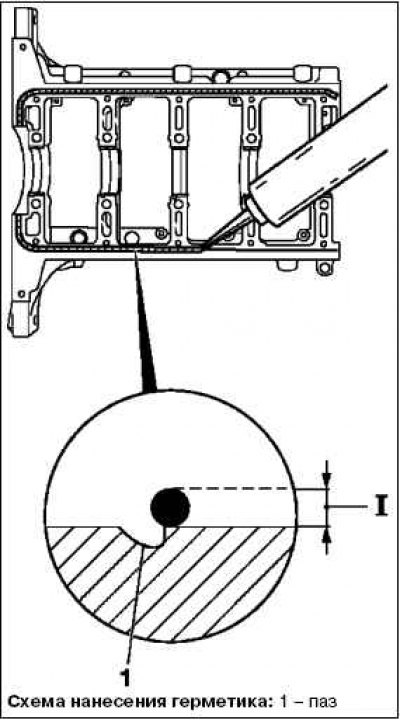
Apply sealant to the outer edges of the groove (dimension I = 2 mm).
Note: Do not apply sealant into the groove.
Note: Please complete assembly within 10 minutes.
Attention! Observe the tightening sequence.
Tighten 10 M8 bolts (internal) torque of 25 Nm, further tighten by +60°.
Tighten 12 M6 bolts (outer) to 10 Nm, further tighten by +60°.
Remove the remaining sealant.
Install the rear crankshaft oil seal. Before doing this, apply silicone grease to the working edge (white).
Install special tool KM-235-6 on the crankshaft journal.
Place the O-ring onto the special tool and press flush using KM-658-1.
Attach the connecting rod bearing caps to the connecting rods with new bolts.
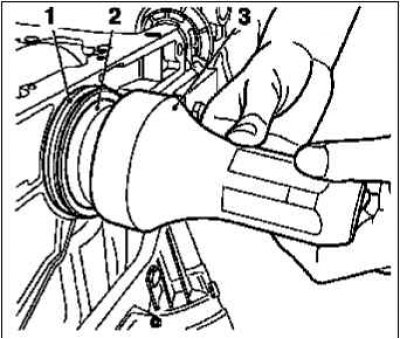
Pressing in the rear crankshaft oil seal: 1 – oil seal; 2 – special device; 3 – special device for pressing
Note: Pay attention to the installation position, tides (arrow in the picture) on the connecting rod bearing caps must face the gearbox.
Tighten the 8 mounting bolts to a torque of 13 Nm, turn an additional +60° +15°.
Note: Always use M6.5 bolts.
Connect the crankshaft pulse sensor wiring harness.
Lock the crankshaft using the special tool KM 952.
Smoothly turn the crankshaft until the special tool KM 952 stops.
Install a new coolant pump seal into the timing case.
Ensure that the guide bushings are installed correctly (arrows in the picture)

Installing connecting rod bearing caps: 1 – caps
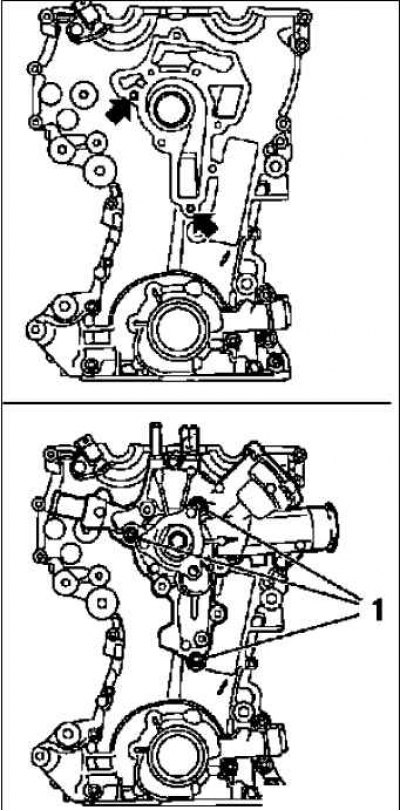
Installing the coolant pump: 1 – mounting bolts
Attach the coolant pump to the timing case with short bolts.
Tighten the 3 mounting bolts to 8 Nm.
Apply sealant.
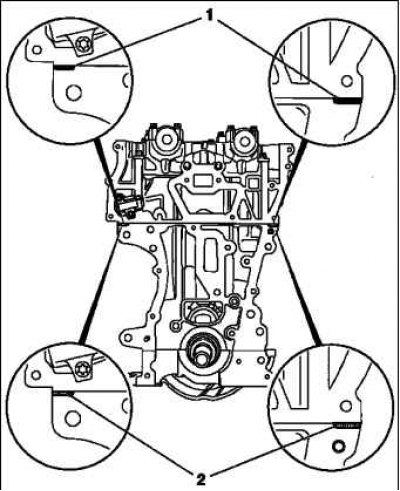
Sealant placement diagram: 1 – cylinder head gasket; 2 – a roller of silicone sealant
Note: The timing case must be installed within 10 minutes after applying the silicon sealant (gray).
Turn the engine on a special device KM 412 by 90°.
Cut off any protruding elastomer from the cylinder head gasket and replace it with a 2mm thick bead of silicone sealant (grey).
Note: A bead of silicone sealant (gray) can be applied directly if there are no elastomer protrusions.
Installation of the valve timing mechanism
Install a new timing case gasket.
Ensure that the guide bushings are installed correctly (arrows in the picture).
Install the timing chain.
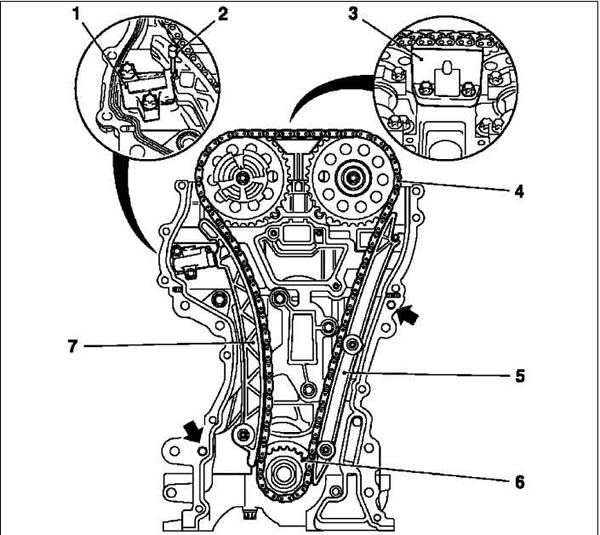
Installing the gas distribution mechanism: 1 – chain tensioner; 2 – special tool; 3 – guide; 4 – timing chain; 5 – guide; 6 – leading gear; 7 – clamping bus
Note: Use new camshaft pulley bolts when installing.
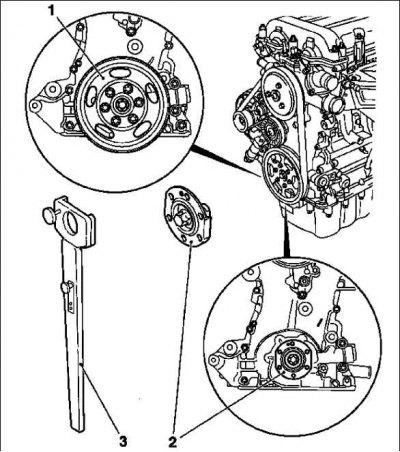
Attaching the crankshaft hub: 1 – crankshaft belt pulley; 2 – crankshaft hub; 3 – special tool
Ensure that the guide bushings are installed correctly (arrows in the picture).
Install the drive gear.
Install the exhaust camshaft sprocket.
Tighten the mounting bolt.
Install the timing chain.
Note: Ensure tension on the drive line (release side) branches of the timing chain.
Install the intake camshaft pulley into the timing chain with the phase sensor disc and tighten the mounting bolt.
Note: The phase sensor disk must be rotated by hand.
Attach the clamp bus to the cylinder block.
Tighten the mounting bolt to 20 Nm.
Attach the guide to the cylinder block.
Tighten the 2 mounting bolts to 8 Nm.
Attach the guide to the cylinder head.
Tighten the 2 mounting bolts to 8 Nm.
Loosen the chain tensioner.
Remove special tool KM-955-1.
Attach the timing case.
Tighten the 22 mounting bolts.
Tighten the 6 bolts to 8 Nm.
Tighten the 14 bolts to 8 Nm.
Tighten the 2 bolts to 35 Nm.
Remove special tools KM 952 and KM 953
Note: Special tools should not be used for holding.
Attach the crankshaft hub.
Mark the installation position of the crankshaft hub.
The mark must face up.
Hold with special tool KM-956-1/-2.
Tighten the bolt to a torque of 150 Nm, turn it further by +45°.
Note: Use a new bolt.
Remove special tool KM-956-1/-2.
Attach the crankshaft belt pulley.
Tighten the 6 mounting bolts to 8 Nm.
Rotate the crankshaft approximately 720° in the direction of engine rotation using the crankshaft hub bolt.
The mark on the crankshaft belt pulley is installed opposite the protrusion on the valve timing mechanism housing.
In this position, the cams of cylinder No.1 are located before TDC (both cams facing outward).
Install special tool KM 952. (3)
At the same time, continue to rotate the shaft in the direction of engine rotation using the crankshaft hub bolt until the KM 952 device stops.
Note: Rotate the crankshaft slowly and smoothly.
In this position, the mark on the crankshaft pulley should align with the protrusion on the timing mechanism housing.
Install the special tool KM 953 on the camshaft.
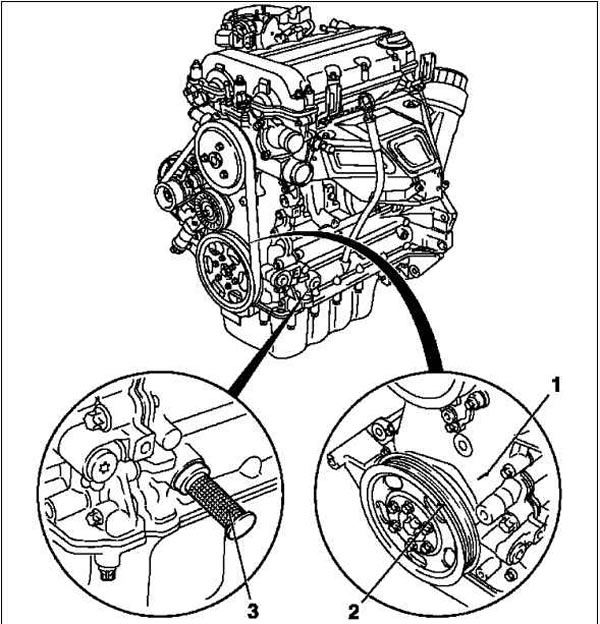
Alignment of the mark on the crankshaft pulley with the protrusion on the timing mechanism housing: 1 – protrusion on the timing mechanism housing; 2 – mark on the belt pulley; 3 – special tool
Note: If the KM 953 device cannot be installed, a basic ignition timing adjustment must be performed.
Note: The KM 953 device must be installed in the camshaft grooves until it stops.
Install the special device KM 954 (1) on the phase sensor disk (2) and attach it to the valve timing mechanism housing.

Installation of the special device KM 954 on the phase sensor disk: 1 – special device; 2 – phase sensor disk
Note: If the KM 953 device cannot be installed, a basic ignition timing adjustment must be performed.
Tighten the 2 mounting bolts.
Remove the KM 954, KM 953 and KM 952 tools.
Install the bolt into the cylinder block base hole with a new sealing ring and tighten to 60 Nm.
Remove any remaining gasket material and clean the sealing surfaces.
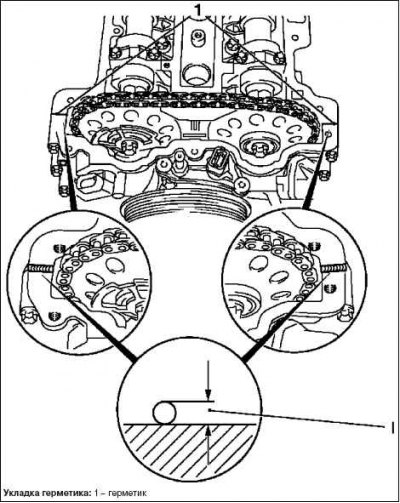
Apply sealant.
Note: The cylinder head cover must be installed within 10 minutes after applying the sealant (gray).
Cut off the protruding portion of the timing case gasket flush with the cylinder head/timing case.
Apply a bead of (grey) silicone sealant approximately 2mm thick (dimension I).
Install the cylinder head cover.
Install a new seal into the cylinder head cover.
Attention! It is necessary to inspect the bolts for damage to the seal. If the seal is damaged, the bolt must be replaced with a new one.
Attach the cylinder head cover to the cylinder head
Tighten the 13 mounting bolts to 8 Nm.
Install the ignition module.
Connect the ignition module to the spark plugs.
Tighten the 2 mounting bolts to 8 Nm.
Connect the ignition module wiring harness connector.
Attach the ignition module cover to the cylinder head cover.
Connect the engine ventilation hose to the cylinder head cover.
Attach the pulley to the coolant pump.
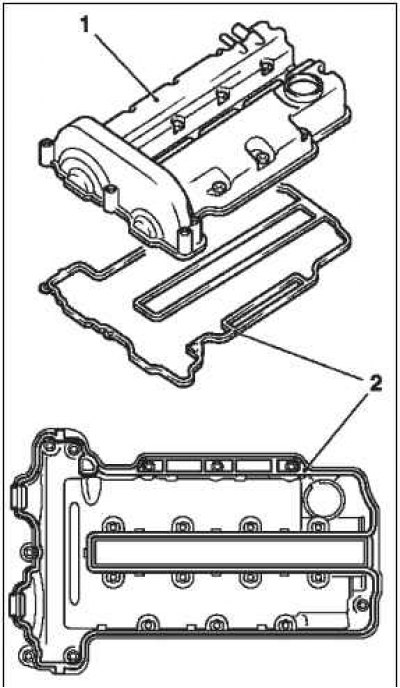
Installing the cylinder head cover: 1 – cover; 2 – seal
Tighten the 3 mounting bolts to 20 Nm.
Connect the wire harness connectors of the coolant temperature sensor, camshaft sensor and oil pressure sensor.
Secure the wire harnesses to the cylinder head cover.
Connect the coolant hoses to the coolant pump and install 2 clamps.
Connect the thermostat housing with the upper coolant hose to the coolant pump.
Install a new O-ring.
Tighten the 3 mounting bolts to 8 Nm.
Install the alternator.
Install 2 bolt connections and tighten to 35 Nm.
Connect the alternator wire harness.
Attach the poly V-belt tensioner.
Tighten the M8 bolt to 20 Nm.
Tighten the M10 bolt to 55 Nm.
Turn the poly V-belt tensioner in the direction of the arrow (figure 2.179), using the KM 6131 device, install the KM 6130 device.
Install the poly V-belt.
Pay attention to the direction of rotation and position of the belt.
Compress the poly V-belt tensioner using the KM 6131 tool.
Loosen the poly V-belt tensioner.
Attach the engine damper block support to the timing case/cylinder block.
Tighten the 3 mounting bolts to 50 Nm.
Install the flywheel.
Lock the flywheel using the KM 652 tool.
Clean the threads on the crankshaft.
Use new bolts.
Tighten the 6 mounting bolts to a torque of 35 Nm, further turning by + 30°.
Engage the clutch.
Attach the oil deflector plate to the base of the cylinder block.
Tighten the 8 mounting bolts to 8 Nm.
Install the oil pan.
Install a new oil pan seal.
Tighten the 16 mounting bolts to 10 Nm.
Add engine oil.
Check the engine oil level and adjust if necessary.
Remove the engine from the stand.
Attach the manual transmission to the engine.
Install the engine.
Visitor comments