


Contents: Cylinder head gasket ⬇ Valve seats ⬇ Valve guide bushings ⬇ Valves ⬇ Valve characteristics ⬇ Clearances in the valve drive…⬇ Valve springs ⬇ Hydraulic valve lifters ⬇
The cylinder head is cast from aluminum alloy, has two intake and two exhaust valves for each cylinder. In the upper part of the cylinder head there are two camshafts. The valves are actuated directly by the camshaft cams through hydraulic tappets, for which the guides are made integral with the cylinder head. The surfaces of the intake and exhaust channels are polished to improve cylinder filling.
Overall height of cylinder head, mm: 135.63.
Permissible warping of the head surface mating with the cylinder block, no more than, mm: 0.025 (grinding of this surface is not allowed).
Cylinder head gasket
The cylinder head gasket is installed with the mark "Oben" or "Top "("Top") up without the use of sealant.
Valve seats
The valve seats are made of cast iron and are pressed into the cylinder head.
Original source is on the website [www.OPELBOOK.ru]
Seat chamfer angle: 44°40'.
Working chamfer width, mm:
- intake valve seats: 1.0-1.4;
- exhaust valve seats: 1.4-1.8.
Gasket thickness after compression, mm: 1.15-1.30.
Valve guide bushings
The valve guides are pressed into the cylinder head.
Guide bushing hole diameter, mm.
- nominal: 7,000-7,015;
- 1st repair size: 7.075-7.090;
- 2nd repair size; 7,150-7,165.
Clearance between guide bushings and valve stems, mm
- intake valves. 0.03-0.06;
- exhaust valves: 0.04-0.07.
Protrusion of valve guide bushings relative to the plane of the cylinder head, mm: 10.7-11.0.
Valves
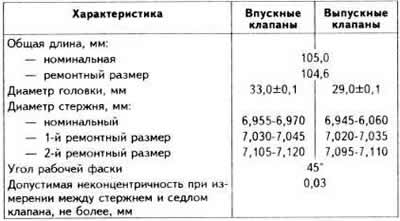
Each engine cylinder has two intake and exhaust valves. The intake valves are made of special steel, the exhaust valves are sodium-cooled. The valves are installed in the cylinder head in a V-shape at an angle of 45°. The valve plates are locked with crackers. The valves do not have rotary devices.
Valve characteristics
Clearances in the valve drive mechanism
The use of hydraulic tappets eliminates the need to adjust the clearances between the hydraulic tappet and the camshaft cam.
Valve springs
Valve springs are the same for intake and exhaust valves.
Hydraulic valve lifters
The valves are driven directly by the camshaft cams through hydraulic tappets, which are installed between the cams and the ends of the valve stems. The hydraulic tappets select the gaps in the valve drive mechanism, so that adjustment of the gaps is not required. The gaps between the camshaft cams and the tappets on a running engine are zero.
The oil pressure supplied to the tappets is limited by a special valve installed in the cylinder head on the distributor side.
Visitor comments