


Contents: Pistons ⬇ Dimensions of piston and cylinder…⬇ Piston pins ⬇ Piston rings ⬇ Characteristics of piston rings ⬇ Connecting rods ⬇ Connecting rod bearing shells ⬇ Marking of connecting rod bearing…⬇ Crankshaft ⬇ Crankshaft dimensions ⬇ Main bearing shells ⬇ Marking of engine main bearing…⬇ Flywheel ⬇
Pistons
Pistons made of aluminum alloy, forged, with a thermoregulating insert. Piston skirts are solid. There are recesses in the piston bottom for the intake and exhaust valves. The pistons of the "20XE" engine are cooled by oil, which is supplied through an opening in the upper head of the connecting rod and splashed onto the piston bottom.
Mounting clearance between piston and cylinder, mm:
- engines "13N", "13S", "14NV": 0,01-0,03;
- other engines: 0.02-0.04.
Offset of the axis of the hole for the piston pin, mm: 0.8.
Piston mass, g:
- engine "13N": 272;
- engine "13S": 285;
- engines "16S", "18E": 358.
Piston protrusion relative to the upper plane of the cylinder block, mm:
- engines "13N", "13S", "14NV": 0,22;
- engines "16S", "18E": 0.33;
- engines "16SV", "C16NZ", "20XE": 0.40;
- engines "18SE", "20NE", "C20NE", "20SEH": 0,18-0,62.
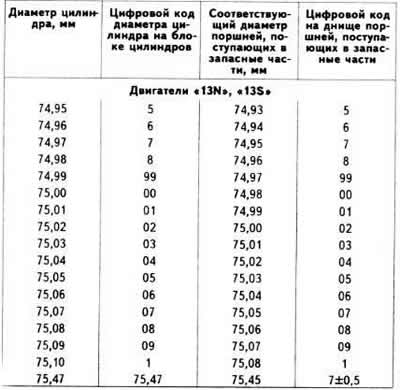
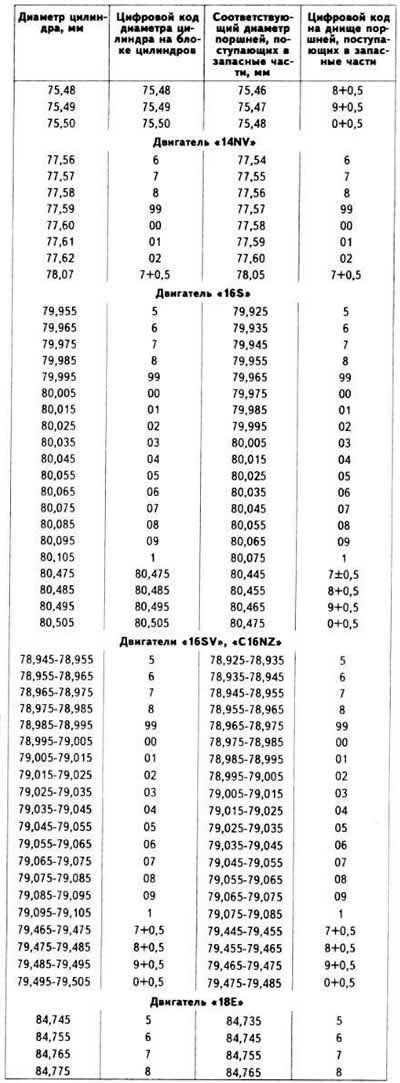
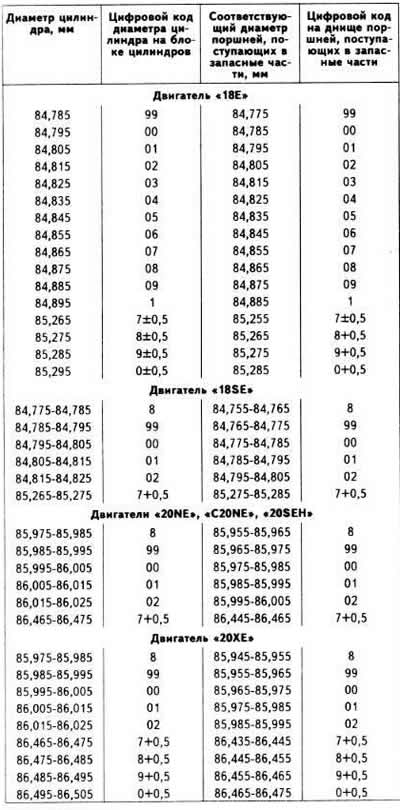
Pistons are selected strictly according to the size of the cylinders in accordance with the markings stamped on the pistons and cylinder block, as indicated in the table below.
Engine piston diameter "13N", "13S", "16S", "18E" is measured perpendicular to the piston pin at a distance of approximately 10 mm from the edge of the skirt, the diameter of engine pistons "14NV", "16SV", "C16NZ", "20NE", "C20NE", "20SEH", "20XE" at a distance of 15 mm from the edge of the skirt.
Dimensions of piston and cylinder groups
Piston pins
The piston pins are made of heat-treated steel. On all engines, except for the "20XE" model, the pin is pressed into the upper head of the connecting rod with tension and rotates freely in the piston bosses. The pin is connected to the connecting rod, which is preheated to a temperature of 280°C. On the "20XE" engine, the piston pins are steel, floating. The pin is fixed from axial movement by spring retaining rings.
Piston pin outer diameter, mm:
- engines "13N", "13S": 20;
- engines "16S", "18E": 23;
- engines "16SV", "C16NZ", "14NV": 18;
- engines "18SE", "20NE", "C20NE", "20SEH", "20XE": 21.
Piston pin length, mm:
- engines "13N", "13S": 65;
- engines "16S", "18E": 70;
- engines "16SV", "C16NZ", "14NV": 55;
- engines "18SE", "20NE", "C20NE", "20SEH": 61,5.
Clearance between piston pin and piston, mm:
- engines "13N", "13S": 0,007-0,015;
- engines "16S", "18E", "18SEj", "20NE", "C20NE", "20SEH": 0,011-0,014.
- engines "16SV", "C16NZ", "14NV": 0,007-0,010.
Tension between the pin and the piston boss, mm (engine "20XE"): 0.003-0.010.
Clearance between the pin and the bushing of the upper connecting rod head, mm (engine "20XE"): 0.015-0.030.
Piston rings
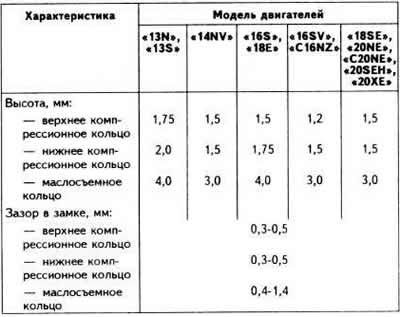
Each piston has three rings, two compression rings and one oil scraper ring, consisting of two steel disks and a multifunctional expander. The joints of the rings are spaced 180° apart. The rings are installed with the mark facing up (to the piston bottom). On the "20XE" engine, when installing the oil scraper ring, the joint of the upper disk should be moved 25-30 mm to the left, and the joint of the lower disk should be moved 25-30 mm to the right relative to the lock of the lower compression ring.
Characteristics of piston rings
Connecting rods
Steel connecting rod, forged, with I-beam cross-section, cover of the lower head of straight cross-section. A bushing is pressed into the upper connecting rod head of the engine "20XE".
In terms of weight, the connecting rods without pistons (pins for the "20XE" engine) and connecting rod bearing liners of the same engine should not differ from each other by more than 8 g.
On engines "13N", "13S" connecting rods of weight groups from 476 to 516 g are installed with an interval of 8 g, on other engines (except for "20XE") from 724 to 772 g with an interval of 8 g. Only connecting rods of the heaviest weight group are supplied as spare parts. Adjustment of connecting rods by weight is performed by removing metal from both lugs with a grinding wheel.
Adjustment of the connecting rods of the "20XE" engine by weight is not allowed. Connecting rods can only be replaced as a complete set.
Distance between centers of connecting rod head holes, mm:
- engines "13N", "13S": 126;
- engines "16S", "18E", "18SE", "16SV", "C16NZ", "20NE", "C20NE", "20SEH": 136.
Axial clearance of connecting rod on crankshaft journal, no more than, mm:
- engines "13N", "13S", "14NV", "16SV", "From 16NZ": 0.11-0.24;
- other engines: 0.07-0.24.
Width of the lower connecting rod head, mm:
- engines "14NV", "16SV", "C16NZ": 21,938-21,986;
- engines "18SE", "20NE", "C20NE", "20SEH", "20XE": 26,338-26,390.
Connecting rod bearing shells
The connecting rod bearing liners are trimetallic. The bearing pad is made of steel tape.
Width of connecting rod bearing shells, mm:
(Article published on the website OpelBook.ru)
- engines "13N", "13S": 22,0;
- engines "16S", "18E": 26.5.
Clearance between connecting rod bearings and crankshaft journals, mm:
- engines "13N", "13S", "14NV", "16SV", "C16NZ"; 0,019-0,071;
- engines "16S", "18E": 0.019-0.063;
- engines "18SE", "20NE", "C20NE", "20SEH", "20XE": 0.006-0.031.
On the engine connecting rod bearing liners "13N", "13S", "14NV", "16SV", "C16NZ" nominal size marking is stamped "GM 400 529 N", engines "16S", "18E" "GM 400 419 N". The repair size inserts of these engines have alphanumeric and color markings.
Marking of connecting rod bearing shells
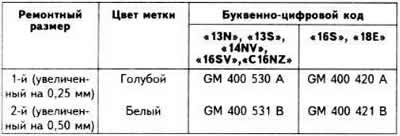
Nominal size bushings for connecting rod bearings of engines "18SE", "20NE", "C20NE", "20SEH" not marked, liners of the 1st repair size have a blue mark, liners of the 2nd repair size have a white mark.
The connecting rod bearings of the "20XE" engine, both nominal and repair sizes, are not marked.
Crankshaft
The crankshaft is made of spheroidal graphite cast iron, five-bearing, with six (four on the "20XE" engine) counterweights. On the first counterweight of the crankshaft of the engines "18SE", "20NE", "C20NE", "20SEH" a toothed ring is made, one of the teeth of which is missing. On the "20XE" engine, a special toothed rim is pressed onto the crankshaft. An electromagnetic sensor of the beginning of the count and angular pulses above the counterweight ring, installed in the cylinder block, generates signals about the angular position and rotation speed of the crankshaft at the moment of passing in the magnetic field of the sensor the place where the tooth is removed. Signals about the angular position of the crankshaft are sent to the ignition system switch, and signals about the rotation speed of the crankshaft are sent to the electronic control unit of the injection system (engine "18SE") or the controller (engines "20NE", "C20NE", "20SEH", "20XE").
Note. On the engine "20XE" with No.14005048 the crankshaft dimensions have been changed. The crankshafts of the old and new design are not interchangeable.
Ovality of main and connecting rod journal surfaces, no more than, mm: 0.004.
Permissible runout of the middle main journal when supported by the outer main journals, mm: 0.03.
Crankshaft axial clearance, mm:
- engines "13N", "13S", "14NV", "16SV", "C16NZ": 0,10-0,20;
- engines "16S", "18E", "18SE", "20NE", "C20NE", "20SEH": 0,07-0,30;
- engine "20XE": 0.05-0.152.
Permissible clearance between the liners and the main journals of the crankshaft, mm:
- engines "13N", "13S", "14NV", "16SV", "C16NZ": 0,025-0,050;
- engines "16S", "18E", "18SE", "20NE", "C20NE", "20SEH", "20XE": 0.015-0.040.
Crankshaft dimensions
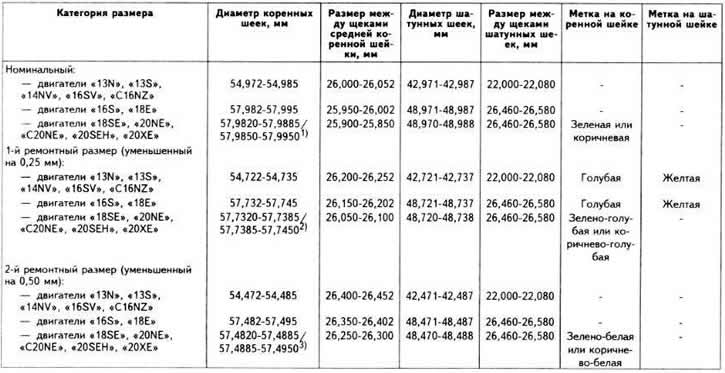
1) The numerator shows the values for the crankshaft with a green mark on the main journal, and the denominator shows the values for the crankshaft with a brown mark.
2) The numerator shows the values for the crankshaft with a green-blue mark on the main journal, and the denominator shows the values for the brown-blue mark.
3)The numerator shows the values for the crankshaft with a green-white mark on the main journal, and the denominator shows the values for the crankshaft with a brown-white mark.
Main bearing shells
The main bearing shells are trimetallic. The bearing pad is made of steel tape.
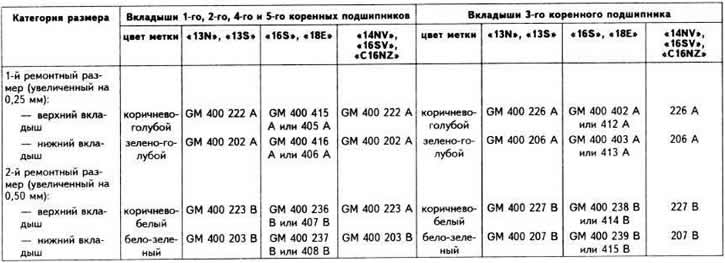
Marking of engine main bearing shells "13N", "13S", "16S", "14NV", "16SV", "C16NZ" and "18E" depending on the size

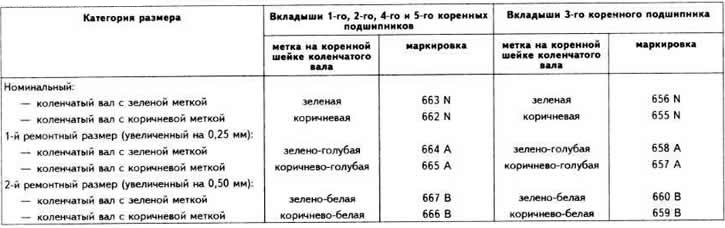
Marking of engine main bearing shells "18SE", "20NE", "C20NE", "20SEH", "20XE" depending on size
Flywheel
The flywheel is made of cast iron and is attached to the crankshaft flange with six bolts.
Permissible flywheel runout, measured on the toothed rim, mm: 0.5.
Maximum thickness of metal removed when grinding the flywheel surface under the driven clutch disc, mm: 0.3.
The size between the supporting surface of the clutch housing and the contact plane of the driven disk, mm:
- engines "13N", "13S", "14NV", "16SV", "C16NZ": 2,0-2,2;
- engines "16S", "18E", "18SE", "20NE", "C20NE", "20SEH", "20XE": 2.1-2.2.
Number of teeth on the toothed rim:
- engines "13N", "13S", "14NV", "16SV", "C16NZ": 121;
- engines "16S", "18E", "18SE", "20NE", "C20NE", "20SEH", "20XE": 135.
Temperature of heating the rim before pressing onto the flywheel, °C: 180-230.
Visitor comments