OpelBook.ru
Cars AvtoVAZ Cars Mitsubishi Cars BMW Cars Mercedes Cars Nissan Cars Toyota Cars Chevrolet
English Русский
Български
Беларускі
Український
Српски
Hrvatski
Română
Polski
Slovenský
Magyar
 |  Sitemap  |  Contacts  |    


Main Astra Corsa Insignia Kadett Omega Vectra Zafira Others Articles
Kadett D (1979-1984) Kadett E (1984-1995)
  • Main
  • Kadett
  • Kadett E
  • OHC power unit
  • Engine design
  • Technical characteristics of the 8-valve cylinder head

Technical characteristics of the 8-valve cylinder head (Opel Kadett E)

            0

Contents: Cylinder head gasket ⬇ Valve seats ⬇ Valve guide bushings ⬇ Valves ⬇ Valve guide rod characteristics ⬇ Intake valve characteristics ⬇ Exhaust valve characteristics ⬇ Clearances in the valve drive…⬇ Valve springs ⬇ Valve spring characteristics ⬇ Hydraulic valve lifters ⬇ Valve drive rocker arms ⬇
The cylinder head is cast from an aluminum alloy, with transverse purging, i.e. the intake manifold and exhaust manifold are located on opposite sides of the cylinder head.

The head contains the valves, hydraulic valve lifters, rocker arms, and the overhead camshaft is housed in a separate, removable bearing housing bolted to the top of the cylinder head.

Combustion chamber volume, cm³:
  • engine "13N": 43.86;
  • engine "13S": 37.70;
  • engine "16S": 47.50;
  • engine "18E": 51.61.

Cylinder head height measured between mating surfaces, mm: 96.00±0.25.

Permissible warping of the head surface mating with the cylinder block, no more than, mm: 0.025 (grinding of this surface is not allowed).

Cylinder head gasket


Cylinder head gasket thickness, mm:
  • engine "14NV": 1.75-1.90;
  • other engines: 1.15-1.30.

The gasket is installed with the label "Oben" or "Top" ("Top") up without the use of sealant.

Valve seats


The valve seats are made of cast iron and are pressed into the cylinder head.

Seat chamfer angle: 44°.

Width of the working chamfer in the cylinder head, mm:

intake valve seats:
  • engines "13N", "13S", "14NV", "16S", "16SV", "C16NZ", "18E": 1.3-1.4;
  • engines "18SE", "20NE", "C20NE", "20SEH": 1,0-1,5.

exhaust valve seats:


  • engines "13N", "13S", "14NV", "16S", "16SV", "C16NZ", "18E": 1.7-1.8;
  • engines "18SE", "20NE", "C20NE", "20SEH": 1,7-2,2.

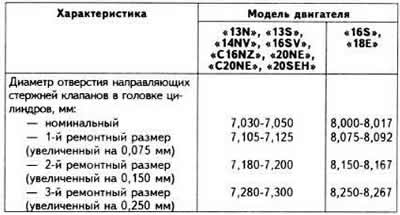
Valve guide bushings


Valve guides are holes drilled and reamed to the nominal or repair size directly in the cylinder head body.

Valves


The valves are located in the cylinder head in a row. The intake valves are made of chromium steel, the exhaust valves are made of chromium-manganese alloy. The valve plates are locked with two crackers. The exhaust valves have rotary devices. The working chamfers of the exhaust valves are subjected to special treatment to improve strength characteristics.

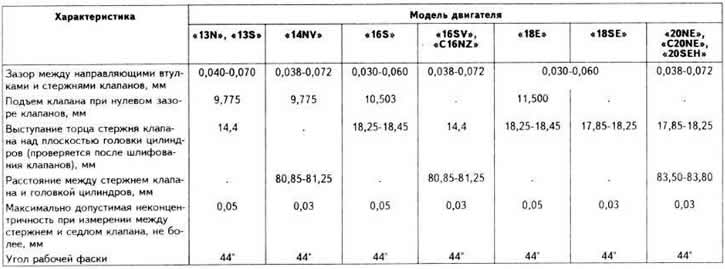
Valve guide rod characteristics


Valve guide rod characteristics

Intake valve characteristics
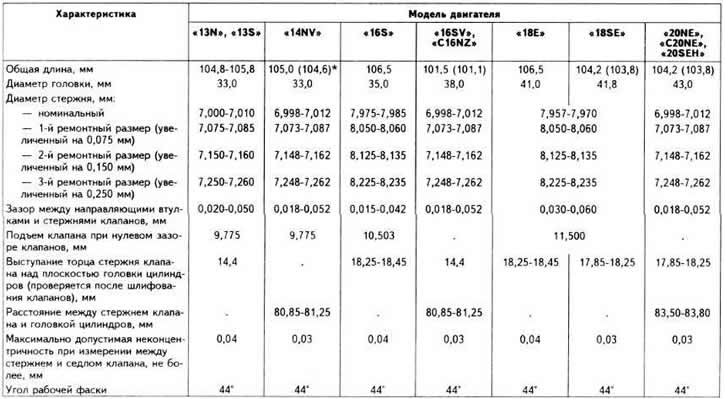


Intake valve characteristics

*The repair size is given in brackets.


Exhaust valve characteristics
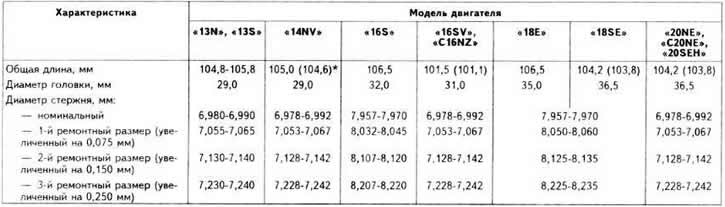


Exhaust valve characteristics

Exhaust valve characteristics

*The repair size is given in brackets.

Clearances in the valve drive mechanism


The use of hydraulic tappets eliminates the need to adjust the clearances between the hydraulic tappet and the camshaft cam.

Valve springs


The valve springs for the intake and exhaust valves are identical in design and characteristics.

Valve spring characteristics
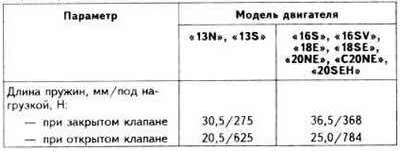


Valve spring characteristics


Hydraulic valve lifters


The valves are actuated by camshaft cams through hydraulic tappets that move in holes made in the body of the cylinder head and have a ball head on which the rocker arms of the valve drive rest.

The oil pressure supplied to the tappets is regulated by a special valve located in the cylinder head.

Valve drive rocker arms


The rocker arms rest on the ball heads of the hydraulic tappets and are centered by a guide groove relative to the end of the valve stem.

Working shoulder of rocker arm, mm:
  • engine "13N": 16.16;
  • engine "13S"; 16,29;
  • engines "16S", "16SV", "18E", "18SE", "20NE", "C20NE", "20SEH": 16,42.


This article is available at russian, bulgarian, belarusian, ukrainian, serbian, croatian, romanian, polish, slovak, hungarian
Checking the article: Shapovalov Yaroslav

Share information:

Previous articles
Opel Kadett E: Engine design
Next articles

Main technical characteristics
Technical characteristics of the 16-valve cylinder head
Technical characteristics of the cylinder block
Technical characteristics of the crank mechanism
Technical characteristics of the valve timing mechanism of 8-valve engines
Technical characteristics of the valve timing mechanism of the 16-valve engine
Technical characteristics of the lubrication system


See similar ones from other Opel car manuals:
▶ Cylinder head and valve parts — cleaning and inspection Opel Astra F (1991-1998, petrol)
▶ Replacing valve stem seals (installed cylinder head) Opel Corsa C (2000-2006, petrol)
▶ Cleaning and checking the technical condition of the… Opel Insignia A (2008-2017)
▶ Cylinder head — removal and installation with engine in car Opel Omega A (1986-1993)
▶ Cylinder head — removal and installation (engine in a car) Opel Vectra A (1988-1995, petrol)
Link to this page in different formats

Visitor comments


No comments yet


How much will 49 + 25 =


Kadett E (1984-1995) 
  • General information
  • Vehicle description
  • Operation and maintenance
  • OHV power unit
  • Engine design
  • Check and repair
  • Engine work
  • OHC power unit
  • Engine design
  • Engine repair
  • Ignition system
  • Cooling and lubrication
  • Supply system
  • Fuel injection «LE-Jetronic»
  • Fuel injection «LE3-Jetronic»
  • Motronic ML4.1 system
  • Motronic M1.5 system
  • Motronic M2.5 system
  • Transmission
  • Clutch
  • Gearbox F10 and F13
  • Gearbox F16 and F20
  • Automatic gearbox
  • Drive shafts
  • Chassis
  • Front suspension
  • Rear suspension
  • Steering
  • Brake system
  • Electrical equipment
  • Equipment and devices
  • Electrical circuits
Kadett D (1979-1984) 
  • General information
  • Car care
  • Maintenance
  • Power unit
  • Gasoline engines
  • Lubrication system
  • Cooling system
  • Power system (gasoline)
  • Carburetor Solex 35 PDSI
  • Carburetor Varajet II
  • Carburetor 1B1
  • Fuel injection (gasoline)
  • Diesel engines
  • Fuel system (diesel)
  • Transmission
  • Clutch
  • Manual gearbox
  • Chassis
  • Front suspension
  • Rear suspension
  • Steering
  • Brake system
  • Wheels and tires
  • Body
  • Body elements
  • Doors and windows
  • Electrical equipment
  • Equipment and devices
  • Lighting system
  • Power devices
  • Ignition system
  • Electrical circuits
OpelBook.ru © 2017–2026 · Mobile version · · Sitemap: EN BG BY UA RS HR RO PL SK HU · Feedback · Site search
Astra F, petrol · Astra G, petrol · Astra G · Astra H · Astra J, petrol · Corsa B · Corsa C, petrol · Corsa C · Insignia A · Kadett D · Kadett E · Omega A · Omega B · Omega B2 · Vectra A, petrol · Vectra A · Vectra B, petrol · Vectra B · Vectra C · Zafira A, petrol · Frontera A, petrol · Frontera B · Ascona C · Vivaro A ·
We want your visit to be comfortable 🤝! We use cookies 🍪 to make that happen.