


Note: Some diesel models of recent years of production, equipped with the Z19DT(H) engine, may be equipped with an AF40 brand AT - it is not considered in this Manual.
1. The models described in this Manual are equipped with an automatic 5-speed AT with the Active Select system - AF23/AF33, which allows you to control gear shifting in both automatic and manual modes, or a 6-speed AT - VT20-E with the CVTronic system with three control modes (see chapter "Controls and operating techniques"). The AF23 and AF33 automatic transmissions are practically the same gearbox, but adapted to different engines and final drive ratios, and are controlled by different programs. The identification number and code are printed on a plate attached to the transmission housing(see accompanying illustration).
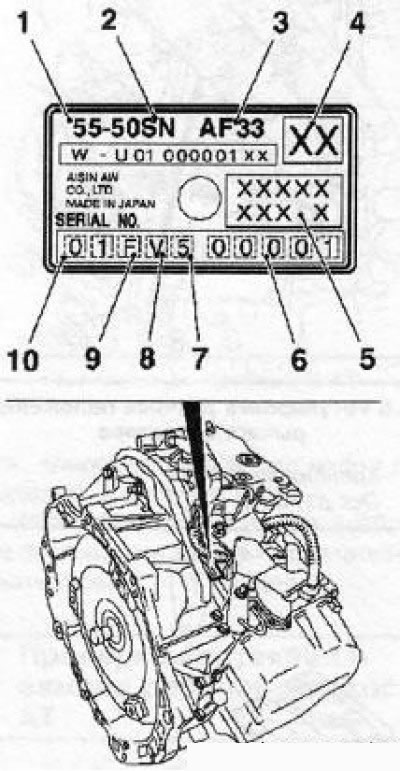
1.1 AT Identification Number (F23/F33)
2. AT consists of a torque converter (rotation converter), planetary assembly and hydraulically controlled clutches (friction clutches) and brake bands. The transmission operation is controlled by an electronic module using electrically controlled valves. AT can operate in one of three modes: normal, winter, and, on recent models, sport. The order of switching on and the purpose of the modes are described in more detail in Chapter "Controls and operating techniques", Section 25.
[Text was copied from the portal: opelbook]
3. Torque converter (rotation converter) provides the transmission of torque from the engine to the gearbox. Due to the fact that the transmission of rotation is carried out hydraulically (via transmission fluid - ATF), the car starts moving and gear shifting is very smooth. In addition, the torque converter provides dynamic adjustments to the torque value during acceleration.
4. The AT planetary gear provides the ability to select five forward and one reverse gear. The gear ratio of the planetary gear is determined by which of its elements are locked and which rotate freely. Locking and releasing of the elements of the planetary assemblies in AT is performed by means of clutches and brake bands, activated by commands coming from the control module. A hydraulic pump placed inside the transmission housing creates the pressure of the working fluid necessary to activate the clutches and brake bands.
5. The driver controls the AT via a selector lever mounted on the floor of the vehicle. Control techniques are described in detail in Chapter "Controls and operating techniques".
6. Due to the complexity of the AT design, the lack of commercially available replacement internal components, and the need to use special equipment, the authors of this Manual do not recommend that vehicle owners perform major transmission repairs on their own. This Chapter only covers procedures for diagnosing common transmission failures, routine maintenance, individual adjustments, removal, and installation.
7. In case of serious breakdown, it is wiser and easier to replace the transmission than to spend time and money on restoring the failed assembly. However, performing the operations of its removal and installation independently can significantly reduce costs (first make sure that the transmission really needs a rebuild).
Visitor comments