


Contents: Description ⬇ General information ⬇
Note: A catalytic converter is not a filter. It creates a chemical reaction, but it does not affect it.
Description
1. Some models are equipped with a catalytic converter, which reduces exhaust emissions. The converter can be installed on models with an engine code starting with the letter "C" or "X".
2. The catalytic converter causes a reaction that converts potentially harmful hydrocarbons and carbon monoxide in the exhaust into harmless gases and water vapor. The converter consists of a steel container containing a ceramic honeycomb coated with a catalyst. The catalyst is a mixture of three precious metals, platinum, palladium and iridium.
3. Exhaust gases pass freely through the honeycomb, where the catalyst accelerates the chemical reaction.
4. To avoid damage to the catalytic converter, the engine should always be properly adjusted and should always be run on unleaded petrol. Normal leaded petrol "damages" the catalytic converter and should therefore not be used.
5. To enable the Motronic engine management system to achieve complete combustion of the fuel-air mixture, and thus reduce exhaust emissions to a minimum, an oxygen sensor is installed in the exhaust gas flow. The sensor monitors the oxygen level in the exhaust gas and sends a signal to the Motronic unit. The unit constantly changes the fuel-air ratio within small limits to reduce emissions and allow the catalytic converter to operate at maximum efficiency. Therefore, on models equipped with a catalytic converter, no adjustment of the idle mixture is possible
General information
6. The exhaust gas from a gasoline engine consists of 99% nitrogen (N₂O), carbon dioxide (CO₂O), oxygen (O2O), other inert gases, and water vapor (H2O). The remaining 1% are harmful substances that harm the environment. Carbon monoxide (CO), unburned hydrocarbons (UHC), nitrogen oxides (NOx), and some solid substances.
7. The device that cleans exhaust gases is called a catalytic converter. It is installed in the exhaust system of a car and uses precious metals (platinum and palladium or iridium) as catalysts to speed up the reaction between pollutants and oxygen in the exhaust gases. CO and HC are further oxidized to H 2 O and CO 2 and (in a three-stage catalytic converter) NOx decomposes to N
8. The converter consists of a ceramic honeycomb coated with a combination of precious metals in such a way as to create the maximum area over which the exhaust gases can flow. The three-stage closed-loop converter can eliminate more than 90% of pollutants.
9. The catalytic converter is a reliable and simple device that does not require maintenance. However, there are some recommendations that the owner must follow to ensure that the converter functions properly for a long time (see illustration).
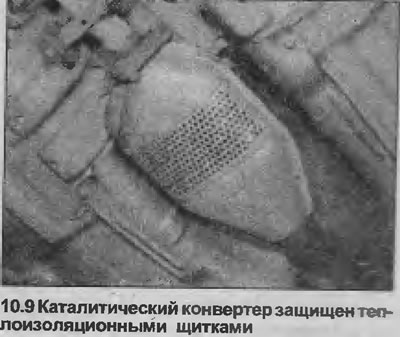
The source is on the online website (OpelBook)
- a) Do not use leaded gasoline if the vehicle is equipped with a catalytic converter. The deposit will coat the precious metals, reducing their conversion efficiency and eventually causing the converter to fail.
- b) Always ensure that the ignition system and fuel system are in good condition (see "Maintenance" and the corresponding Section). In particular, replace the air filter element, fuel filter and spark plugs on time. If the inlet fuel-air mixture becomes too rich, unburned fuel will enter the converter and burn in it, overheating the element and eventually destroying the converter.
- c) If the engine misfires, do not operate the vehicle (or at least as little as possible) until the damage is repaired Due to misfires, unburned fuel gets into the converter, which overheats and fails.
- d) Engine management indicator (image of engine with lightning), comes on when the ignition is switched on and the engine is started, and then goes out. When the engine is running, it may come on briefly and then go out immediately. If the indicator comes on and does not go out while the engine is running, consult your Opel dealer as soon as possible. If damage occurs in the fuel injection/ignition system, in addition to increased fuel consumption and the fact that this can have a negative effect on the engine, the catalytic converter may also fail.
- e) Do not attempt to tow-start the vehicle. The catalytic converter will become soaked with unburned fuel, which may cause overheating after starting, see (b) above.
- f) Do not turn off the ignition at high engine speeds. If the ignition is turned off for any reason when the engine is running above idle speed, unburned fuel (very hot) gets into the catalytic converter, the element may catch fire and damage the converter.
- g) Do not use additives for motor oil or fuel. They may contain substances harmful to the catalytic converter
- h) Do not operate the vehicle if the oil burns to visible blue smoke. Unburned carbon will clog the converter channels and reduce its efficiency; in severe cases, the element may overheat.
- i) Remember that the catalytic converter operates at very high temperatures, therefore the heat shields on the underbody and body of the car will be so hot that they can ignite flammable materials that may be nearby. DO NOT park the car on dry leaves in long grass.
- j) Remember that the catalytic converter is extremely FRAGILE. Do not hit it with tools when servicing. Use extreme caution when working on the exhaust system. Do not drive on roads with high protrusions, etc., to avoid catching the exhaust system,
- k) In some cases, especially when the vehicle is new and/or is operated in a manner that requires frequent engine shut-off and restart, a hydrogen sulphide odor may be detected from the exhaust system(rotten eggs). This happens to many cars equipped with a catalytic converter. The smell is caused by a small amount of sulfur in gasoline reacting with hydrogen in the exhaust system to form hydrogen sulfide (CS). Although this gas is poisonous, it is not produced in sufficient quantities. After driving a few thousand kilometers, the problem should disappear. It can also be caused by a change in driving style or brand of gasoline.
- l) A catalytic converter on a vehicle in good condition and well adjusted should last 80,000-160,000 km.
Visitor comments