


The ignition system consists of a primary low-voltage circuit (LT) and a secondary high-voltage circuit (HT). When the ignition is turned on, current is supplied to the primary winding of the ignition coil, and a magnetic field is created. At the correct moment of ignition, the low-voltage circuit is electronically interrupted by a sensor disk attached to the crankshaft. The magnetic field drops and a current is induced in the secondary high-voltage winding. This high-voltage voltage is supplied through the distributor rotor to the appropriate spark plug. After the ignition spark is supplied, the low-voltage circuit is reactivated and the cycle is repeated.
The ignition timing is controlled by a microprocessor in the control unit. On 1.8 models, the control unit is located in the right rear corner of the engine compartment, and on carburettor models, a vacuum hose is connected to it. On 2.0 models, the control unit is integrated with the Motronic engine control unit, located on the right side in the driver's footwell. The control unit receives information about engine speed, load and temperature, and based on this data, determines the correct ignition timing.
Note: When working on the ignition system, remember that high voltage can be significantly higher than on a conventional system and in some cases can be fatal.
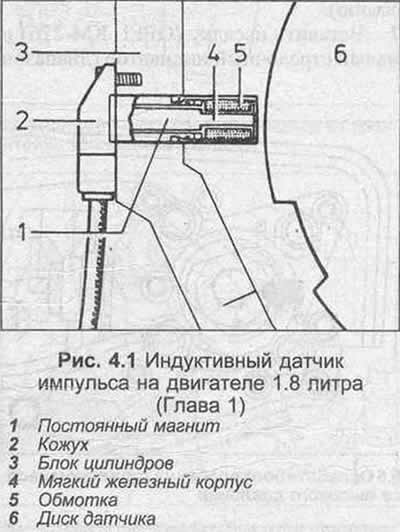
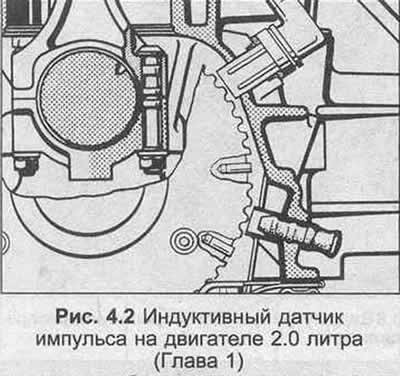
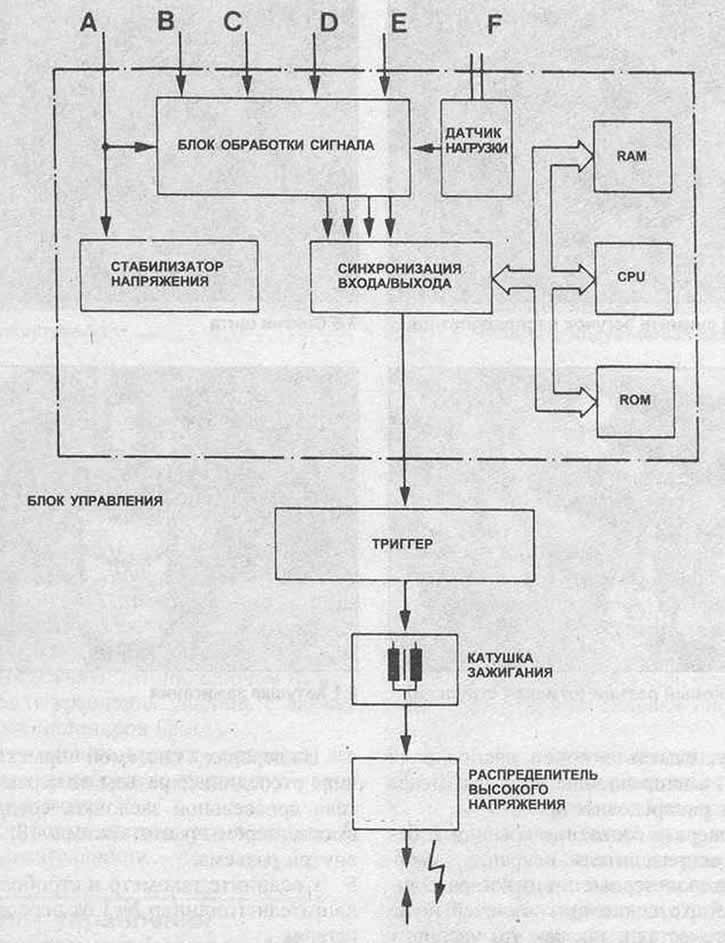
Figure 4.3 Components of the ignition system on 1.8 liter carburetor engines (Chapter 1)
A - Battery voltage
B - Resistance code (octane number)
C — Coolant temperature
D — Engine speed
E - Throttle switch position
F — Intake manifold vacuum
CPU — Control Processor (microprocessor)
RAM — Random Access Memory (random access memory)
ROM — Read-Only Memory (persistent memory) (program memory)
I/O — Input/Output
[Material copied from the portal Opelbook.ru]
Visitor comments