


2. Proceed as described in points 1 and 2 Chapters 17.
3. Disconnect the flexible hoses and the rear ends of the rigid brake pipes from the underbody of the vehicle.
4. Support the torsion beam with a jack, placing a piece of board between them.
5. Loosen and remove the nuts and bolts securing the trailing arms to the underbody.
6. Gently lower the jack until the trailing arm bushings are accessible, then support the torsion beam with axle stands. Be careful not to deform the brake pipes.
7. There is a special Opel tool for removing and installing bushings, but a long bolt, nut, washers and a piece of metal tube or socket can be used.
8. Before removing the bushing, cut off the flange from the inner end of the bushing using a sharp knife.
9. Removing the bushing will be easier if you heat the bushing housing in the trailing arm to approximately 70°C using, for example, a hair dryer. Do not use an open flame (the fuel tank is located nearby).
10. Remove the bushing from the trailing arm (see point 7).
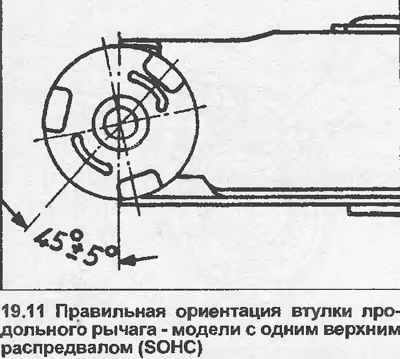
11. Wet the new bushing with a small amount of soapy water, then push it into place so that the tabs on the end of the bushing are oriented as shown (see illustration).
12. Repeat the procedure on the second trailing arm of the rear suspension. The bushings must be replaced in pairs.
13. Raise the torsion beam using a jack and install the bolts and nuts securing the front ends of the trailing arms to the underbody.
Do not fully tighten the fasteners at this stage. Remove the axle supports.
14. Attach the rigid brake lines and flexible hoses to the underbody of the vehicle.
15. Proceed as described in points 27-31 Chapters 17.
Visitor comments