
OpelBook.ru
Cars AvtoVAZ Cars Mitsubishi Cars BMW Cars Mercedes Cars Nissan Cars Toyota Cars Chevrolet
English Русский
Български
Беларускі
Український
Српски
Hrvatski
Română
Polski
Slovenský
Magyar
 |  Sitemap  |  Contacts  |    


Main Astra Corsa Insignia Kadett Omega Vectra Zafira Others Articles
Frontera A (1991-1998, petrol) Frontera B (1998-2004) Ascona C (1981-1988) Vivaro A (2001-2014)
  • Main
  • Opel
  • Frontera B
  • Chassis
  • Suspension and axles
  • General information

General information (Opel Frontera B)

            0

Contents: Front suspension ⬇ Rear suspension ⬇ Drive shafts ⬇
The suspension is the link between the body and the wheels. Through it, the forces acting on the wheels are transmitted to the body. The elements included in the suspension soften dynamic loads, reduce body vibrations, and ensure good stability and smooth running of the car.

Front suspension


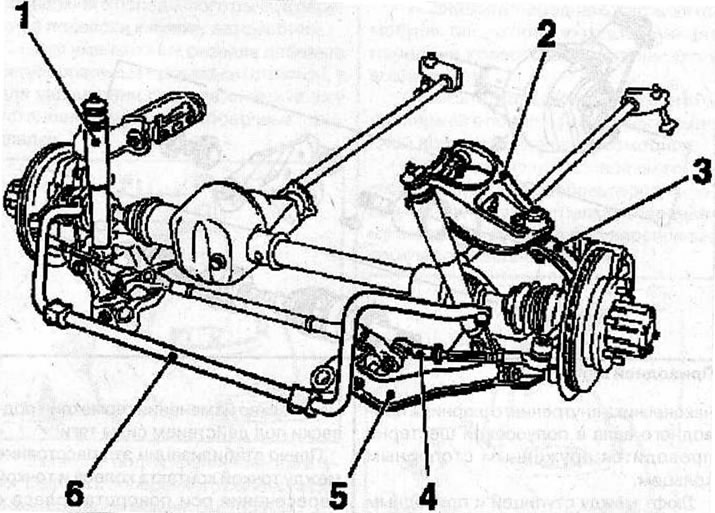
Double wishbone front suspension: 1 - shock absorber; 2 - Upper wishbone of the front suspension; 3…

Double wishbone front suspension: 1 - shock absorber; 2 - Upper wishbone of the front suspension; 3 - steering knuckle; 4 - steering rods; 5 - lower wishbone of the front suspension; 6 - anti-roll bar


The front axle uses a double wishbone suspension.

The three-arm transverse levers of the front suspension are attached with two arms to two rotary joints on the car body, and the outer arms of the levers are attached through ball joints to the upper and lower parts of the steering knuckle. This type of attachment of the transverse levers ensures elastic movement of the suspension in the vertical plane and rotation of the wheel in the horizontal plane.

The advantage of using double wishbones in car suspension is very precise wheel alignment and a lot of adjustments. Depending on the arrangement (e.g. symmetrical arrangement, change in tilt or change in length ratio (trapezoidal rod shape)) transverse levers of the car suspension can positively influence various parameters of car control.


If springs with lower stiffness are installed on a car to increase comfort, when the car is moving on a turn, centrifugal forces lead to an increase in the car's tilt. Therefore, to improve the balance of the car and reduce roll, a front anti-roll bar is installed. The anti-roll bar is of the torsion type, both ends of which are connected to the lower arms via rods, and the central part of the stabilizer is fixed to the lower part of the body.

The purpose of shock absorbers is to convert vibrations of the body and suspension into heat, resulting in damping of vibrations. The shock absorber consists of a tube with a piston and rod, as well as a second tube. The piston has a hole and a valve, and the cylinder in which the piston moves is filled with oil. The use of two tubes ensures optimum vibration damping, since the resistance to the efforts to pump oil from one section of the shock absorber to another and vice versa acts both during extension and compression of the shock absorber. This ensures double action of the shock absorber.

Rear suspension
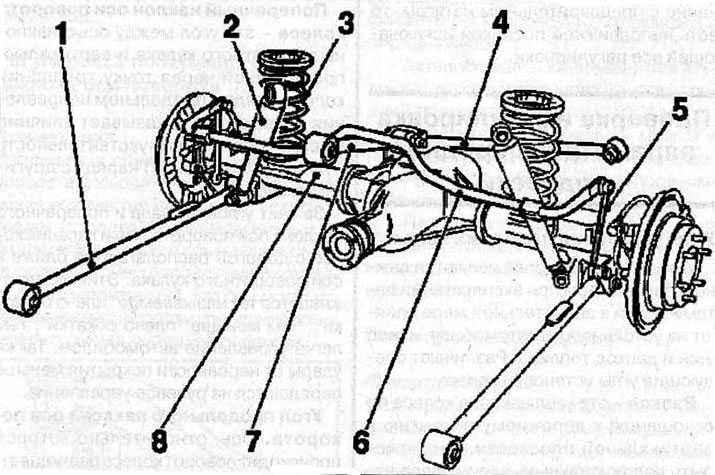


Rear suspension: 1 - longitudinal lever; 2 - shock absorber; 3 - spring; 4 - diagonal crossbar; 5 -…

Rear suspension: 1 - longitudinal lever; 2 - shock absorber; 3 - spring; 4 - diagonal crossbar; 5 - anti-roll bar link;

6 - anti-roll bar; 7 - upper arm; 8 - solid rear axle


The rear suspension consists of a solid rear axle, trailing arms, diagonal cross-member, upper arms, shock absorbers, springs and anti-roll bar. This rear suspension design takes up little space, is characterized by a high load-bearing capacity and ensures constant wheel alignment angles.

Warning! It is strictly forbidden to carry out welding and straightening work on suspension elements. Be sure to replace self-locking nuts, as well as bolts with signs of corrosion.

Drive shafts
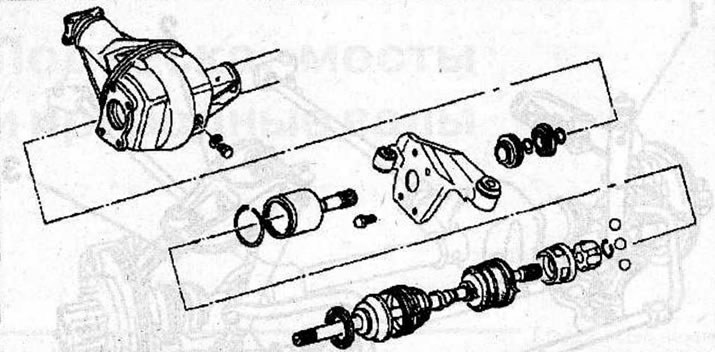


Drive shaft

Drive shaft


Torque from the gearbox to the wheels is transmitted using constant velocity joint drive shafts.

Each shaft consists of three parts: the inner and outer constant velocity joints (CV joints) and the central part of the shaft.

The splined end of the outer joint housing is inserted into the wheel hub and secured with a nut. CV joints are lubricated with consistent grease, which is replaced only when the joint is disassembled.

CV joints are necessary to transmit torque and compensate for movement of the front suspension. Also, CV joints allow you to change the length of the drive shaft and transmit torque at constantly changing angles.


In the front axle housing, the drive shafts are attached with splined connections to the differential axle gears. The splined end of the inner joint of the drive shaft is fixed in the axle gear by a spring retaining ring.

The play between the hub and the drive shaft is eliminated by the arrangement of the splines. The splines in the hub are straight, while the splines on the shaft are at a slight angle. Different spline designs provide a connection with a pre-tension, i.e. a fixed fit that eliminates all adjustments.


This article is available at russian, bulgarian, belarusian, ukrainian, serbian, croatian, romanian, polish, slovak, hungarian
Checking the article: Chernov Alexander

Share information:

Previous articles
Opel Frontera B: Suspension and axles
Next articles

Technical data
Checking and adjusting the front suspension parameters
Changing the oil in the front axle housing
Front axle
Switching mechanism while driving
Shift mechanism drive
Replacing the front axle pinion seal


Link to this page in different formats

Visitor comments


No comments yet


How much will 14 + 34 =


Vivaro A (2001-2014) 
  • General information
  • User manual
  • Power unit
  • Petrol engine F4R
  • Diesel engine F9Q
  • Diesel engine G9U
  • Transmission
  • Clutch and drive shafts
  • Manual gearbox
  • Chassis
  • Front suspension
  • Rear suspension
  • Brake system
  • Body
  • Exterior
  • Interior
  • Electrical equipment
  • Heating and ventilation
  • Air conditioner
  • Equipment and devices
  • Electrical diagrams
Ascona C (1981-1988) 
  • General information
  • Maintenance
  • Power unit
  • Gasoline engines
  • Diesel engines
  • Cooling system
  • Fuel and exhaust system
  • Contact ignition system
  • Contactless ignition system
  • Transmission
  • Clutch
  • Mechanical gearbox
  • Automatic gearbox
  • Drive shafts
  • Chassis
  • Steering
  • Brake system
  • Car suspension
  • Body
  • Exterior
  • Interior
  • Doors and windows
  • Electrical equipment
  • Equipment and devices
  • Power devices
  • Electrical circuits
Frontera B (1998-2004) 
  • General information
  • User manual
  • Maintenance
  • Power unit
  • Petrol engines 2.2 l
  • Petrol engines 3.2 l
  • Diesel engines 2.2 l
  • Cooling system
  • Fuel system (petrol)
  • Fuel system (diesel)
  • Ignition system
  • Transmission
  • Clutch
  • Manual gearbox MUA5C
  • Automatic gearbox 4L30E
  • Chassis
  • Suspension and axles
  • Steering
  • Brake system
  • Body
  • Exterior
  • Interior
  • Doors, locks and windows
  • Heating and air conditioning
  • Electrical equipment
  • Power devices
  • Equipment and devices
  • Lighting and signaling
  • Electrical diagrams
Frontera A (1991-1998, petrol) 
  • General information
  • Introduction to guide
  • User manual
  • Maintenance
  • Power unit
  • Engine repair
  • Lubrication system
  • Cooling system
  • Power and exhaust system
  • Engine electrics
  • Transmission
  • Clutch
  • Mechanical gearbox
  • Cardan shafts
  • Chassis
  • Brake system
  • Front suspension
  • Rear suspension
  • Steering
  • Body
  • Repair and care
  • Electrical equipment
  • Equipment and devices
  • Electrical circuits
OpelBook.ru © 2017–2026 · Mobile version · · Sitemap: EN BG BY UA RS HR RO PL SK HU · Feedback · Site search
Astra F, petrol · Astra G, petrol · Astra G · Astra H · Astra J, petrol · Corsa B · Corsa C, petrol · Corsa C · Insignia A · Kadett D · Kadett E · Omega A · Omega B · Omega B2 · Vectra A, petrol · Vectra A · Vectra B, petrol · Vectra B · Vectra C · Zafira A, petrol · Frontera A, petrol · Frontera B · Ascona C · Vivaro A ·
We want your visit to be comfortable 🤝! We use cookies 🍪 to make that happen.