OpelBook.ru
Cars AvtoVAZ Cars Mitsubishi Cars BMW Cars Mercedes Cars Nissan Cars Toyota Cars Chevrolet
English Русский
Български
Беларускі
Український
Српски
Hrvatski
Română
Polski
Slovenský
Magyar
 |  Sitemap  |  Contacts  |    


Main Astra Corsa Insignia Kadett Omega Vectra Zafira Others Articles
Frontera A (1991-1998, petrol) Frontera B (1998-2004) Ascona C (1981-1988) Vivaro A (2001-2014)
  • Main
  • Opel
  • Frontera A
  • Power unit
  • Cooling system
  • Cooling and Heating Systems — General Information

Cooling and Heating Systems — General Information (Opel Frontera A)

            0

Contents: Replacing the coolant ⬇ Coolant ⬇
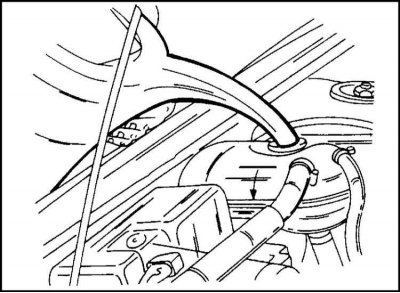
Unscrewing the expansion tank cap (2.0L engine)

Unscrewing the expansion tank cap (2.0L engine)
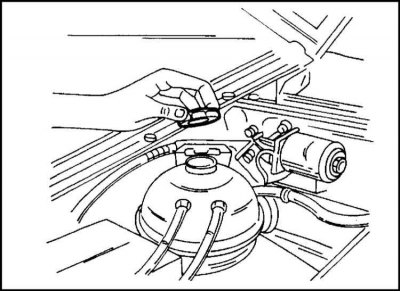
Expansion tank for 2.4L engine

Expansion tank for 2.4L engine

The engine is equipped with a circulation cooling system. A vane water pump is used to circulate the coolant. The cooling system operates with a separate expansion tank.

The cooling system removes excess heat generated during engine operation into the environment. Part of the energy from fuel combustion in an engine is released in the form of heat. This heat is capable of heating the engine in a very short time to a temperature that can cause it to fail. Some of this heat is used to heat the car's interior. Thanks to the appropriate placement of pipelines, heat exchanger (radiator) and thermostat, rapid heating of the system is achieved.


The thermostat regulates the temperature of the coolant in the engine and the heat exchanger of the internal heating system depending on the thermal state of the engine.

Starting from a certain temperature, the thermostat connects the radiator to the coolant circulation circuit. As the temperature of the liquid increases further, the fan turns on, directing the air flow through the radiator and thus providing additional cooling of the circulating liquid.

Replacing the coolant


Contact the Head Routine care and maintenance.

Coolant


At the factory, the system is filled with coolant, which should not be changed for a year.

When preparing a coolant, it is necessary to maintain a certain ratio of antifreeze to water. As already mentioned, it is necessary to use the coolant recommended by Opel, since its chemical composition is specially developed for the engine of this car. The volumes of operating fluids are given in the Specifications. The liquid protects the system up to an outside air temperature of – 40°C.


This article is available at russian, bulgarian, belarusian, ukrainian, serbian, croatian, romanian, polish, slovak, hungarian
Checking the article: Meshcheryakov Damir

Share information:

Previous articles
Opel Frontera A: Cooling system
Next articles

Engine Cooling System Specifications
Checking the radiator and radiator cap
Removal and installation the radiator
Replacing the cooling fan
Coolant pump — removal and installation
Replacing and tensioning the V-belt


See similar ones from other Opel car manuals:
▶ Cooling systems — general information Opel Astra F (1991-1998, petrol)
▶ Heating, ventilation and air conditioning systems Opel Corsa B (1993-2000)
▶ Elements of heating and ventilation systems Opel Omega B (1993-1999)
▶ Ventilation, heating and air conditioning (HVAC) systems Opel Vectra C (2002-2008)
▶ Checking the tightness of the cooling system Opel Insignia A (2008-2017)
Link to this page in different formats

Visitor comments


No comments yet


How much will 42 + 33 =


Vivaro A (2001-2014) 
  • General information
  • User manual
  • Power unit
  • Petrol engine F4R
  • Diesel engine F9Q
  • Diesel engine G9U
  • Transmission
  • Clutch and drive shafts
  • Manual gearbox
  • Chassis
  • Front suspension
  • Rear suspension
  • Brake system
  • Body
  • Exterior
  • Interior
  • Electrical equipment
  • Heating and ventilation
  • Air conditioner
  • Equipment and devices
  • Electrical diagrams
Ascona C (1981-1988) 
  • General information
  • Maintenance
  • Power unit
  • Gasoline engines
  • Diesel engines
  • Cooling system
  • Fuel and exhaust system
  • Contact ignition system
  • Contactless ignition system
  • Transmission
  • Clutch
  • Mechanical gearbox
  • Automatic gearbox
  • Drive shafts
  • Chassis
  • Steering
  • Brake system
  • Car suspension
  • Body
  • Exterior
  • Interior
  • Doors and windows
  • Electrical equipment
  • Equipment and devices
  • Power devices
  • Electrical circuits
Frontera B (1998-2004) 
  • General information
  • User manual
  • Maintenance
  • Power unit
  • Petrol engines 2.2 l
  • Petrol engines 3.2 l
  • Diesel engines 2.2 l
  • Cooling system
  • Fuel system (petrol)
  • Fuel system (diesel)
  • Ignition system
  • Transmission
  • Clutch
  • Manual gearbox MUA5C
  • Automatic gearbox 4L30E
  • Chassis
  • Suspension and axles
  • Steering
  • Brake system
  • Body
  • Exterior
  • Interior
  • Doors, locks and windows
  • Heating and air conditioning
  • Electrical equipment
  • Power devices
  • Equipment and devices
  • Lighting and signaling
  • Electrical diagrams
Frontera A (1991-1998, petrol) 
  • General information
  • Introduction to guide
  • User manual
  • Maintenance
  • Power unit
  • Engine repair
  • Lubrication system
  • Cooling system
  • Power and exhaust system
  • Engine electrics
  • Transmission
  • Clutch
  • Mechanical gearbox
  • Cardan shafts
  • Chassis
  • Brake system
  • Front suspension
  • Rear suspension
  • Steering
  • Body
  • Repair and care
  • Electrical equipment
  • Equipment and devices
  • Electrical circuits
OpelBook.ru © 2017–2026 · Mobile version · · Sitemap: EN BG BY UA RS HR RO PL SK HU · Feedback · Site search
Astra F, petrol · Astra G, petrol · Astra G · Astra H · Astra J, petrol · Corsa B · Corsa C, petrol · Corsa C · Insignia A · Kadett D · Kadett E · Omega A · Omega B · Omega B2 · Vectra A, petrol · Vectra A · Vectra B, petrol · Vectra B · Vectra C · Zafira A, petrol · Frontera A, petrol · Frontera B · Ascona C · Vivaro A ·
We want your visit to be comfortable 🤝! We use cookies 🍪 to make that happen.