
OpelBook.ru
Cars AvtoVAZ Cars Mitsubishi Cars BMW Cars Mercedes Cars Nissan Cars Toyota Cars Chevrolet
English Русский
Български
Беларускі
Український
Српски
Hrvatski
Română
Polski
Slovenský
Magyar
 |  Sitemap  |  Contacts  |    


Main Astra Corsa Insignia Kadett Omega Vectra Zafira Others Articles
Frontera A (1991-1998, petrol) Frontera B (1998-2004) Ascona C (1981-1988) Vivaro A (2001-2014)
  • Main
  • Opel
  • Frontera A
  • Power unit
  • Cooling system
  • Replacing and tensioning the V-belt

Replacing and tensioning the V-belt (Opel Frontera A)

            0

For driving units installed on engines manufactured since 1995 (2.0L OHC and DOHC) the so-called multi-rib V-belt is used. The belt is tensioned automatically. If there is air conditioning, the belt additionally drives the compressor pulley. A similar belt drives the power steering pump.

For the old 2.0L engine and the 2.4L engine, the V-belt is tensioned by shifting the generator. To properly tension the belt, auto repair shops use a special measuring tool, the use of which is not discussed here. In general, the belt at the center of the maximum distance between the pulleys should deflect by 12-13 mm under the influence of the thumb.

Engine 2.0L OHC (until mid-1995) and a 2.4L engine


As already mentioned, the belt tension is checked with a special measuring device. During temporary inspection, the belt tension of the previous model 2.0L engine and the 2.4L engine is checked as follows:

1. Press with your thumb at the middle of the maximum distance between the pulleys. Check if the deflection corresponds to the set value.

2. If necessary, loosen the tension bar fastening (2.0L engine) or the tension screw nut (2.4L engine) and the lower generator mounting bolt and push the generator outward (2.0 L) or turn the tension screw (2.4 L) to tighten the belt.
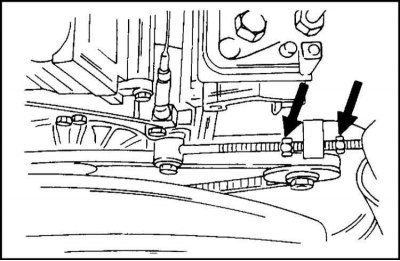
3. While holding the alternator in this position, tighten both loose bolts to 25 Nm (2.0 L) or…


3. While holding the alternator in this position, tighten both loose bolts to 25 Nm (2.0 L) or tighten the tensioner screw nuts (2.4 L). After adjustment, check the belt tension. The 2.4L engine tension screw is shown in the illustration.


Replacing the V-belt is performed as follows:

Engine 2.0 l


Replacement is performed after loosening the generator mount as described above. After replacement, check the belt tension.

Engine 2.4 l


If equipped with air conditioning, the compressor drive V-belt must be removed before replacing the coolant pump drive belt. It is also necessary to remove the power steering pump drive belt.
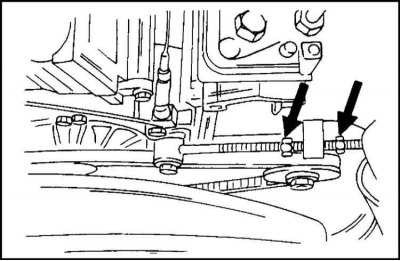
1. Loosen both nuts shown in the illustration. arrows, and unscrew the tension screws to loosen and…


1. Loosen both nuts shown in the illustration. arrows, and unscrew the tension screws to loosen and remove the belt.

2. Install a new V-belt and adjust its tension with the tension screw as described above. Tighten the nuts to a torque of 25 Nm.

2.0L engine since mid-1995
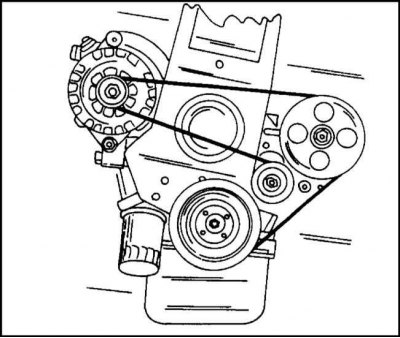


1a. V-belt routing diagram for 2.0L engine since 1995 and DOHC engine without air conditioning.
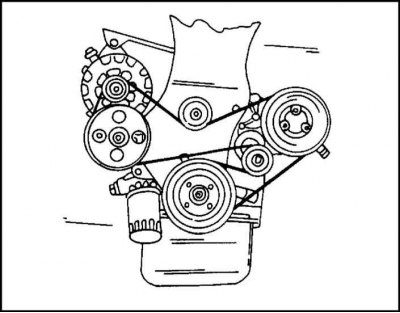

1a. V-belt routing diagram for 2.0L engine since 1995 and DOHC engine without air conditioning.


1b. V-belt routing diagram for a 2.0L engine produced since mid-1995 and for a DOHC engine with a…


1b. V-belt routing diagram for a 2.0L engine produced since mid-1995 and for a DOHC engine with a power steering pump and air conditioning.
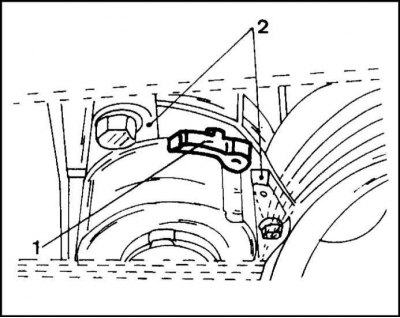
1c. Figures 1a and 1b show the multi-rib belt routing diagram for an engine with and without a…


1c. Figures 1a and 1b show the multi-rib belt routing diagram for an engine with and without a power steering pump. The belt tension is maintained automatically by a tension roller. Only the movable tension lever can be checked, as shown in the illustration. 1c. If the tension lever (1) is not between the two stops (2), replace the V-belt and tension roller. The replacement is carried out as follows:
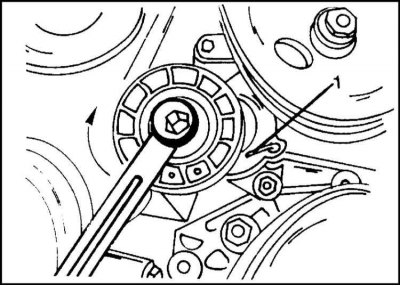
2. Place the key as shown in the illustration on the tension roller and turn it in the direction of…


2. Place the key as shown in the illustration on the tension roller and turn it in the direction of the arrow (clockwise). At the same time, the belt tension is weakened and it can be removed. If the belt is reinstalled, it is necessary to mark the direction of rotation on the belt with paint or a felt-tip pen. To hold the tension roller, you can insert a pin in the location indicated in the illustration (1).


3. Place the belt on all pulleys and pull the roller back again and then press it against the belt. When the engine is first started, the belt tension is reset automatically.

Since the belt is multi-ribbed, it is important to correctly position it in the pulley grooves. After this, remove the pin from the tension roller and release the roller onto the belt again.

Sometimes it is necessary to replace or remove the belt tension roller. In this case, after removing the belt, turn the roller in the direction shown in the illustration. point 2 so that the pin (1) enters the hole intended for it. Remove both tension roller bolts and remove the roller.

When installing, the roller is again fixed with a pin (1). Tighten the bolts to a torque of 18 Nm. The belt is put on, the pin is removed and the tension roller is pressed against the belt.

DOHC Engine


The belt tension check and replacement are carried out in the same way as the belt of the 2.0L engine, produced since mid-1995. Before removing, it is necessary to paint an arrow on the outside of the belt indicating the direction of rotation of the belt if the belt is to be installed again. The tension roller is replaced in the manner described above.


This article is available at russian, bulgarian, belarusian, ukrainian, serbian, croatian, romanian, polish, slovak, hungarian
Checking the article: Meshcheryakov Damir

Share information:

Previous articles
Opel Frontera A: Cooling system
Next articles

Coolant pump — removal and installation
Replacing the cooling fan
Removal and installation the radiator
Checking the radiator and radiator cap
Engine Cooling System Specifications
Cooling and Heating Systems — General Information
Thermostat and thermostat housing


See similar ones from other Opel car manuals:
▶ Checking the condition and replacing the auxiliary drive… Opel Astra G (1998-2004)
▶ Checking the condition and replacing the auxiliary drive… Opel Corsa B (1993-2000)
▶ Replacing the accessory drive belt Opel Insignia A (2008-2017)
▶ Replacing the camshaft drive belt of a 16-valve engine Opel Kadett E (1984-1995)
▶ Toothed drive belt and sprockets (without automatic… Opel Vectra A (1988-1995, petrol)
Link to this page in different formats

Visitor comments


No comments yet


How much will 36 + 37 =


Vivaro A (2001-2014) 
  • General information
  • User manual
  • Power unit
  • Petrol engine F4R
  • Diesel engine F9Q
  • Diesel engine G9U
  • Transmission
  • Clutch and drive shafts
  • Manual gearbox
  • Chassis
  • Front suspension
  • Rear suspension
  • Brake system
  • Body
  • Exterior
  • Interior
  • Electrical equipment
  • Heating and ventilation
  • Air conditioner
  • Equipment and devices
  • Electrical diagrams
Ascona C (1981-1988) 
  • General information
  • Maintenance
  • Power unit
  • Gasoline engines
  • Diesel engines
  • Cooling system
  • Fuel and exhaust system
  • Contact ignition system
  • Contactless ignition system
  • Transmission
  • Clutch
  • Mechanical gearbox
  • Automatic gearbox
  • Drive shafts
  • Chassis
  • Steering
  • Brake system
  • Car suspension
  • Body
  • Exterior
  • Interior
  • Doors and windows
  • Electrical equipment
  • Equipment and devices
  • Power devices
  • Electrical circuits
Frontera B (1998-2004) 
  • General information
  • User manual
  • Maintenance
  • Power unit
  • Petrol engines 2.2 l
  • Petrol engines 3.2 l
  • Diesel engines 2.2 l
  • Cooling system
  • Fuel system (petrol)
  • Fuel system (diesel)
  • Ignition system
  • Transmission
  • Clutch
  • Manual gearbox MUA5C
  • Automatic gearbox 4L30E
  • Chassis
  • Suspension and axles
  • Steering
  • Brake system
  • Body
  • Exterior
  • Interior
  • Doors, locks and windows
  • Heating and air conditioning
  • Electrical equipment
  • Power devices
  • Equipment and devices
  • Lighting and signaling
  • Electrical diagrams
Frontera A (1991-1998, petrol) 
  • General information
  • Introduction to guide
  • User manual
  • Maintenance
  • Power unit
  • Engine repair
  • Lubrication system
  • Cooling system
  • Power and exhaust system
  • Engine electrics
  • Transmission
  • Clutch
  • Mechanical gearbox
  • Cardan shafts
  • Chassis
  • Brake system
  • Front suspension
  • Rear suspension
  • Steering
  • Body
  • Repair and care
  • Electrical equipment
  • Equipment and devices
  • Electrical circuits
OpelBook.ru © 2017–2026 · Mobile version · · Sitemap: EN BG BY UA RS HR RO PL SK HU · Feedback · Site search
Astra F, petrol · Astra G, petrol · Astra G · Astra H · Astra J, petrol · Corsa B · Corsa C, petrol · Corsa C · Insignia A · Kadett D · Kadett E · Omega A · Omega B · Omega B2 · Vectra A, petrol · Vectra A · Vectra B, petrol · Vectra B · Vectra C · Zafira A, petrol · Frontera A, petrol · Frontera B · Ascona C · Vivaro A ·
We want your visit to be comfortable 🤝! We use cookies 🍪 to make that happen.