


2.0L OHC Engine
To ensure warranty, the thermostat is supplied only with a drain plug, i.e. the parts are replaced as a set.
The thermostat is removed as follows:
1. Disconnect the ground cable from the battery.
2. Drain the coolant (section Filling the cooling system coolant Chapters Routine care and maintenance).
3. Disconnect the upper hose from the connecting pipe on the engine, and unscrew the plug together with the thermostat from the thermostat housing.
Installation is performed in the reverse order of removal. A new sealing ring is always installed. Tighten the bolts to a torque of 8 Nm.
If there is a leak under the sealing ring, then removing and installing the thermostat housing is a rather labor-intensive operation. To get to the thermostat housing, you need to remove the toothed belt. In addition, it is necessary to remove the crankshaft pulley, cylinder block cover, timing belt tensioner and timing belt protective cover.
1. Disconnect the ground cable from the battery.
2. Remove the multi-ribbed V-belt as described.
3. Drain the cooling system (section Filling the cooling system coolant Chapters Routine care and maintenance).
4. Remove the four generator mounting bolts.
5. Disconnect the two hoses from the thermostat housing and unplug the temperature gauge sensor.
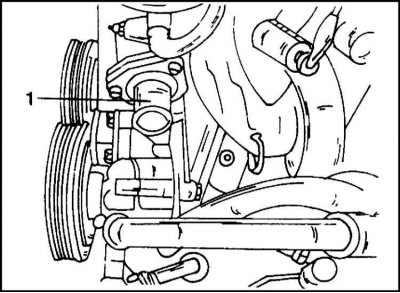
6. Disconnect the hose from the thermostat housing and from the fluid outlet pipe (1).
7. Remove the timing belt as described for the OHC engine.
8. Remove the timing belt tensioner roller (tightening torque 25 Nm).
9. Holding the crankshaft from turning (put the gear on), loosen the pulley mounting bolt (tightening torque 130 Nm + 40° to 50°, always replace the bolt with a new one). Remove the pulley (sits with great tension).
13 Disconnect the cables from the camshaft housing cover. Disconnect the two hoses and the housing cover (tightening torque 8 Nm).
10. Remove the timing gear from the camshaft by unscrewing the bolt (the shaft is held from turning by the hexagon). Bolt tightening torque 45 Nm.
11. Disconnect the camshaft position sensor cable from the inner shield, remembering its connection.
12. Loosen the mounting bolts and remove the protective cover from the oil pump and camshaft housing (tightening torque 6 Nm).
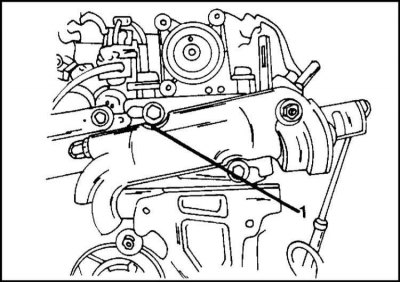
13. Now access to the thermostat housing (1) is free, as shown in the illustration. After unscrewing the mounting bolts, the housing is removed and a sealing ring is visible in the hole. This ring is always replaced, even if it does not appear to be damaged.
When replacing the thermostat housing, the temperature sensor (if he is ok) is screwed into the new housing (11 Nm). The water outlet pipe is secured with a tightening torque of 8 Nm (new sealing ring).
14. The thermostat housing is installed in the reverse order of its removal. Insert a new sealing ring into the hole and secure the housing with bolts. Tightening torque of bolts 15 Nm. Pay special attention to the generator mount:
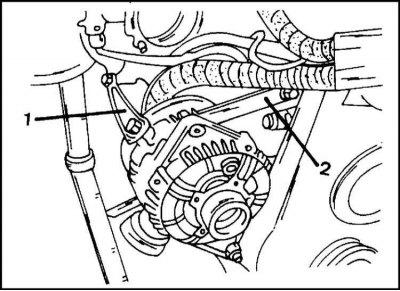
15. Support strips (1) and (2) in the illustration. are fastened with a torque of 18 Nm.
16. Tighten the lower mounting bolt to a torque of 35 Nm.
The thermostat cannot be repaired and must be replaced if damaged. A simple check of it is performed in the following way:
1. Hang the thermostat with the outlet pipe on a wire in a container with cold water.
2. Secure the thermometer in the same way.
3. Heat the water gradually and check if the thermostat starts to open at the temperature specified in Specifications and whether it opens completely. If this does not happen, replace the pipe and thermostat as a set.
DOHC Engine
The thermostat location here is similar to the thermostat location on an eight-valve engine (2.0L OHC engine). The difference is that the thermostat is located directly in the housing. To ensure warranty, the thermostat is supplied complete with a housing only.
1. Drain the cooling system (section Filling the cooling system coolant Chapters Routine care and maintenance). and disconnect the upper hose from the branch pipe on the thermostat housing.
2. Loosen the bolts and remove the thermostat housing with the sealing ring from the cylinder head. Clean mating surfaces thoroughly.
3. Install the new thermostat housing with thermostat and new sealing ring on the cylinder head and secure with bolts. Tighten the bolts to a torque of 15 Nm.
This engine has a flange attached to the cylinder head that is different from the other two attached hoses. The seal replacement is performed as follows:
4. Disconnect the ground cable from the battery.
5. Remove the V-belt as described.
6. Drain the cooling system (section Filling the cooling system coolant Chapters Routine care and maintenance)..
7. Disconnect both brackets from the exhaust manifold and generator. Loosen the lower generator mounting bolt and tilt the generator back.
8. Disconnect both hoses from the connecting flange and disconnect the flange itself. Clean the mating surface immediately.
9. Install the flange with a new seal on the cylinder head. Tighten the bolts to 15 Nm.
10. Reconnect the hoses and secure them with clamps.
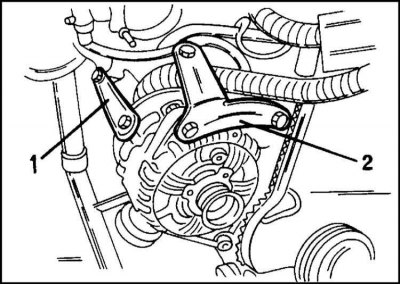
11. Set the generator to operating position. Tighten the mounting bolts of both supports (1, 2) to 20 Nm and the lower generator bolt to 35 Nm. The generator mounting for this engine is shown in the illustration.
12. Install the belt according to the instructions for this engine, connect the battery and fill the system with fluid.
Start the engine and after a while check the system for leaks.
Engine 2.4 l
1. Partially drain the cooling system as described in the section Filling the cooling system coolant Chapters Routine care and maintenance. The coolant level must be at least below the thermostat height.
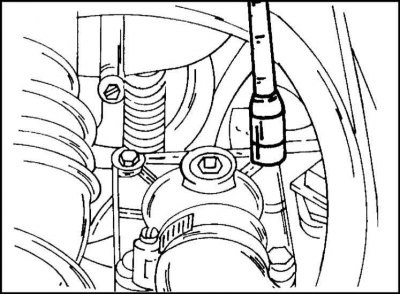
2. Loosen the thermostat housing mounting bolts (illustrated) and remove the cover. The thermostat is now free and can be removed. There is a rubber sealing ring above the thermostat.
The thermostat is installed in the reverse order of removal. The sealing ring is always replaced with a new one.
1. Tighten the cover mounting bolts to a torque of 6 Nm.
Finally, fill the cooling system with liquid as described in the section Filling the cooling system coolant Chapters Routine care and maintenance.
Visitor comments