
OpelBook.ru
Cars AvtoVAZ Cars Mitsubishi Cars BMW Cars Mercedes Cars Nissan Cars Toyota Cars Chevrolet
English Русский
Български
Беларускі
Український
Српски
Hrvatski
Română
Polski
Slovenský
Magyar
 |  Sitemap  |  Contacts  |    


Main Astra Corsa Insignia Kadett Omega Vectra Zafira Others Articles
Frontera A (1991-1998, petrol) Frontera B (1998-2004) Ascona C (1981-1988) Vivaro A (2001-2014)
  • Main
  • Opel
  • Ascona C
  • Transmission
  • Automatic gearbox
  • Automatic transmission — general description

Automatic transmission — general description (Opel Ascona C)

            0

The models in question may have an automatic transmission manufactured by General Motors, which has three forward gears, a reverse gear, and a kickdown device. As with a manual transmission, the differential and final drive are located in the transmission housing.

The main components of an automatic transmission are the torque converter, which transmits torque to the gear units via a chain drive, and the hydraulic circuit, which regulates the selection of gears, clutches and brakes in accordance with engine speed and load. The automatic transmission is a very precise mechanism and working with it requires absolute cleanliness. Dirt getting into the box can cause the valves to malfunction and possibly damage the internal parts of the box.

Considering the complexity of the box's design, at home you can only perform with it those operations that are indicated in the following sections. The box repair must be performed by a specialist.
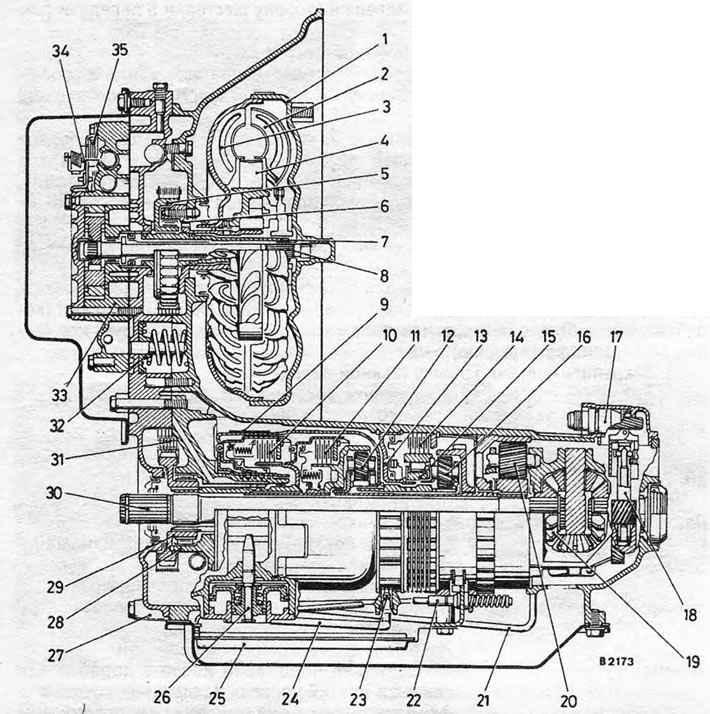
Figure 6.38. Automatic transmission type 125 TNM: 1. Torque converter; 2. Turbine wheel; 3. Pump…

Figure 6.38. Automatic transmission type 125 TNM: 1. Torque converter; 2. Turbine wheel; 3. Pump wheel; 4. Guide wheel; 5. Leading sprocket; 6. Sprocket holder; 7. Turbine shaft; 8. Oil pump shaft; 9. Brake band; 10. Direct coupling; 11. Forward clutch; 12. Input satellite carrier; 13. Clutch casing; 14. Low speed and reverse clutch; 15. Freewheel clutch; 16. Reactive planetary gear; 17. Tachometer drive gear; 18. Regulator; 19. Differential; 20. Axial drive; 21. Regulator hydraulic line; 22. Parking lock activation device; 23. Compaction; 24. Hydraulic line; 25. Transmission fluid filter; 26. Brake band servo unit; 27. Carter; 28. Driven sprocket holder; 29. Driven sprocket; 30. Axle shaft; 31. Chain drive; 32. Battery; 33. Pump with valves; 34. Downshift device; 35. Hydraulic line booster valve.


Original posted on the website [OPELBOOK.ru]


This article is available at russian, bulgarian, belarusian, ukrainian, serbian, croatian, romanian, polish, slovak, hungarian
Checking the article: Kornev Georgy

Share information:

Previous articles
Opel Ascona C: Automatic gearbox
Next articles

Automatic transmission — specifications
Automatic transmission — routine maintenance
Downshift Cable — Replacement and Adjustment
Gear Shift Lever Cable — Removal, Installation and Adjustment
Automatic transmission — removal and installation
Automatic transmission — fault diagnosis


See similar ones from other Opel car manuals:
▶ Automatic transmission repair — general information Opel Astra F (1991-1998, petrol)
▶ General information about automatic transmission Opel Corsa B (1993-2000)
▶ Automatic Transmission Overhaul — General Description Opel Omega B2 (1999-2003)
▶ General description of automatic transmission Opel Vectra A (1988-1995, petrol)
▶ Automatic transmission Opel Kadett E (1984-1995)
Link to this page in different formats

Visitor comments


No comments yet


How much will 12 + 45 =


Vivaro A (2001-2014) 
  • General information
  • User manual
  • Power unit
  • Petrol engine F4R
  • Diesel engine F9Q
  • Diesel engine G9U
  • Transmission
  • Clutch and drive shafts
  • Manual gearbox
  • Chassis
  • Front suspension
  • Rear suspension
  • Brake system
  • Body
  • Exterior
  • Interior
  • Electrical equipment
  • Heating and ventilation
  • Air conditioner
  • Equipment and devices
  • Electrical diagrams
Ascona C (1981-1988) 
  • General information
  • Maintenance
  • Power unit
  • Gasoline engines
  • Diesel engines
  • Cooling system
  • Fuel and exhaust system
  • Contact ignition system
  • Contactless ignition system
  • Transmission
  • Clutch
  • Mechanical gearbox
  • Automatic gearbox
  • Drive shafts
  • Chassis
  • Steering
  • Brake system
  • Car suspension
  • Body
  • Exterior
  • Interior
  • Doors and windows
  • Electrical equipment
  • Equipment and devices
  • Power devices
  • Electrical circuits
Frontera B (1998-2004) 
  • General information
  • User manual
  • Maintenance
  • Power unit
  • Petrol engines 2.2 l
  • Petrol engines 3.2 l
  • Diesel engines 2.2 l
  • Cooling system
  • Fuel system (petrol)
  • Fuel system (diesel)
  • Ignition system
  • Transmission
  • Clutch
  • Manual gearbox MUA5C
  • Automatic gearbox 4L30E
  • Chassis
  • Suspension and axles
  • Steering
  • Brake system
  • Body
  • Exterior
  • Interior
  • Doors, locks and windows
  • Heating and air conditioning
  • Electrical equipment
  • Power devices
  • Equipment and devices
  • Lighting and signaling
  • Electrical diagrams
Frontera A (1991-1998, petrol) 
  • General information
  • Introduction to guide
  • User manual
  • Maintenance
  • Power unit
  • Engine repair
  • Lubrication system
  • Cooling system
  • Power and exhaust system
  • Engine electrics
  • Transmission
  • Clutch
  • Mechanical gearbox
  • Cardan shafts
  • Chassis
  • Brake system
  • Front suspension
  • Rear suspension
  • Steering
  • Body
  • Repair and care
  • Electrical equipment
  • Equipment and devices
  • Electrical circuits
OpelBook.ru © 2017–2026 · Mobile version · · Sitemap: EN BG BY UA RS HR RO PL SK HU · Feedback · Site search
Astra F, petrol · Astra G, petrol · Astra G · Astra H · Astra J, petrol · Corsa B · Corsa C, petrol · Corsa C · Insignia A · Kadett D · Kadett E · Omega A · Omega B · Omega B2 · Vectra A, petrol · Vectra A · Vectra B, petrol · Vectra B · Vectra C · Zafira A, petrol · Frontera A, petrol · Frontera B · Ascona C · Vivaro A ·
We want your visit to be comfortable 🤝! We use cookies 🍪 to make that happen.