


Note: If it becomes necessary to tow a vehicle with a working transmission, tow it forward only (transmission in position N), on four wheels, for a distance of no more than 100 km at a speed of no more than 80 km/h. If the transmission is suspected of being faulty or if it is necessary to tow the vehicle a considerable distance (or at high speed), the vehicle must be towed on the rear wheels only.
1. The transmission unit includes a torque converter and two epicyclic gear assemblies, which are hydraulically controlled by multi-plate clutches and brake bands. The final drive differential is similar to that described in Section 7A. The fluid temperature is regulated by an additional transmission fluid cooling radiator installed on the radiator.
2. Electrically controlled gear shifting activates the 3rd and 4th gear locking mechanism and provides several driving modes and sub-modes, selectable according to road conditions and driver preference.
3. The gear shift moment is determined automatically by the electronic control unit (ECU), based on data from various sensors (transmission fluid temperature, input and output shaft torque, engine coolant temperature, gas pedal and valve position, etc.) and changes depending on the selected driving mode (see illustration). The ECU is located behind the glove box or behind the driver's footwell trim panel.
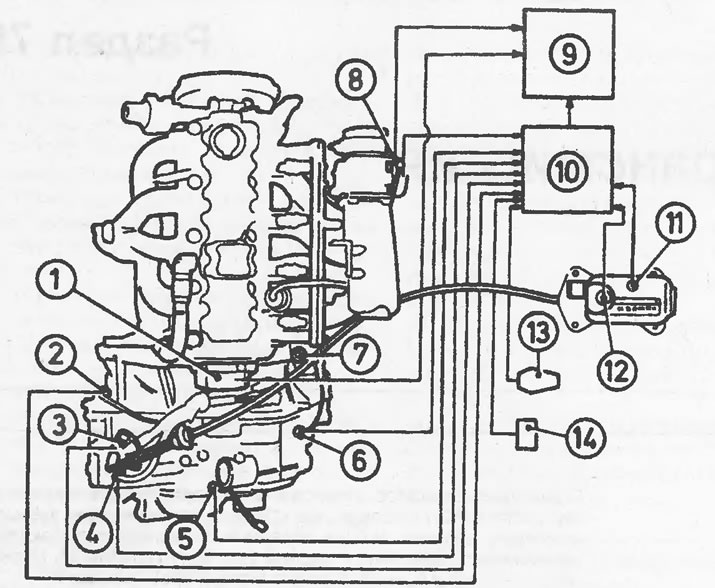
1.3 Electrical system of the automatic transmission control unit AF 14/20 - version with ignition/fuel injection system Motronic
1 Distributor
2 Transmission fluid temperature sensor
3 Starter blocker
4 Connection of electromagnetic pressure control units
5 Input shaft rotation sensor
6 Output shaft speed sensor
7 Speedometer drive wiring connection
8 Throttle position sensor
9 Motronic Block
10 Automatic Transmission ECU
11 Submode button "Winter"
12 Sub-mode button "Economy/Sport"
13 Downshift mechanism
14 Brake light switch
4. The ECU controls the transmission via four electromagnetic units that regulate fluid pressure, which allows or shifts gear (electromagnetic blocks 1 and 2), or control the operation of the transformer clutch (electromagnetic block 3), or match the fluid pressure to the throttle position (electromagnetic block 4).
5. The ECU also reduces the ignition timing during gear shifting (to ensure switching accuracy) and turns off the air conditioner (where is it used), if its operation interferes with the operation of the system. In addition, the ECU has a self-diagnosis function that turns on a special control lamp if problems occur in the system.
6. Driving mode "D" has the following submodes:
7. "Economical" - turns on automatically when the engine starts. When the ignition is turned on, the control lamp on the panel lights up, which then goes out. The sub-mode uses all four gears, including the accelerating 4th. Gear shifting is performed at low engine speeds for maximum smoothness and economy.
8. "Sport" - is activated by pressing the "S" button at the top of the gear selector lever (the control lamp on the panel will light up). Submode blocks (electrically)4th gear. Gear shifting is performed at higher engine speeds. To exit the sub-mode, either press the button again, or turn the ignition off and on again, or activate the self-diagnostic system (on the move), or switch to the "Winter" sub-mode.
9. The "Winter" sub-mode (also known as "Start assist") is activated by pressing the button with the symbol located at the base of the gear selector lever.
This sub-mode locks 1st and 2nd gears so that the car can move off smoothly (in 3rd gear) on slippery roads. Switching to the "Economy" sub-mode can be done in several ways: press the button again, move the gear selector lever to another position, turn the ignition off and on again, hold the gas pedal fully depressed for more than two seconds, activate the self-diagnosis system (while driving) or increase the speed to 80 km/h.
10. The transmission and its control unit are a very complex system, but if the transmission is used correctly, it will serve reliably and for a long time. Repair and overhaul of the transmission cannot be performed by most dealers, let alone by the car enthusiast. However, the dealer can test the electrical system of the control unit using special Opel diagnostic equipment. Therefore, this Chapter is limited to service procedures that can be performed by the car enthusiast. Overhaul, troubleshooting, or any repair work should only be entrusted to a suitably equipped Opel dealer.
11. Models equipped with the X20 XEV engine have a modified ECU. One of the changes is a downshift lock that prevents the transmission from "D" to "3" at speeds above 194 km/h.
Material copied from this portal (OPELBOOK.ru)
Visitor comments