


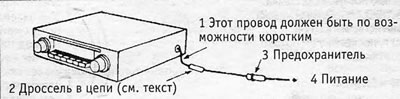
Figure 12.83. Interference suppressor installed on a Bosch generator
In order to get rid of extraneous unwanted noises, there is no need to incur large expenses and spend a lot of effort, as some people think. With a little common sense and patience, and by following the instructions below, you can virtually eliminate the effects of interference.
The first reason is the generator. The noise it produces in the receiver resembles the operation of an electric mixer, and this noise increases with increasing speed (if you want to get proof of this, you can remove the drive belt and try what happens). The remedy for this is quite simple: connect a capacitor of 1.0 µF to 3.0 µF between ground and the large (B+) terminal of the generator. The last remark is very important, because if you connect it to a small contact, you have the possibility of ruining the generator forever.
The second most common cause of electrical interference is the ignition system. Here you need to connect a 1.0 μF capacitor between the ground and the "SW" or "+" contact on the coil. This will help stop the tick-tick-tick sounds coming from the speaker. Next come the candles themselves. High voltage wires already have an interference suppression system, so it is not recommended to do anything else with them. Do not insert suppression caps or cut wires to install suppression in the circuit.
At this stage it is advisable to check that the radio is well grounded, and also that the antenna is well grounded and its plug is properly inserted in place, and that the radio is properly tuned (see previous Section). Also, make sure the battery cable is as short as possible and is not hanging all over the vehicle. It would be a good idea to check that the correct fuse is being used. For most receivers this should be a 1 - 2 amp fuse.
Now most of the causes of interference have been eliminated. If the problem still exists, check out the causes of inertia in general, which can help you figure out what exactly is interfering in your particular case.
The radio receiver receives electromagnetic waves from the air; some of these waves are sent by radio stations and other transmitters, and some, unwanted ones, are sent by the car itself. These home-grown signals are generated by extraneous electrical discharges occurring around the vehicle. Typically, the sources of such signals are electric motors; i.e. windshield wiper motor, washer motor, power window, heater fan or antenna motor. Other sources of interference may include turn signals and instruments. Direction indicators are usually not suppressed. In recent years, receiver manufacturers have been including a choke in the power supply circuit in addition to a fuse. If your installation does not have one, you can insert it (see Figure 12.84).
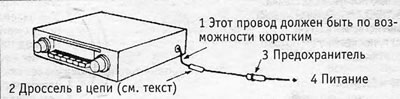
Figure 12.84. Choke in the receiver circuit
All the above mentioned components can be purchased at auto stores. For a transistor receiver, a 2-amp choke is adequate. If you have an electric clock, its effect can be suppressed by adding a 0.5-µF capacitor as shown for the motor in Figure 12.85.
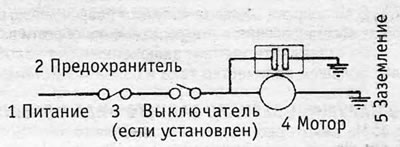
Figure 12.85. Electric motor suppression
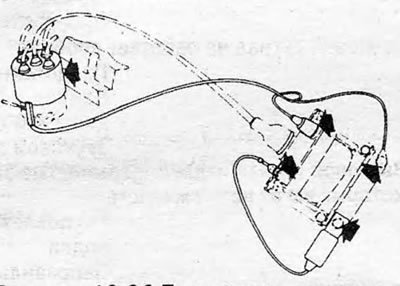
Figure 12.86 Ignition coil suppressor and distributor shielding - indicated by arrows
If interference still exists after you have taken all of the above measures, first evaluate how much of a nuisance it is causing you, as the human ear can easily become deaf to unwanted noise. However, if you are determined to eliminate the noise completely, proceed as follows.
Some "experts" suggest installing a screen between the receiver and the engine. Of course, it won't hurt, but if the entire receiver is shielded and interference still exists, it's unlikely that a piece of aluminum foil will make much of a difference.
A more sensible approach would be to shield the wires if you determine that the interference is coming from them. First, examine the power supply wire: interference may occur between the receiver and the choke (that's the reason why the power cord should be as short as possible). In this case, you can shield the wire - and here you need to buy a shielded wire and install it. It is also possible to install shielded wires leading to the speakers, although interference from these is highly unlikely.
Without a doubt, the main source of interference is the high voltage ignition wires, even if they have been protected. The best way to combat this is to install special sleeves over them. Since this is not practical, one can simply place an aluminum shield over the wires.
And finally, about the most severe cases. There are some methods you can try. Where metal meets metal, there may be strong electrical excitation, so it is very important to ensure a good connection. The cases in which noise from metal surfaces contact most often occurs are listed below (in descending order of influence) — and you can get rid of them by tying up and securing, if possible, the moving parts:
- (a) Muffler and body
- (b) Exhaust pipe and engine block or body
- (c) Air cleaner and body
- (g) Front and rear bumpers and body
- (d) Steering column and body
- (e) Hood and trunk lid and body
These reasons mainly occur when the engine is idling or under load. Although the moving parts are already secured with nuts, bolts, etc., they tend to rust and corrode, thus forming a stubborn source of interference.
If you hear a muffled pulsating sound when your vehicle is moving, it may be caused by static discharges in the wheel or tire. This can be eliminated by purchasing an antistatic agent and treating the inner surface of the tires with it.
In conclusion, it should be noted that it is all relatively simple and therefore inexpensive to get rid of 95 percent of the noise, but getting rid of the remaining 5 percent is much more difficult and will require certain funds. It is up to the owner to decide whether to take such measures. Also please remember that it is simply impossible to get concert sound from a cheap receiver.
Finally, tape recorders are mentioned at the beginning of this Section: they are usually not affected by interference, but in very severe cases the best recommendations are the first three sentences plus the use of a 3 to 5 amp choke in the power supply cable, and shielding of the power and speaker cables.
Note: If your vehicle is equipped with electronic ignition, it is not recommended to install resistors on the spark plugs and a capacitor on the coil, as they may damage the system. Most electronic ignition systems have built-in suppression and therefore should not cause interference.
Article posted on a web portal www.OpelBook.ru
Visitor comments