


The hub bearings are of the double-row ball type.
The rear suspension is of the semi-independent type and has a torsion bar and closing arms with mini-block coil springs and telescopic shock absorbers.
Wheels can be made of stamped steel or light alloy depending on the model.
Some models are equipped with a level control system, which is described in this Chapter.
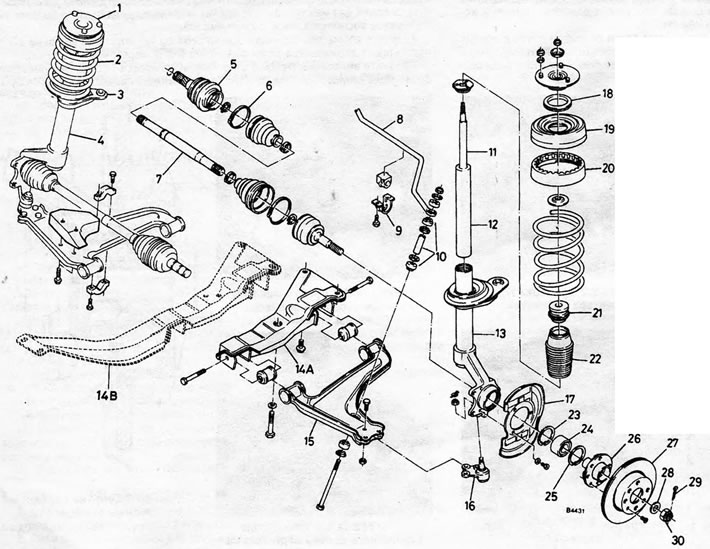
Figure 10.1 — Front suspension components (disassembled). 1. Upper support of the rack.; 2. Spiral spring.; 3. Steering bracket.; 4. Suspension strut.; 5. Outer joint of the drive shaft and short axle.; 6. Bellows clamp.; 7. Drive shaft.; 8. Anti-roll rod.; 9. Anti-roll bar clamp.; 10. Link of the end of the anti-roll bar.; 11. Rack spindle.; 12. Rack cartridge.; 13. Strut tube with short axle holder.; 14A. Control bracket support (short type).; 14V. Control bracket support (long type).; 15. Control bracket.; 16. Ball joint of the control bracket.; 17. Disc shield.; 18. Upper strut bearing.; 19. Flexible support insulator.; 20. Upper spring seat.; 21. Spring recoil stop.; 22. Bellows.; 23. Spring ring.; 24. Inner bearing.; 25. Spring ring.; 26. Hub.; 27. Disc.; 28. Thrust gasket.; 29. Cotter pin.; 30. Toothed nut.
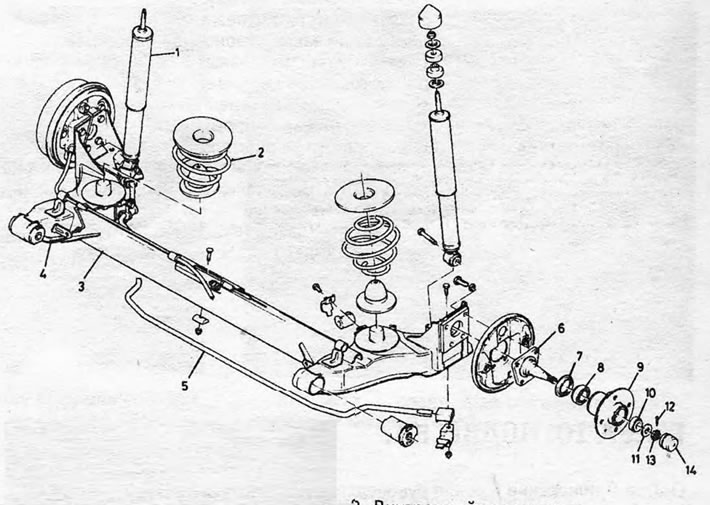
Figure 10.2 — Rear suspension components (disassembled): 1. Shock absorber.; 2. Spiral spring.; 3. Bridge crossbar.; 4. Closing link.; 5. Anti-roll rod.; 6. Short axle.; 7. Oil seal.; 8. Inner bearing.; 9. Hub.; 10. Outer bearing.; 11. Thrust gasket.; 12. Cotter pin.; 13. Toothed nut.; 14. Dust cap.
[Original source on the website OpelBook]
Visitor comments