


Contents: Heating and ventilation system ⬇ Air conditioning system (A/C) ⬇ Safety precautions when servicing…⬇
Heating and ventilation system
7. The main components of the interior heating system (see accompanying illustrations 1.7a and 1.7b) are an electric fan with several speed modes and a heat exchanger placed in a box-shaped heater casing, fixed under the car's dashboard. The heat exchanger is connected to the engine cooling system by means of hoses. The control unit for the heater/air conditioner is mounted in the car's dashboard. The coolant heated in the engine circulates through the heater's heat exchanger, giving off its heat to the air filling the casing. When the interior heating is turned on, the plate damper opens, as a result of which the internal volume of the heater casing is connected to the volume of the interior. When the fan is turned on, the impeller of the latter begins to drive the air supplied to the interior through the heat exchanger, providing its intensive heating. Air leaves the interior through the ventilation openings in the rear of the car (see illustration 1.7c).
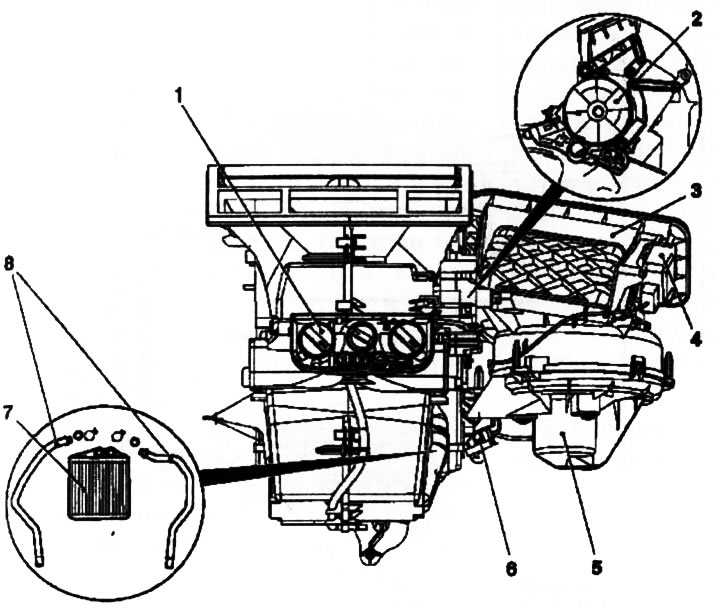
1.7a. Basic Elements of an HVAC System (without climate control): 1. Heater/Air Conditioner (HVAC) Control Panel; 2. Electric motor for air flow distribution control drive; 3. Air circulation system damper housing; 4. Electric motor for driving the circulation damper; 5. Fan electric motor; 6. Resistive assembly of the fan electric motor; 7. Heat exchanger; 8. Heater hoses
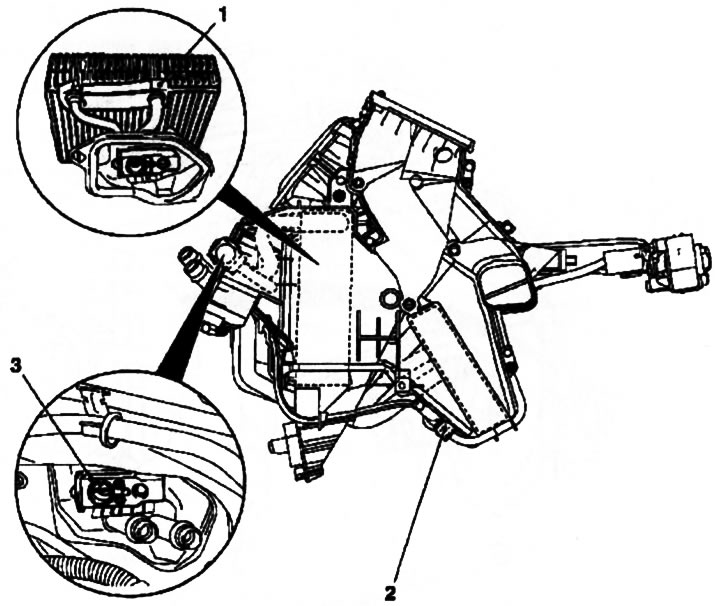
1.7b. HVAC system components: 1. Evaporator; 2. Air distributor assembly wiring connector; 3. Expansion valve
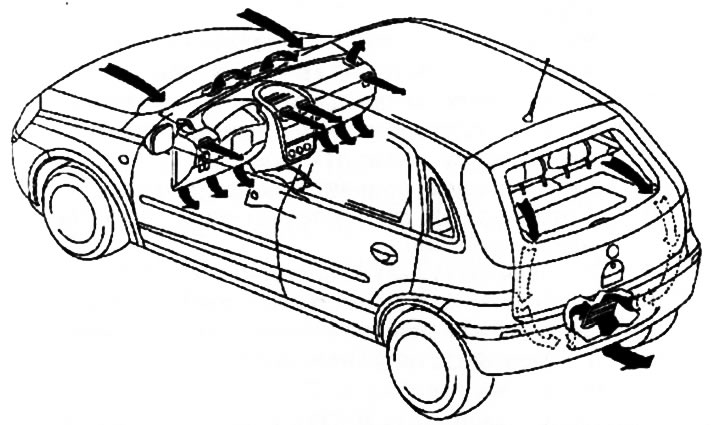
1.7s. Corsa C interior ventilation diagram
Note: If necessary, the interior air circulation mode can be activated on models with the corresponding configuration.
8. Air is supplied to the passenger compartment through the face-level deflectors, footwell nozzles and windshield blower deflectors (see accompanying illustration). Before air enters the cabin, it is cleaned by a dust filter.
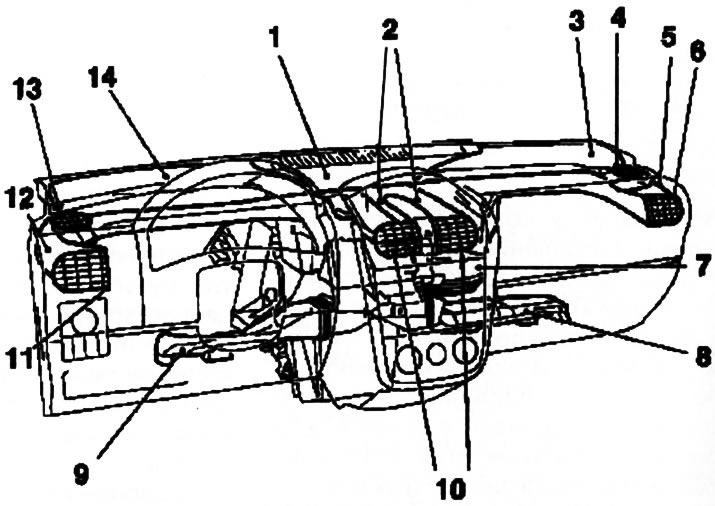
1.8. Air supply hoses to the cabin: 1. Windshield air supply hose; 2, 5, 12. Air supply hoses to the face level deflectors; 3, 14. Side sleeves; 4, 13. Upper side deflectors for blowing side windows; 6, 11. Side deflectors of the front level; 7. Fan electric motor; 8. Air supply hose to the passenger footwell; 9. Air supply hose to the driver's foot well; 10. Central front level deflectors
9. Diesel models can be equipped with an additional nozzle-type heater. It is installed behind the front bumper on the driver's side. The coolant passes through the heat exchanger of the additional heater and is heated, thereby reducing the warm-up time of a cold engine and increasing the efficiency of heating the passenger compartment. The additional heater is activated after starting the engine at low outside temperatures and/or if the diesel engine gives off too little heat to warm the passenger compartment.
10. Messages about malfunctions in HVAC systems are recorded in the ECM electronic memory unit and can be read by connecting a special scanner - accurate diagnostics without the above device is impossible.
11. The rules for using the controls for the operation of HVAC systems are described in detail in the Chapter "Controls and Operating Techniques".
Attention: If, as part of the work on the heater, work is also carried out on electrical equipment, it is necessary to disconnect the battery (see Chapter 5).
Air conditioning system (A/C)
12. At the owner's request, the car can be equipped with an air conditioner. The air conditioner is installed as a single system with the heating system and together with it ensures the maintenance of the set air temperature in the cabin.
13. The air conditioning system consists of a condenser installed on the radiator of the cooling system, an evaporator located next to the heater heat exchanger, a compressor mounted on the engine block, and a receiver-dryer (battery), equipped with a high-pressure reducing valve. All components are interconnected by refrigeration lines (see accompanying illustration). The compressor is driven from the crankshaft by means of a multi-rib belt.
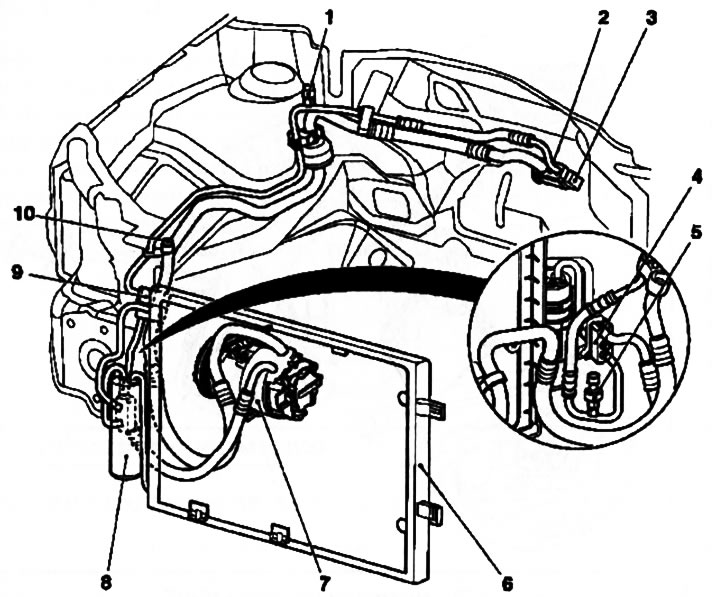
1.13. General arrangement of the air conditioning system elements in the engine compartment: 1. High pressure circuit service connector; 2. Connector; 3. Expansion valve; 4. Refrigeration line divider (air conditioner); 5. Pressure switch sensor; 6. Capacitor; 7. Compressor; 8. Receiver-dryer; 9. Refrigeration line divider; 10. Low pressure circuit service connector
14. The operating principle of the air conditioning system is shown schematically in the accompanying illustration. In cooling mode, the air conditioner operates on the principle of a refrigerator: the compressor compresses the gaseous refrigerant (R 134 A, freon-free), whereupon the refrigerant heats up and is directed to the condenser, where it cools and liquefies. Passing through the expansion valve, the refrigerant expands and enters the evaporator, turning into steam - a process accompanied by strong heat absorption.
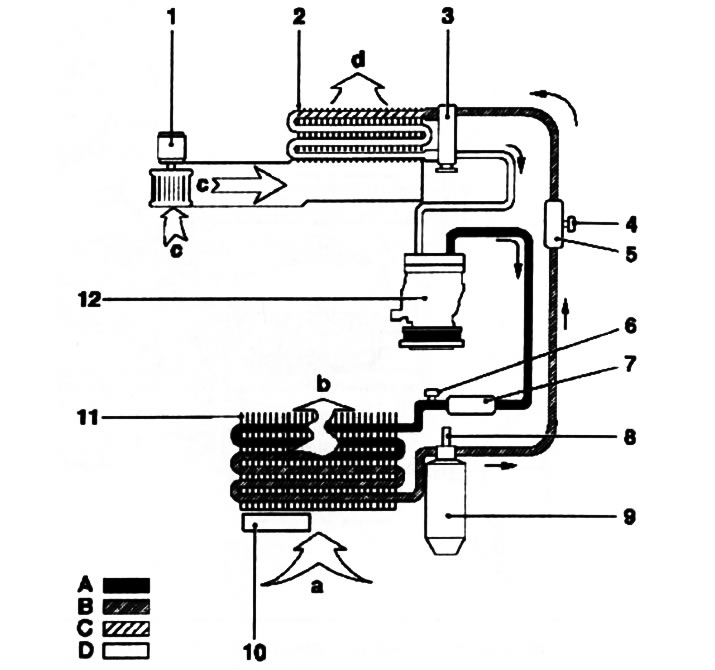
1.14. Functional diagram of the K/V system: 1. Fan; 2. Evaporator; 3. Expansion valve; 4. Low pressure circuit service connector; 5. Pulsation damper; 6. High-pressure circuit service connector; 7. Pulsation damper; 8. Pressure switch sensor; 9. Receiver-dryer; 10. Additional fan; 11. Capacitor; 12. Compressor; a. Inlet flow of cold air passed through the condenser heat exchanger; b. The output flow of heated air, driven through the condenser heat exchanger and having removed heat from the refrigerant; c. Air flow created by a fan; d. Air flow through the evaporator heat exchanger; A. Gas phase of the high-pressure circuit; B. Liquid phase of the high-pressure circuit; C. Liquid phase of the low-pressure circuit; D. Gas phase of the low-pressure circuit
15. The fan drives the air entering the passenger compartment through the evaporator heat exchanger. Due to the process of evaporation and expansion of the refrigerant, heat is absorbed from the air flowing around the evaporator. The air is cooled and the resulting moisture turns into condensate, which is directed outside the passenger compartment. The intensity of the cooling process depends on the set temperature and the setting of the fan switch.
16. At the user's request, the air conditioning system can be switched off, which switches off the compressor and, in vehicles with a diesel engine, also switches off the additional heating element - which significantly reduces fuel consumption.
17. An HVAC system with automatic temperature control can be installed as an option (climate control). The automatic operation mode ensures that a constant temperature selected by the user is maintained in the passenger compartment and dehumidifies the air entering the passenger compartment. In addition, the amount and distribution of air supplied to the passenger compartment are automatically regulated, and fluctuations in outside temperature are compensated. When the economy mode (ECO) is activated, the air conditioner is switched off, but the heating and ventilation systems continue to operate in automatic mode.
18. The rules for using the controls for the operation of heating, ventilation and air conditioning systems are described in detail in Chapter "Controls and operating techniques".
19. Lubrication of the moving parts of the air conditioning system is provided by the components contained in the refrigerant and its regular circulation, which prevents the formation of pores in the seals and the occurrence of corrosion. Therefore, even if there is no need to use the air conditioner, especially in the cold season, it should be turned on at least once a month for a short time at the highest power. Turning on should be done at a uniform speed of the car and with a warmed-up engine.
Warning: Air conditioning work should only be performed by service station specialists. For this reason, air conditioning repair is not described here! Do not open the refrigerant circulation circuit, since the refrigerant may cause frostbite if it comes into contact with the skin!
Safety precautions when servicing the air conditioning system
The A/C system must be serviced only by trained technical personnel who are trained in safe operation techniques, proper equipment, and depressurization procedures, as well as familiar with the methods of collecting and storing automotive refrigerant.
- Avoid contact of refrigerant with skin;
- Wear safety glasses when working near the A/C system;
- If refrigerant gets on your skin or in your eyes, do not rub the affected area. Immediately rinse the affected area with cold water for at least 15 minutes. Immediately seek medical attention at a medical facility. Self-medication is not allowed;
- The refrigerant is stored in cylinders under pressure. Store the cylinder at a temperature not exceeding +50°C. Take measures to prevent the cylinder from falling from a height or other situations that may lead to its damage;
- Work should be carried out in a well-ventilated area. The refrigerant is colorless and odorless, evaporates quickly, reduces oxygen access and makes breathing difficult;
- The gaseous refrigerant is heavier than air and should collect relatively quickly at a low level, such as under a car;
- When refrigerant burns, toxic gas is formed. Keep refrigerant away from open sources of fire. Do not smoke when working on the A/C system;
- When welding near the A/C system, do not expose it to high temperatures or open flames. Overheating may cause the system to become pressurized and ignite;
- Cleaning the condenser or evaporator with water vapor is not permitted. Only cold water or compressed air should be used.
Visitor comments