


Contents: Examination ⬇ Replacement ⬇
Examination
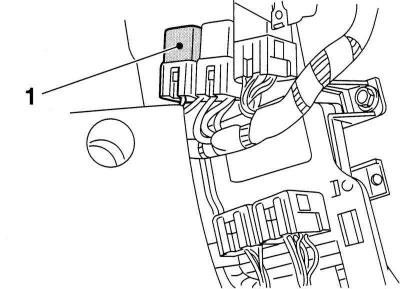
The fuel pump relay is located in the footwell, behind the right C-pillar cover adjacent to the front passenger door. The relay provides power to the electric fuel pump and interrupts power supply if there are no ignition pulses when the ignition is off (the engine stalls).
If it is necessary to turn on the fuel pump for testing purposes with the engine off, disconnect the relay and short-circuit terminal 30 (thick red wire) and terminal 87 (red-blue wire) between each other with a short wire. To check the fuel pump relay, the battery must be charged.
1. On 1.2 and 1.4 l engines with 45 and 60 hp. accordingly, temporarily switch off the ignition. The fuel pump should operate for 2 s.
2. Check fuse #26 in the fuse box.
3. Disconnect the relay (1) First remove the pocket on the front passenger side under the instrument panel, as well as the side trim of the A-pillar.
Relay location
4. Connect a voltmeter to terminals 30 () and 85 (-) at the location of the relay. The voltage between them should be approximately 12 V.
5. Otherwise, connect a voltmeter between terminal 30 of the relay and the negative terminal of the battery. If the voltmeter does not show a voltage of approximately 12 V, check the integrity of the wire of terminal 85 (see Chapter On-board electrical equipment) or check the red wire. Replace the wire if necessary.
6. Turn on the ignition. If there is no 12V voltage at terminal 86 (), check the integrity of the black wire. Replace the wire if necessary.
7. Short-circuit terminals 30 and 87 with a short wire. If the pump works, replace the pump relay. Otherwise, check the red-blue wire going to the fuel pump. Replace the wire if necessary.
8. If the wires are intact and current flows, replace the fuel pump.
Checking the performance of the fuel pump
1. Relieve fuel pressure.
2. On 1.2 and 1.4 liter engines with 45 and 60 hp respectively disconnect the fuel supply hose (1) to the injection unit and direct the hose into a container with a capacity of approximately 2 l.
Fuel supply hose
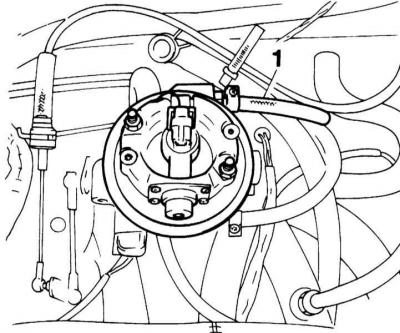
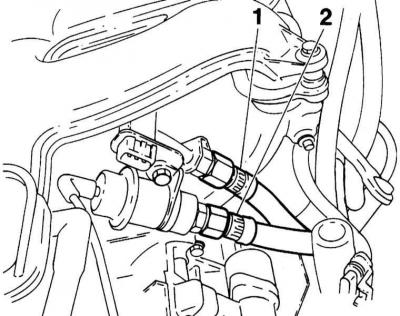
3. On 1.4 and 1.6 l engines with 82 hp and 1.0 and 1.2 l DOHC engines disconnect the fuel supply hose (1) from the fuel line and direct the hose into a container with a capacity of approximately 2 liters. Disconnect the hose from the fuel pressure regulator and close it.
Fuel supply (1) and return (2) hoses
4. Disconnect the fuel pump relay wiring.
5. Connect terminal 30 from the relay base (thick red wire) and terminal 87 (red-blue wire) turn on the fuel pump for one minute. At 12 V, the pump should supply approximately 1.4 l/min.
6. If the performance is low, replace the fuel filter and check the pump performance again. If the check result is negative, replace the fuel pump.
7. Put on the fuel hose and secure it with a clamp or union nut. If the vacuum hose was removed from the pressure regulator, put it on.
Replacement
The fuel pump is located under the rear seat, directly in the fuel tank. On a diesel engine, the fuel pump is built into the injection pump.
On CORSA COMBO vehicles, the fuel tank must be removed to remove the fuel pump. Before removing the fuel pump, the fuel tank must be completely emptied to prevent fuel leakage. To do this, either drive the vehicle until the fuel runs out or pump out the fuel through the filler neck using a pump that has explosion protection.
Ensure that your work area is well ventilated. Follow safety rules when working with gasoline!
1. Relieve fuel pressure.
2. Disconnect the negative cable from the battery.
3. Fold down the rear seat.
4. Fold back the mat.
5. Use a screwdriver to pry off the plastic cover on the bottom of the car body.
[Material provided by this website: www.OpelBook.ru]
6. Disconnect the connector (1).
Connector (1) and fuel lines (2) of the fuel pump
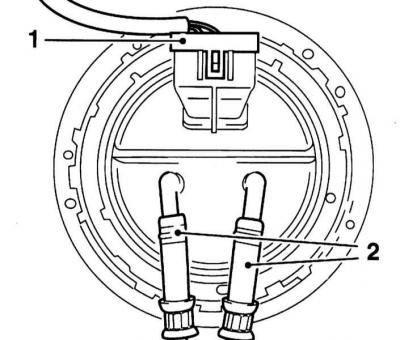
7. Mark the fuel lines (2) with tape and disconnect them from the corresponding fittings (refer to illustration). To do this, loosen the clamps with a screwdriver or cut them.
Before disconnecting the hoses, place plenty of rags in the appropriate places to collect any leaking fuel.
8. To prevent fuel from leaking, you can also plug the hoses. You should also close the fittings to prevent dirt from getting into the system.
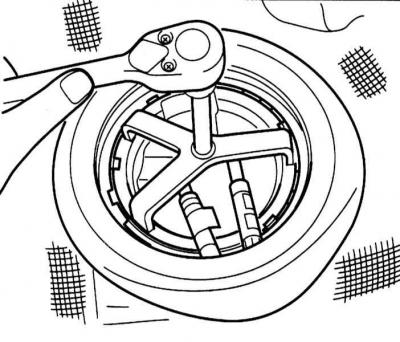
9. Open the fuel pump lock. For this, you can use the special tool KM-797. If you do not have this tool, place a corresponding plastic wedge at the groove of the locking ring and open the clamp by lightly hitting the wedge with a hammer.
Opening the fuel pump lock
Do not use a metal wedge for this purpose to avoid the risk of sparks!
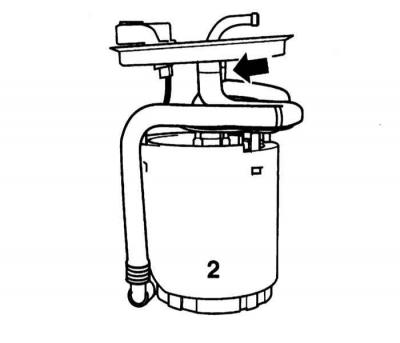
10. Disconnect the fuel return hose (arrow) from the fitting.
Fuel return hose
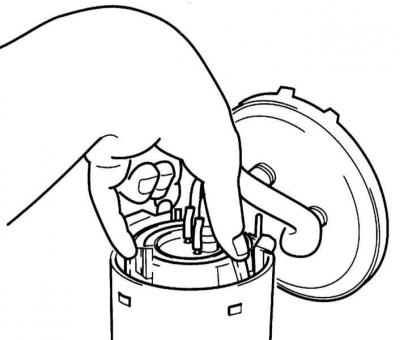
11. Squeeze the three locking tabs with your hands.
Pump body locking tabs
12. Use a hook to remove the pump body from the tank and wipe off any dripping fuel with a rag.
Removal the pump

If there is any damage to the fuel pump equipped with a filter mesh, the mesh must also be replaced. Damage and contamination of the fuel pump mesh can cause malfunctions in the fuel pump.
13. Installation is carried out in the reverse order of dismantling the components.
14. After installation, start the engine and check the pump operation and for leaks.
Visitor comments