


Contents: Operating principle of frontal…⬇ Operating principle of side airbags ⬇ The operating principle of head…⬇
Operating principle of frontal airbags
The front airbag modules are mounted in the steering wheel hub and in the right side of the instrument panel, directly above the main storage compartment (see illustration 13.1a).
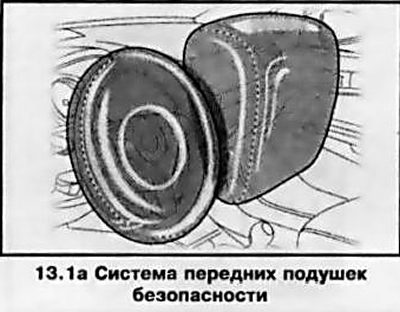
Directional G-force sensors respond to acceleration exceeding a certain limit value, which may occur during a severe frontal collision.
Note: Front airbag deployment may also occur in other types of collisions where the loads sensed by the sensors are comparable to those experienced in a severe frontal collision.
The SRS control unit activates the airbag gas generators based on the sensor signal, causing them to instantly fill up. In case of minor collisions and vehicle rollovers, as well as side and rear impacts, the front airbags should not deploy, which once again confirms the need to use seat belts.
[The source is on the online website OpelBook.ru]
During a collision, the seat belt keeps the lower part of the occupant's body from moving. The front airbags take on and absorb most of the impact energy, helping to prevent injury to the driver and front passenger as a result of their head and chest hitting the steering wheel/dashboard, and reducing the severity of injuries sustained in an accident. However, the deployment of the airbags themselves can cause abrasions and other minor injuries to the face.
Directional overload sensors determine the severity of the collision depending on the characteristics of the obstacle. When colliding with a stationary, non-deformable obstacle (for example, a curb, a pole, etc.) airbags deploy at lower speeds than in a collision with a moving deformable obstacle (for example with another car).
Note: This feature is only available for front airbags.
Since the signals for the deployment of both front airbags are sent to the SRS control unit from the same sensors, their deployment also occurs simultaneously. However, it is possible that the module of only one of the airbags will be initiated - this becomes possible when the magnitude of the directional overloads that arose during the collision was on the edge of the sensitivity range of the sensors. In this case, the seat belts provide sufficiently reliable protection for the driver and front passenger, while the effect of the airbag deployment will be minimal.
The inflation of airbags is accompanied by a loud bang and the release of smoke. Smoke is not a sign of a fire and does not have a harmful effect on the human body. In fact, it is a suspension of fine powder, which is usually sprinkled on the folded airbag shells. People with respiratory diseases may experience some discomfort and irritation from the gaseous products contained in the air, emitted by the airbag gas generators - they should leave the car as soon as possible and go out into the fresh air.
Caution: To avoid burns, do not touch the SRS system components immediately after the airbags have deployed!
Immediately after the airbags are triggered and perform their functions, the gas is released from them, which allows the driver to maintain visibility and freely manipulate all vehicle controls.
The entire duration of the process from the moment the overload sensors send a signal to the release of gas from the cushions takes no more than a tenth of a second. The modules are triggered so quickly that the human ear is simply unable to perceive the pop of the gas generators when filling the cushions.
On models equipped with the front passenger seat occupancy recognition system (see below), the corresponding front airbag will not deploy in the event of a collision if there is no passenger present. It will also be deactivated if a special Opel child seat equipped with integrated transponders (see below) is installed in the front seat.
Operating principle of side airbags
Side airbags (see illustration 13.1b) are designed to provide additional protection for the driver and front passenger in the event of severe side impacts. In the event of minor impacts, when the vehicle rolls over, or in frontal or rear impacts, the side airbags should not deploy.
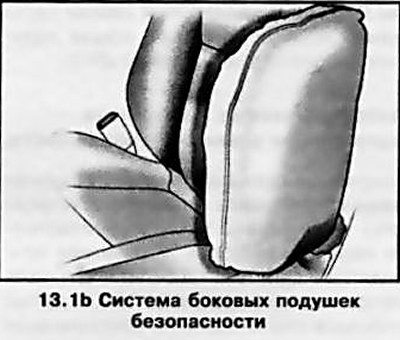
Note: Sometimes the side airbags may deploy in other types of collisions when the loads sensed by the sensor are comparable to those caused by a severe side impact.
In the event of a severe side impact, the airbag installed on the seat from which the impact was received will be deployed. The operating principle of the side airbags is completely analogous to the operating principle of the front airbags.
Warning: Using front seat covers may cause SRS to malfunction in the event of an accident! Only special covers designed specifically for this model may be installed - contact your authorized Opel dealer!
On models equipped with a front passenger seat occupancy recognition system, the corresponding side airbag will not deploy in the event of a collision if there is no passenger present. It will also be deactivated if a special child seat equipped with built-in transponders is installed in the front seat (see below).
The operating principle of head airbags
Head airbags (curtains) (see illustration 13.1c) are designed to provide additional protection for the driver and passenger's heads in the event of severe side impacts. They are deployed together with the side airbags. In the event of a severe side impact, the airbag installed on the side that was hit will be deployed.
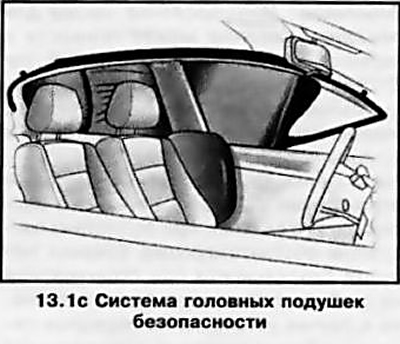
The operating principle of head airbags is completely analogous to the operating principle of front airbags.
On models equipped with the front passenger seat occupancy sensing system, the head airbags deploy even if the front passenger side airbag is deactivated.
Visitor comments