
OpelBook.ru
Cars AvtoVAZ Cars Mitsubishi Cars BMW Cars Mercedes Cars Nissan Cars Toyota Cars Chevrolet
English Русский
Български
Беларускі
Український
Српски
Hrvatski
Română
Polski
Slovenský
Magyar
 |  Sitemap  |  Contacts  |    


Main Astra Corsa Insignia Kadett Omega Vectra Zafira Others Articles
Frontera A (1991-1998, petrol) Frontera B (1998-2004) Ascona C (1981-1988) Vivaro A (2001-2014)
  • Main
  • Opel
  • Frontera A
  • General information
  • User manual
  • Airbags

Airbags (Opel Frontera A)

            0

In the center of the steering wheel of a car equipped with a driver's airbag there is an…


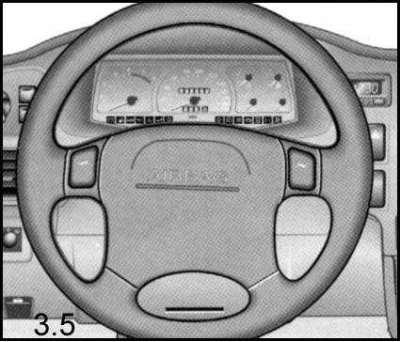
In the center of the steering wheel of a car equipped with a driver's airbag there is an inscription AIRBAG.

If there is a front passenger airbag, a similar inscription is placed on the instrument panel above the glove compartment.

The system includes airbags with gas-filled cylinders located in the steering wheel and instrument panel of the car, an electronic control unit with a shock sensor and a control lamp on the instrument panel

The airbag is initiated during a strong frontal impact of the vehicle, the vector of which is in the sector 30 from the center line. If the car hits a hard obstacle, the airbags are activated even at low speeds. To deploy the airbags after a collision with a deformable obstacle (for example, another car) the speed of the vehicle must be high enough.

Note: In view of the above, the criteria that determine the deployment of the airbag system are the direction and nature of the impact, as well as the rigidity of the vehicle structure and the obstacle it encounters, and in no way the damage sustained by the vehicle as a result of the accident.


When the system is initiated, the airbag is filled with gas within milliseconds, thereby providing additional protection for the driver and front passenger by limiting their freedom of movement in the longitudinal direction.


The system provides the maximum level of protection only if the position of the backrests and headrests of the front seats of the vehicle are correctly adjusted. When seated correctly, the driver should hold the steering wheel with his arms slightly bent at the elbows. The passenger seat should be moved as far back as possible with the seatback in the upright position. Do not place your head, arms or legs on the air bag covers.

Attention! Remember that the presence of airbags in the car does not relieve the driver and front passenger from the need to fasten their seat belts while driving!


The airbag system will not be activated in the following cases:
  • a) Ignition is off;
  • b) The force of the frontal impact is small;
  • c) The car turns over in an accident;
  • d) The impact does not occur in a frontal direction.

Malfunctions of the airbag system are monitored by a built-in self-diagnosis system. The driver is informed about the system status by a control lamp on the vehicle's instrument panel (see above).

Attention!
  • To avoid injury, do not place any foreign objects in the space filled by the inflating air bag.
  • When servicing components located near the airbag, use extreme caution - accidental deployment of the airbag due to careless handling could result in serious injury.
  • Removal of the steering wheel and instrument panel of models equipped with airbags must only be performed by representatives of an Opel dealership or service center.
  • The airbag is designed to deploy only once, after which it must be replaced.
  • Do not place any foreign objects on the steering wheel or instrument panel. To wipe surfaces, use only a dry or well-wrung-out damp cloth. Do not use any solvents.
  • Disposal of a vehicle equipped with airbags or the airbag assemblies themselves must only be carried out through an Opel dealership.

Warning! Do not install a rear-facing child seat in the front seat of vehicles equipped with an…


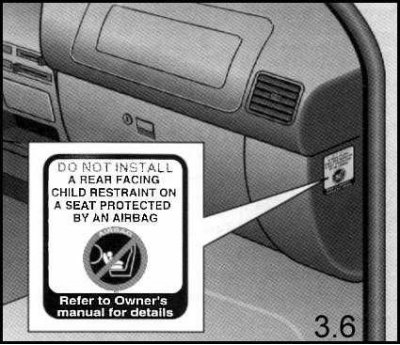
Warning! Do not install a rear-facing child seat in the front seat of vehicles equipped with an airbag. A sticker with the corresponding warning is usually attached to the instrument panel on the door side.


This article is available at russian, bulgarian, belarusian, ukrainian, serbian, croatian, romanian, polish, slovak, hungarian
Checking the article: Meshcheryakov Damir

Share information:

Previous articles
Opel Frontera A: User manual
Next articles

Seat belts
Cigarette lighter and ashtrays
Expansion of luggage compartment volume (5-door models)
Expansion of luggage compartment volume (3-door models)
Opening and closing the hood
Rear windows of 3-door softtop models (with folding roof)
Devices for safe transportation of children in a car
Seat headrests
Devices for traffic safety and passenger comfort
Adjusting the position of the seats and steering column
Ignition, engine start and steering column lock switch
Engine Starting Information


See similar ones from other Opel car manuals:
▶ Airbags — general information and deactivation Opel Astra G (1998-2004, petrol)
▶ Safety precautions when working with airbags Opel Insignia A (2008-2017)
▶ Scheme 18. Airbags Opel Omega B2 (1999-2003)
Link to this page in different formats

Visitor comments


No comments yet


How much will 45 + 33 =


Vivaro A (2001-2014) 
  • General information
  • User manual
  • Power unit
  • Petrol engine F4R
  • Diesel engine F9Q
  • Diesel engine G9U
  • Transmission
  • Clutch and drive shafts
  • Manual gearbox
  • Chassis
  • Front suspension
  • Rear suspension
  • Brake system
  • Body
  • Exterior
  • Interior
  • Electrical equipment
  • Heating and ventilation
  • Air conditioner
  • Equipment and devices
  • Electrical diagrams
Ascona C (1981-1988) 
  • General information
  • Maintenance
  • Power unit
  • Gasoline engines
  • Diesel engines
  • Cooling system
  • Fuel and exhaust system
  • Contact ignition system
  • Contactless ignition system
  • Transmission
  • Clutch
  • Mechanical gearbox
  • Automatic gearbox
  • Drive shafts
  • Chassis
  • Steering
  • Brake system
  • Car suspension
  • Body
  • Exterior
  • Interior
  • Doors and windows
  • Electrical equipment
  • Equipment and devices
  • Power devices
  • Electrical circuits
Frontera B (1998-2004) 
  • General information
  • User manual
  • Maintenance
  • Power unit
  • Petrol engines 2.2 l
  • Petrol engines 3.2 l
  • Diesel engines 2.2 l
  • Cooling system
  • Fuel system (petrol)
  • Fuel system (diesel)
  • Ignition system
  • Transmission
  • Clutch
  • Manual gearbox MUA5C
  • Automatic gearbox 4L30E
  • Chassis
  • Suspension and axles
  • Steering
  • Brake system
  • Body
  • Exterior
  • Interior
  • Doors, locks and windows
  • Heating and air conditioning
  • Electrical equipment
  • Power devices
  • Equipment and devices
  • Lighting and signaling
  • Electrical diagrams
Frontera A (1991-1998, petrol) 
  • General information
  • Introduction to guide
  • User manual
  • Maintenance
  • Power unit
  • Engine repair
  • Lubrication system
  • Cooling system
  • Power and exhaust system
  • Engine electrics
  • Transmission
  • Clutch
  • Mechanical gearbox
  • Cardan shafts
  • Chassis
  • Brake system
  • Front suspension
  • Rear suspension
  • Steering
  • Body
  • Repair and care
  • Electrical equipment
  • Equipment and devices
  • Electrical circuits
OpelBook.ru © 2017–2026 · Mobile version · · Sitemap: EN BG BY UA RS HR RO PL SK HU · Feedback · Site search
Astra F, petrol · Astra G, petrol · Astra G · Astra H · Astra J, petrol · Corsa B · Corsa C, petrol · Corsa C · Insignia A · Kadett D · Kadett E · Omega A · Omega B · Omega B2 · Vectra A, petrol · Vectra A · Vectra B, petrol · Vectra B · Vectra C · Zafira A, petrol · Frontera A, petrol · Frontera B · Ascona C · Vivaro A ·
We want your visit to be comfortable 🤝! We use cookies 🍪 to make that happen.