


Contents: Hazard warning switch ⬇ Master switch of single lock ⬇ Sports mode switch (SPORT) ⬇ Tire Pressure Monitoring System…⬇
Hazard warning switch
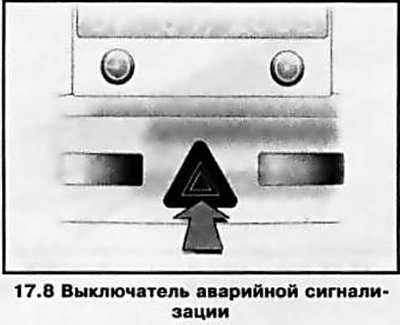
The hazard warning lights are switched on using a push-button switch mounted in the central part of the console section of the vehicle's instrument panel above the central air vents (see illustrations 15.1 and 17.8). The button is marked with a pictogram depicting two triangles inscribed into each other. Pressing the hazard warning button causes all four direction indicators to operate simultaneously (and their indicator lights on the vehicle's instrument cluster). The alarm is designed to warn other road users about a forced stop of the vehicle and is also used in other dangerous situations provided for by the traffic regulations. To turn off the hazard warning, press the switch button again. The hazard warning can be turned on regardless of whether the key is inserted into the ignition switch and in what position it is turned.
Note: If any of the airbags is deployed, the hazard warning lights are activated automatically.
Master switch of single lock
The main switch for the single lock is mounted in the console part of the instrument panel above the central air vents to the right of the hazard warning switch (see illustration 3.1).
Detailed information about the single lock functions is provided in Section 8.
Sports mode switch (SPORT)
SPORT mode activation button (with appropriate equipment) built into the console portion of the instrument panel above the central air vents to the left of the hazard warning switch (see illustration 17.9).
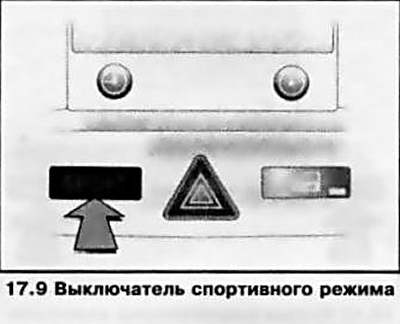
This mode is activated by briefly pressing the button - the LED built into the button should light up. In addition, the corresponding indicator will appear on the display indicating the selected gearbox mode.
The "SPORT" mode will be deactivated by briefly pressing the same button again or by turning off the ignition - the LED built into the button should go out. Holding the "SPORT" button pressed for approximately 4 seconds will deactivate the ESP system (see Section 25) - the sport mode will remain on, the indicator of deterioration of road surface properties (see Section 16) is activated in permanent mode. In addition, the transmission mode selection display will show "ESPotf". The anti-skid system will be activated by pressing the "SPORT" button again or the next time the ignition is turned on. Note: On models equipped with puncture-resistant tires (see Chapter 1 Section 5), do not switch off the ESP system when the tire is flat! When winter mode is switched on, SPORT mode is automatically deactivated and cannot be activated.
Tire Pressure Monitoring System (DDS) Switch
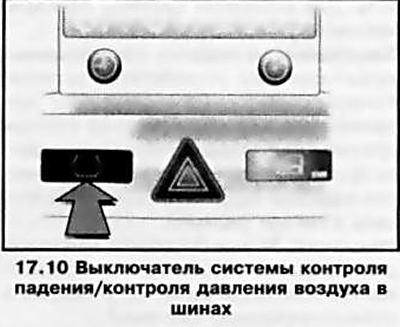
Depending on the configuration, the tire pressure monitoring system (see Section 27) continuously monitors the rotation speed of all wheels and the air pressure of 8 tires while driving, allowing timely detection of air leakage in one or more tires. After adjusting the air pressure in the tire, replacing a tire or wheel, the system must be initiated by pressing the DDS button (see illustration 17.10), located on the console part of the instrument panel above the central deflectors, to the left of the hazard warning switch.
More detailed information on the operation of the control system is given in Section 27.
Parking assistance switch
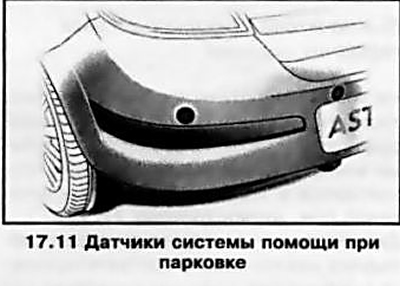
The parking assistance system measures the distance from the car to the obstacle behind and when approaching the obstacle at a close distance, it activates an intermittent sound signal in the car interior - when approaching the obstacle at less than 30 cm, the signal buzzer becomes continuous. The system determines the distance using four sensors built into the rear bumper (see illustration 17.11).
Please note: The presence of the parking assistance system does not relieve you of the obligation to exercise caution when reversing - under certain conditions, various reflective surfaces of objects or clothing, as well as extraneous sound sources, can create interference in which the system will not react to the obstacle!
On models with the appropriate equipment, the button for the parking assistance system switch is built into the console part of the instrument panel above the central air vents, to the left of the hazard warning light switch (see illustration 17.12). When the ignition is turned on, the LED built into the switch button lights up, confirming the functional readiness of the system. The system is activated automatically when reverse gear is engaged if the ignition is on. After reverse gear is disengaged, the system is automatically turned off.
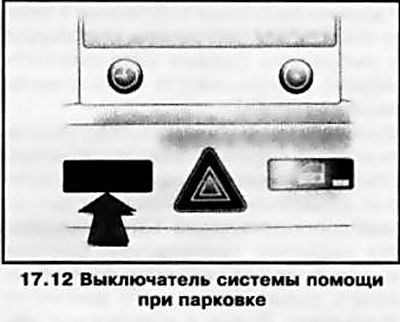
If the system needs to be switched off when the reverse gear is engaged, the switch button should be pressed - the LED built into the button should go out. To activate the system, press the same button again.
Note: On models equipped with a factory-fitted towing hitch, when driving with a trailer, the parking assistance system is automatically deactivated when the trailer's external lighting electrical supply plug is connected to the towbar socket.
Caution: Rear racks, such as those for transporting bicycles, mounted close to the sensors may interfere with the functioning of the system!
On models with the corresponding configuration, the front seat cushions are equipped with built-in heating elements, which are activated using individual switches (see illustration 17.13).
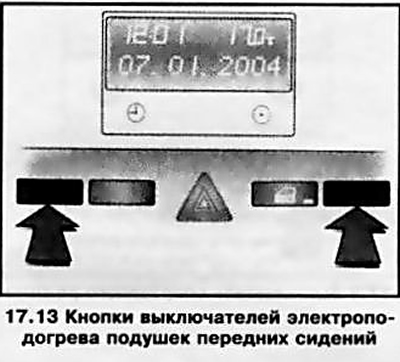
To activate the electric heating, you need to press the button of the corresponding switch one or more times - the LEDs built into the switch button should light up, informing about the selected heating intensity mode (depending on the number of button presses).
The operation of each seat's electric heater is controlled by a temperature-sensitive switch sensor, which automatically switches the corresponding heating element on and off, maintaining the set temperature. The electric heating system only starts to operate when the engine is started.
Attention: People with increased skin sensitivity are not recommended to use heating for a long time when the heating elements are activated at the highest intensity!
Warning: Do not turn on electric heaters for a long time, or if there is no passenger on the seat! Never cover the seats with any heat-insulating coverings (blankets, sofa cushions, covers, etc.) - this may cause the heating elements to overheat! Do not place hard or heavy objects on the seats, do not pierce the seat cushions with pins or similar objects, this may cause the heating elements to fail.
Control panel for operating the infotainment system
See Part D.
Control unit for the operation of ventilation, heating and air conditioning systems
The ventilation/heating/air conditioning (HVAC) control unit is located in the lower part of the console section of the instrument panel. For more information on the system management principles section, see Part D of this Chapter (see Section 18). This subsection only covers the rear window defroster activation pushbutton switch built into the HVAC control panel.
Push-button switch for heated rear window
Activation of electric heating is performed by pressing the switch button of the switchboard when the ignition is switched on. Electric heating allows you to remove condensation, frost, and even light ice from the glass surface. The correct activation of the heating element is confirmed by the operation of the built-in LED button.
Note: On models with the corresponding equipment, the heated door mirrors are activated simultaneously with the heated rear window.
The heating is switched off by pressing the button again, or automatically, about 15 minutes after activation by a signal from a special timer - the LED should go out.
Note: On diesel models equipped with a diesel particulate filter, the rear window heating is automatically switched off while the filter is being cleaned.
The thread-like mesh of the heater heating element is glued to the inner surface of the rear window and requires careful handling - try not to damage the mesh when wiping the glass (wiping should be done only along the heating threads).
Visitor comments