


Warning! Before performing the operation, be sure to read the section "Safety precautions for maintenance and repair of the engine management system".
To complete the work you will need a multimeter.
Sequence of execution
1. Prepare the car for work (see "Preparing the car for maintenance and repair").
2. Relieve the pressure in the fuel line (see "Fuel Line - Pressure Relief").
3. Remove the decorative engine cover (see "Engine trim panel - removal and installation"),
4. On 1.4 and 1.6 DOHC engines, remove the coolant supply hose to the throttle assembly from the holders on the cylinder head cover and move it to the side (see "Cylinder head cover for 1.4 and 1.6 DOHC engines - removal, gasket replacement and installation").
5. Disconnect the crankcase ventilation system hoses from the cylinder head cover (see "Cylinder head cover for 1.4 and 1.6 DOHC engines - removal, gasket replacement and installation" or "1.8 DOHC Engine Cylinder Head Cover - Removal, Gasket Replacement and Installation"),
6. On 1.4 and 1.6 DOHC engines, remove the air intake pipe (see "Throttle assembly - removal, gasket replacement and installation").
7. Using a slotted screwdriver, alternately disengage 12 holders on 1.4 and 1.6 DOHC engines...
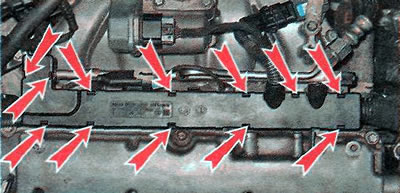
...or 13 holders on the 1.8 DOHC engine and remove the upper cover of the protective casing of the wiring harness.
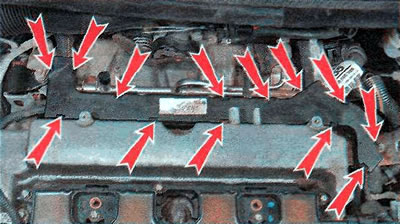
8. Remove the wiring harness from the protective casing (shown on the example of a 1.6 DOHC engine, on other engines the harness is removed in the same way).
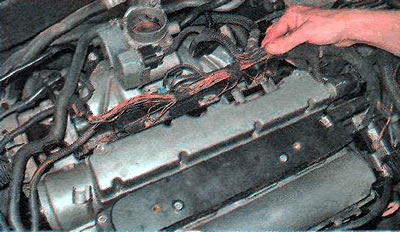
9. Using a slotted screwdriver, bend the retainer slightly...
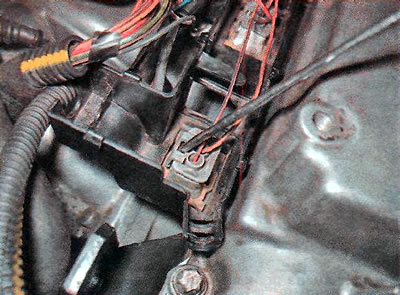
... and disconnect the wiring harness connector from the injector of the first cylinder (shown on 1.6 DOHC engine, similar on other engines).
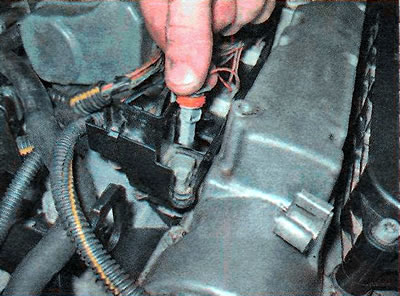
10. In a similar manner, disconnect the pads from the injectors of the remaining cylinders and move the wiring harness to the side.
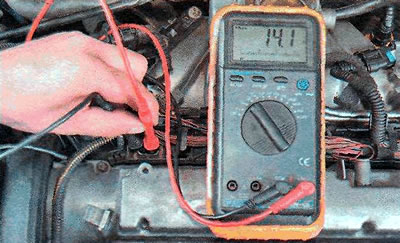
11. Alternately connect the multimeter in voltmeter mode to terminals 1 of the injector wiring harness pads and to the vehicle ground (shown on 1.6 DOHC engine, similar on other engines). Turn on the ignition and read the instrument. The voltage should be at least 12 V. Turn off the ignition.
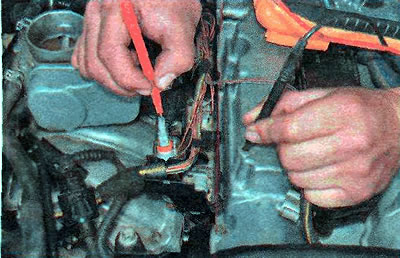
If there is no voltage, check fuse Ef6 (see "Fuse and relay mounting blocks"). If the fuse has blown, replace it. Turn the ignition on again. If the fuse blows again, there is a short circuit in the circuit that needs to be eliminated (see "Checking and repairing electrical circuits").
12. If the fuse is intact, check relay E4 (see "Fuse and relay mounting blocks", "Checking the relay"),
13. If the fuse and relay are intact, but there is no voltage, then there is a break in the circuit that must be eliminated (see "Checking and repairing electrical circuits").
14. Using a multimeter in ohmmeter mode, check the resistance of the injector winding, for which we connect the multimeter leads to the injector contacts. The resistance should be about 13-14 Ohms, otherwise the injector must be replaced. We check the other injectors in the same way (shown on 1.6 DOHC engine, similar on other engines).
15. Using two wires directly from the battery, briefly apply 12 V to the injector contacts. A working injector should make a characteristic click when the valve opens. Replace faulty injectors.
Note: The following operations are only necessary for removing the fuel rail and replacing the injectors.
16. On 1.4 and 1.6 DOHC engines, disconnect the detonation sensor wiring harness connector...
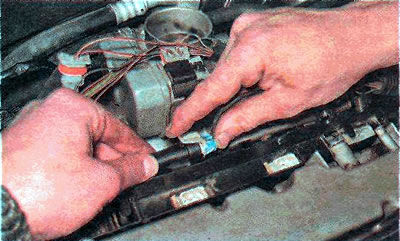
...and disconnect the wiring harness block from the protective casing, moving it in the direction indicated by the arrow.
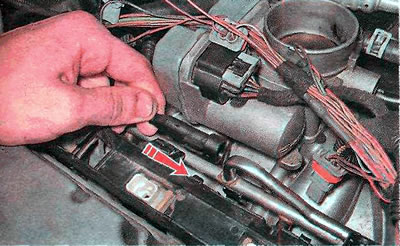
17. Holding the fuel rail fitting with a 17 mm wrench, use a 19 mm wrench to unscrew the pipeline nut and disconnect it from the fuel rail (shown on 1.6 DOHC engine, similar on other engines).
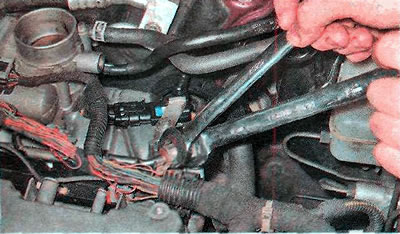
18. On 1.4 and 1.6 DOHC engines, use the TORX E8 key to unscrew the right...
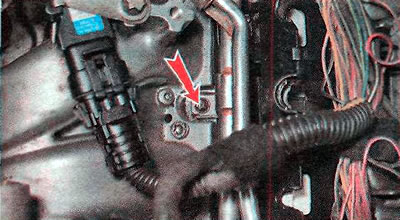
...and the left fuel rail mounting bolts.
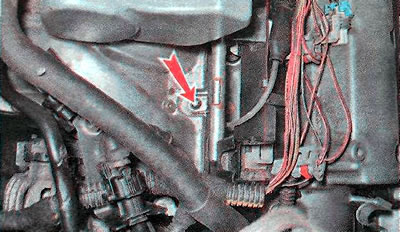
19. On the 1.8 DOHC engine, use the TORX E10 key to unscrew the protective cover mounting bolt...
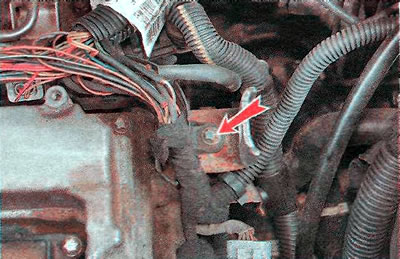
...and with a TORX E8 key - two bolts securing the fuel rail.
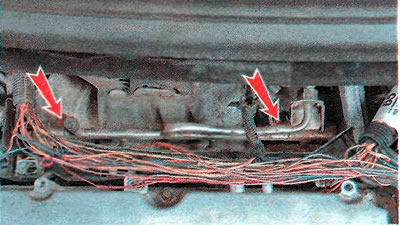
20. Pulling upwards, remove the fuel rail assembly with the injectors and the lower part of the protective casing (shown on 1.6 DOHC engine, similar on other engines).
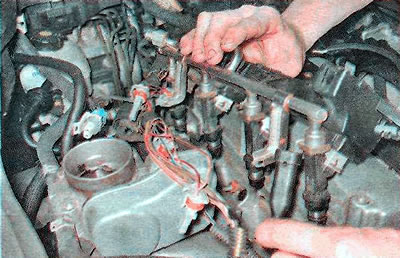
Warning: Replace the lower injector sealing rings whenever the fuel rail assembly with injectors is removed (see below).
Note: The further execution of the operation is shown on the 1.6 DOHC engine, on other engines it is similar.
21. Using a slotted screwdriver, pry up and remove the injector block retainer.
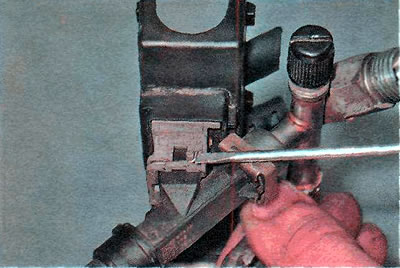
22. In a similar manner, remove all other fasteners and disconnect the protective cover.
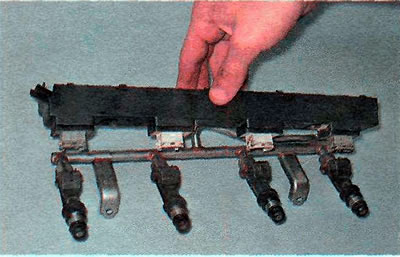
23. Using a slotted screwdriver, pry up the injector retainer...
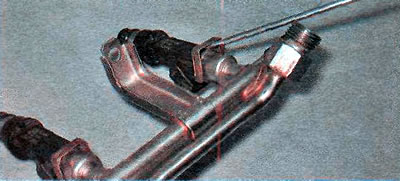
...and we take it off.
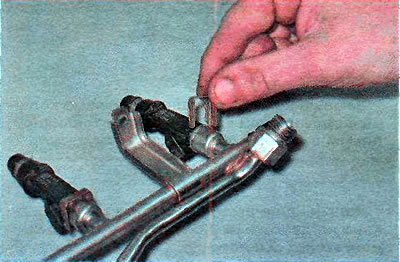
24. Remove the injector from the fuel rail.
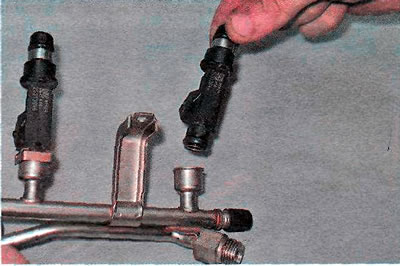
Warning! Replace the upper injector sealing rings when removing the injector from the rail.
25. Use a screwdriver to pry up the upper sealing ring of the injector and remove it.
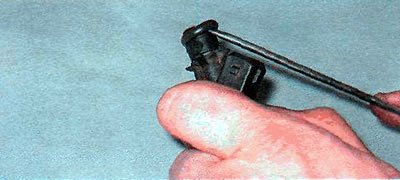
26. Remove the lower sealing ring in the same way.
Material published on the website [OpelBook.ru]
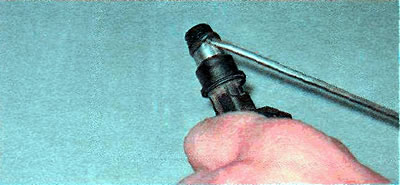
Note: There are three O-rings on the 1.8 DOHC engine.
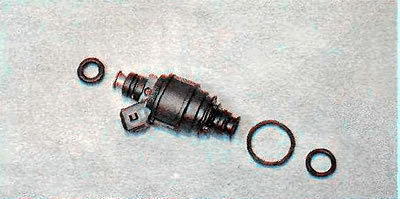
27. Install all removed parts in reverse order. When installing new injector sealing rings, make sure that they are not twisted.
Recommendation: To facilitate installation of the injector into the fuel rail, as well as to install the fuel rail into the intake manifold, lubricate the injector sealing rings with a thin layer of technical petroleum jelly or transmission oil.
Visitor comments