


Signs of faulty injectors:
- ignition failures;
- knocking in one or more cylinders;
- the engine gets very hot;
- loss of engine power, high fuel consumption;
- exhaust smoke too dark.
Examination
Turn on the engine at idle speed and loosen the union nuts of the injection heaters one by one. If the knocking noise disappears when you loosen any nut, then the faulty injector has been found.
The injectors can also be checked using a special device (in a workshop environment).
Removal
1. Remove the engine cover and the exhaust pipe above the injectors.
2. Remove the brake booster vacuum line from the cylinder head bracket.
3. Remove the intake manifold.
4. Clean the injection lines using the cold cleaning method.
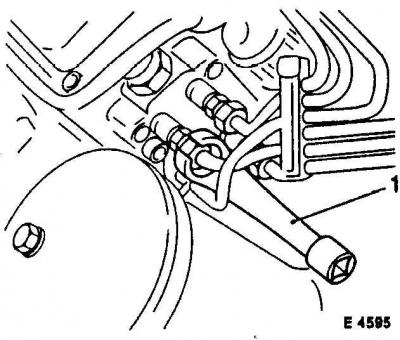
5. Remove all injection pipes (1) by loosening the union nuts on the injectors and the injection pump using a spanner, such as HAZET 4550.
Warning! Do not change the bend shape of the pipes. Put suitable protective caps on the injectors and injection pump to prevent dirt from getting in.
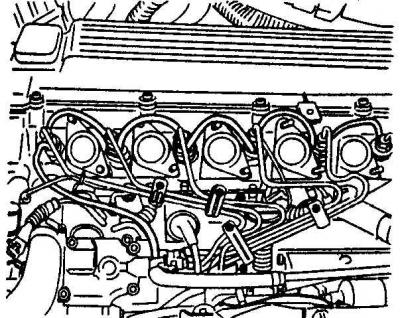
6. If the injection pipe retaining clips are to be removed, mark their location in advance.
7. Carefully remove the return line from the injectors.
8. Remove the injectors using a 27 mm wrench, such as HAZET 4555-1.
9. Protect the bottom of the nozzles from dirt with protective caps.
Warning! Make sure that the injectors do not fall. Also, disconnect the cable connector for the built-in injection start sensor from the injectors of the 4th cylinder. Reinstall all injectors in their previous positions.
Installation
1. Tighten the injectors to 65 Nm.
2. Tighten the injection pipes with a torque of 25 Nm.
3. Put on the return line.
4. Connect the cable together with the injection start moment sensor to the injector of the 4th cylinder.
5. If removed, install retaining clips as marked.
6. Install the brake booster vacuum line to the cylinder head bracket.
7. Install the intake manifold.
8. Start the engine, check the fuel system for leaks.
9. If the engine does not start, bleed the fuel system.
Visitor comments