


Contents: Crankcase ventilation system (PCV) ⬇ Evaporative Emissions (EVAP) System…⬇ Exhaust gas composition control ⬇ Exhaust Gas Recirculation (EGR)…⬇
Crankcase ventilation system (PCV)
All models
The system components do not require any special maintenance beyond the normal checks of the condition of the hoses and their fittings in accordance with the Vehicle Maintenance Schedule (see Chapter Routine maintenance).
Evaporative Emissions (EVAP) System - Gasoline Models
Examination
First of all, always check the condition of the vacuum hoses, obstruction, disconnection or damage of which is most often the cause of system failure (please refer to the hose routing diagram on your vehicle's VECI label). If necessary, replace damaged hoses. A complete diagnosis of the system is only possible using specialized equipment connected to the DLC connector (see The operating principle of fuel injection systems). In case of failure, the purge valve and/or carbon adsorber must be replaced.
Replacement
Carbon adsorber
The carbon canister is installed under the right front fender of the car.
1. To ensure adequate access to the canister, set the parking brake, then jack up the front of the vehicle and place it on supports. Remove the right front wheel.
2. Loosen the mounting screws, release the clamps and remove the wheel arch protection liner.
3. Disconnect the electrical wiring and remove the right turn signal side repeater assembly (see Chapter On-board electrical equipment).
4. Remove the canister mounting nut. In the engine compartment, disconnect the hoses from the canister, having marked them first. Remove the canister from the car.
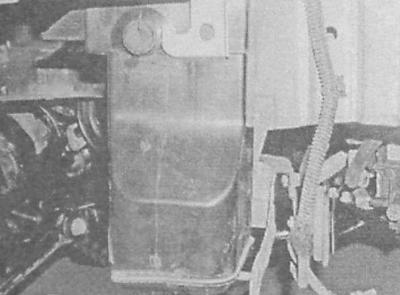
5. Installation is carried out in the reverse order. Make sure that the hoses are connected correctly and that the fasteners are tightened securely.
Evaporative Canister Purge Valve
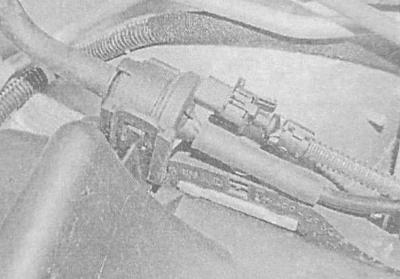
The purge valve is installed on the right side of the engine compartment, behind the air cleaner.
1. Turn off the ignition, press the lock and disconnect the valve wiring connector.
2. Disconnect the hoses from the valve (try to remember the order of the connections), Release the clips, separate the valve from the air cleaner housing and remove it from the vehicle.
3. Installation is carried out in reverse order.
Exhaust gas composition control
Examination
Catalytic converter
Diagnostic equipment to check the catalytic converter is expensive and extremely difficult to operate. If you suspect a converter failure, take the car to a service station for inspection.
Every time the car is raised above the ground for any reason, inspect the converter for signs of mechanical damage, traces of leaks and corrosion development. Check the condition of the welds and the reliability of tightening the flange bolts that secure the device to the sections of the exhaust system. A defective catalytic converter must be replaced.
Despite the reliability of the converter design, there is a fairly high probability of its blockage. The simplest way to check the patency of the converter is to check using a vacuum gauge.
1. Connect a vacuum gauge to the intake manifold vacuum source (see Repair procedures for 1.7L and 2.0L diesel engines without removing them from the vehicle).
2. Warm up the engine to normal operating temperature, move the selector lever to position "P" (models with AT), or put the transmission in neutral (models with manual transmission) and set the parking brake.
3. Read the vacuum gauge readings with the engine idling.
4. Quickly open the throttle valve almost to the stop, then immediately release it, dropping the speed to idle. Read and record the vacuum gauge readings.
5. Repeat the described test three more times, recording the result each time.
6. If the result of the fourth measurement is more than 2.54 mm Hg lower than the reading taken at idle speed, then there is a possibility that the transducer or muffler is not working properly.
Lambda probe (oxygen sensor)
1. Locate the sensor's electrical connector. From the back of the connector, insert an unbent paper clip into the signal wire contact socket (terminal No.1 []), insert the second paper clip into the socket of terminal No.2 (ground). Connect the positive probe of the voltmeter to the first paper clip, connect the negative probe to the paper clip inserted into the ground terminal. Set the parking brake, move the AT selector lever to the "P" position, on models with a manual transmission, select neutral gear. Jack up the front of the car and place it on supports.
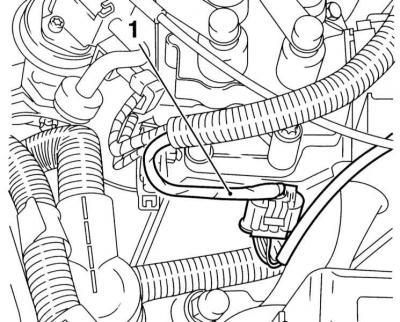
2. Start the engine and begin monitoring changes in the lambda probe signal voltage.
Try not to touch the hot surfaces of the exhaust system!
3. At the initial stage, the cold sensor should generate a constant signal with an amplitude of 0.1-0.2 V (open loop mode)After about two minutes, the engine will reach normal operating temperature and the sensor readings will begin to fluctuate between 0.1 and 0.9 V (closed loop mode). If the system does not enter closed loop mode, or enters with an unacceptably long delay (lazy sensor), replace the sensor.
4. Also check the proper functioning of the lambda probe heater. Disconnect the probe wiring connector and connect an ohmmeter between the heater terminals (terminals No.3 and 4). The nominal resistance is 10-40 Ohms.
5. Check the power supply to the heater. Disconnect the electrical connector and measure the voltage on it from the harness side between terminal No.4 and ground. With the ignition on (do not start the engine) the voltmeter should register battery voltage. If there is no power, check the wiring condition in the circuit section between the main relay, ECM and lambda probe.
6. If the above checks are negative, replace the faulty sensor.
Replacement
Catalytic converter
The catalytic converter is a maintenance-free component, however, there are some things that the owner of a properly equipped vehicle should pay attention to.
- Do not use unleaded fuel in a vehicle equipped with a catalytic converter - the lead it contains is deposited on the rare earth metal-coated surfaces of the catalytic converter, which significantly reduces the efficiency of the converter and can ultimately lead to its complete failure;
- Monitor the condition of the exhaust system components, regularly perform the necessary checks in accordance with the Schedule of routine vehicle maintenance (see Chapter Routine maintenance);
- If there are misfires, you should refuse to use the vehicle until the malfunction is corrected - unburned fuel entering the converter can then ignite and cause the catalyst to fail;
- For the same reason, you should avoid starting the engine by towing or pushing the vehicle;
- Do not turn off the ignition at high engine speeds;
- Do not use any additives to fuel or engine oil - they may contain components harmful to the catalytic converter.
- If a bluish plume appears at the outlet of the exhaust system, which is a consequence of the burning of engine oil, the authors of this Manual also recommend that you stop using the vehicle (see point c);
- Remember that the catalytic converter operates at very high operating temperatures - do not park the car on areas covered with dry grass or last year's leaves;
- Remember that the catalytic converter can be easily damaged by impact, so use caution when performing any work near it;
- The appearance of the smell of hydrogen sulfide (rotten eggs) in the first days of operation of a new car is a consequence of the normal functioning of the catalytic converter - the smell should disappear after the first few thousand kilometers of mileage;
- If the car is in good working order, the service life of the catalytic converter is up to 150,000 km. In case of a decrease in the efficiency of the catalytic converter, it is subject to replacement.
For a description of the catalytic converter removal and installation procedures, see. Removal and installation the exhaust manifold.
Lambda probe (oxygen sensor)
When servicing the lambda probe, some special precautions should be taken:
- The lambda probe is equipped with a section of electrical wiring that is permanently mounted into it and equipped with a contact plug. Attempts to disconnect it may lead to irreversible failure of the sensor;
- Try to keep dirt and grease out of the sensor louvers or electrical connector;
- Do not use any solvents to clean the lambda probe;
- Handle the sensor with extreme care - do not drop it and try not to shake it;
- The silicone protective cover must be placed on the sensor in a strictly defined manner so as not to melt and impair the proper functioning of the probe.
Models with 1.4 and 1.6 l engines
1. Warm up the engine to normal operating temperature, turn off and disconnect the negative battery cable.
2. Follow the wiring from the sensor screwed into the left side of the exhaust manifold to the contact connector of its wiring. Release the wiring from the clamps and disconnect the connector.
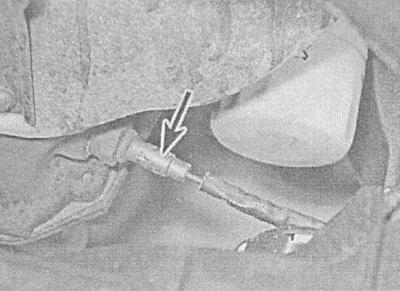
3. Unscrew the sensor and remove it from the manifold.
Try not to touch hot exhaust system components!
4. Installation is carried out in the reverse order. Before screwing in, lubricate the threaded part of the sensor with heat-resistant grease such as Opel No.1948602/90295397. Tighten the sensor with the required force and ensure that the electrical wiring is laid correctly - the harness should not touch the heated surfaces of the exhaust system.
Models with 1.8 and 2.0 l engines
1. Set the parking brake, then jack up the front of the car and support it on stands. Disconnect the negative battery cable.
2. Follow the wiring from the sensor screwed into the intake section of the exhaust system to the contact connector of its wiring on the left on the cylinder head. Release the wiring from the clamps and disconnect the connector.
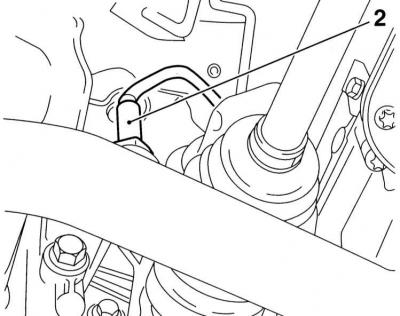
3. Unscrew the sensor and remove it from the vehicle - the sealing ring must be replaced without fail.
4. Installation is carried out in the reverse order. Before screwing in, lubricate the threaded part of the sensor with heat-resistant grease such as Opel No.1948602/90295397. Tighten the sensor with the required force and ensure that the electrical wiring is laid correctly - the harness should not touch the heated surfaces of the exhaust system.
Exhaust Gas Recirculation (EGR) System
Examination
All models
A comprehensive system check can only be performed using specialized equipment connected to the DLC (see The operating principle of fuel injection systems). Failed EGR valves must be replaced.
Replacement
EGR valve
Petrol models
1. Turn off the ignition, disconnect the electrical wiring from the valve models equipped with a SOHC engine, the valve is installed in the middle part of the intake manifold, models with DOHC engines - on its left side.
2. Unscrew the mounting screws and remove the valve assembly with the sealing gasket.
3. Installation is carried out in the reverse order. Do not forget to replace the gasket, make sure that the valve is tightened with the required force.
Diesel models
Models with 1.7L SOHC engines
1. Release the clamps, unscrew the support bracket mounting bolts and remove the boost pipe connecting the turbocharger to the intercooler.
2. Disconnect the vacuum hose from the EGR valve, remove the retaining ring and remove the EGR valve from the left side of the intake manifold.
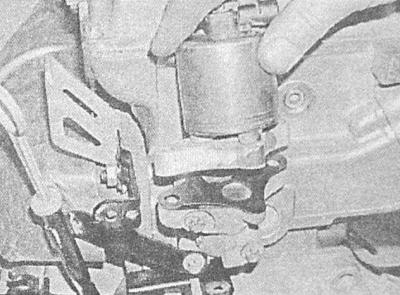
3. Installation is carried out in reverse order.
Models with 1.7L DOHC engines
1. Remove the ECM (see The operating principle of fuel injection systems). Remove the mounting bolts and the ECM support bracket located above the EGR valve.
2. Disconnect the vacuum pipe from the EGR valve.
3. Remove the mounting bolts and disconnect the inlet pipe from the top of the EGR valve.
4. Using an open-end wrench, loosen the EGR pipe fitting on the valve.
EGR valve (1.7L DOHC engine)
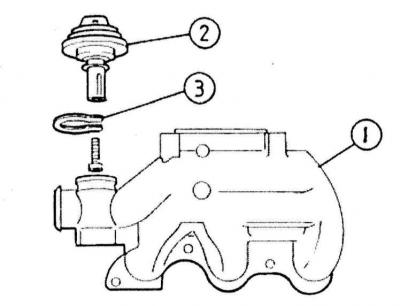
1 - Inlet manifold
2 — EGR valve
3 — Retaining ring
5. Loosen the bolts securing the EGR valve to the intake manifold - try to remember the installation position of the support brackets secured with the same nuts.
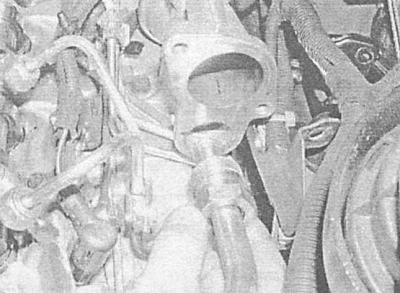
6. The failed valve must be replaced.
7. Installation is carried out in reverse order.
Models with 2.0L engines
The valve is not supplied individually to the spare parts market and in case of failure is replaced as a unit with the upper section of the intake manifold (see Removal and installation the intake manifold).
EGR valve operation control solenoid valve - diesel models
Models with 1.7L SOHC engines
1. Disconnect the electrical wiring and vacuum hoses from the valve assembly at the rear of the intake manifold - try to remember the routing and order of connection of the lines.
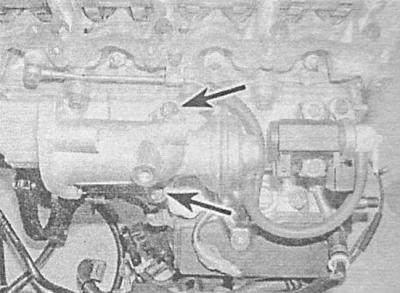
2. Remove the two mounting bolts and remove the solenoid valve.
3. Installation is carried out in reverse order.
Models with 1.7L DOHC engines
1. If necessary, remove the air cleaner and air intake duct on the right side of the engine compartment (see Removal and installation air intake tract components).
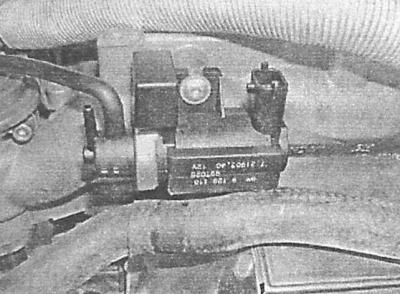
2. The valve is installed on the right side of the intake manifold. Disconnect the vacuum hoses from the valve - note the difference in their diameters.
3. Disconnect the electrical wiring from the valve.
4. Unscrew the two mounting bolts and remove the valve.
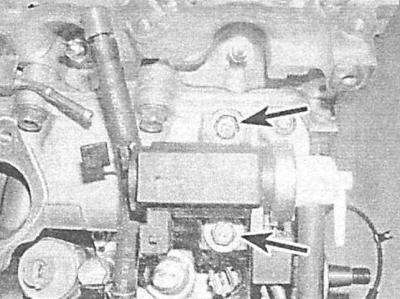
5. Installation is carried out in reverse order.
Models with 2.0L engines
The valve is installed in the front left part of the engine compartment, next to the pipeline switching valve. Moreover, the EGR valve is the rear of the two and can be identified by the black color of the electrical wiring.
1. Disconnect the electrical wiring and vacuum hoses from the valve. Remove the mounting screws and remove the valve from the support bracket - try to remember the installation position of the components.
2. Installation is carried out in reverse order.
Visitor comments