


Contents: Multec central injection system ⬇ Multec-S distributed injection system ⬇ Distributed injection system…⬇
Multec central injection system
Main components of the Multec central injection system (1.6L SOHC engines)
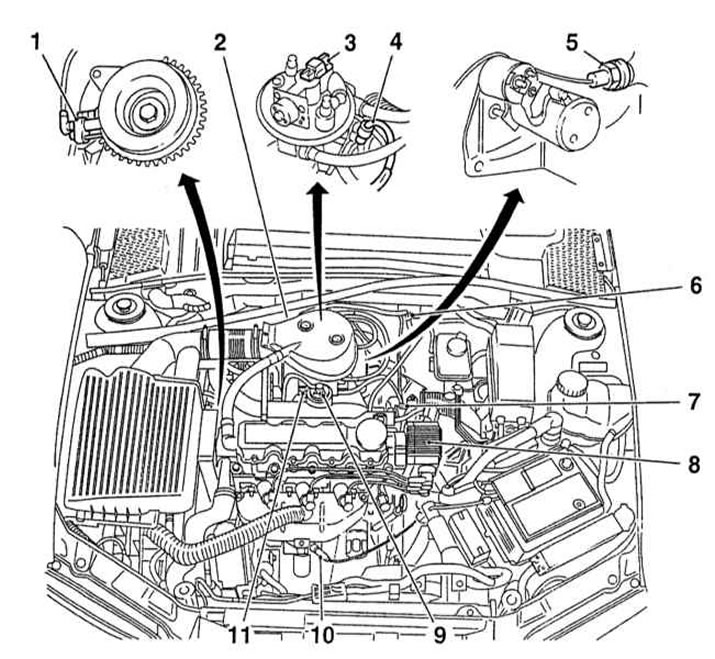
1 — Crankshaft position sensor (CKP)
2 — Throttle body
3 — Fuel injection injector
4 — Throttle Position Sensor (TPS)
5 — Knock sensor (KS)
6 — Manifold Absolute Pressure (MAP) Sensor
7 — Carbon adsorber purge valve
8 — Ignition module
9 — EGR valve
10 — Lambda probe
11 — Stepper motor of the idle speed stabilization system
Part of the Multec system (see the illustration Main components of the Multec central injection system (1.6L SOHC engines)) includes the following components: a closed-type catalytic converter, evaporative emission control (EVAP) and exhaust gas recirculation (EGR) systems. In terms of operating efficiency, the system meets all international standards. Below is a description of the operating principle of the engine part of the system responsible for fuel injection. Information on the operation of the ignition subsystem is provided in Chapter Engine electrical equipment.
The submersible fuel pump, located in the fuel tank, supplies fuel under pressure to the fuel line, passing it along the way through the fuel filter installed at the rear under the car. The fuel supply pressure is determined by the pressure regulator installed on the throttle body. Excess fuel is sent back to the fuel tank through the return line.
The electrical part of the control system consists of the electronic control module (ECM) and the following information sensors:
- Position sensor (potentiometer) throttle Position Sensor (TPS) informs the ECM of the throttle position;
- Coolant Temperature (ECT) Sensor informs the ECM of the engine coolant temperature;
- Lambda probe (uK models) informs the ECM of the concentration of O2 molecules in the exhaust gases (for more details see. Exhaust and emission control systems);
- Crankshaft Position Sensor (CKP) informs the ECM of engine speed and crankshaft position;
- Knock Sensor (KS) informs the ECM of signs of pre-ignition;
- Manifold Absolute Pressure (MAP) Sensor informs the ECM of engine load by monitoring the depth of vacuum in the intake manifold;
- Anti-lock brake system (ABS) control unit informs the ECM of the vehicle's speed;
- Air conditioning system switch sensor (with appropriate equipment) notifies the ECM that the air conditioner is turned on.
All incoming information is processed by the ECM, which then issues commands to control ignition and opening of the fuel injector. The injector is controlled by changing the width of the control electric opening pulse, which allows for adjustment of the air-fuel mixture composition with minimal delay when external factors change. Thanks to the possibility of such adjustments, engine output is maintained at the maximum level at any stage of the unit's operation: at start-up, during warm-up, during acceleration, deceleration and movement at a constant speed.
The ECM also controls the idle speed. The necessary adjustments are made by activating a stepper motor mounted on the throttle body. The engine, on commands from the ECM, opens/closes the bypass channel, if necessary (for example, with the throttle valve closed or in the idle position) bypassing the throttle chamber.
In addition, the ECM controls the operation of the EVAP fuel vapor collection system (see Exhaust and emission control systems).
If the sensors receive information indicating the occurrence of an abnormal situation, the ECM switches to an emergency operating mode, when the base values of the corresponding parameters are substituted for inadequate signals - the efficiency of the engine output in this mode is naturally reduced. The driver is warned about the ECM entering emergency mode by the activation of the failure indicator lamp on the vehicle instrument panel (see Chapter User manual), the corresponding diagnostic code is entered into the processor memory (see Chapter Engine electrical equipment).
Under certain circumstances, the vehicle's behavior may not change at all. The only sign that the ECM has switched to emergency mode may be an increase in exhaust toxicity. Keep in mind that after replacing a faulty sensor with a working one, the system will not automatically switch to normal mode on its own - you should clear the processor memory from the diagnostic codes contained in it. Even if the reason for the system switching to the emergency safe mode was a wiring break, the processor memory should be cleared after it.
The DLC diagnostic connector is located in the center console in front of the parking brake lever under the decorative cover
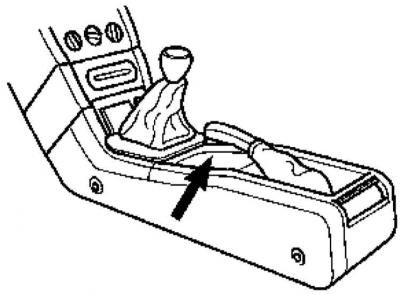
Location of DLC connector in console
The decorative cover has been removed
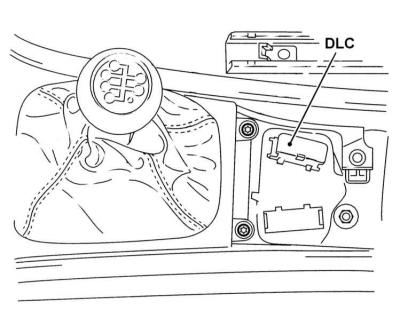
If the warning light comes on, the vehicle should be taken to an authorized Opel service station as soon as possible for a detailed diagnosis using special equipment and for the necessary repairs to be carried out (see illustrations The DLC diagnostic connector is located in the center console in front of the parking brake lever under the decorative cover and Location of DLC connector in console).
Diagnostic equipment (scanner type reader) connects to the DLC connector located under the decorative trim in front of the parking brake lever.
Multec-S distributed injection system
Main components of the Multec-S central injection system (1.4 and 1.6 l DOHC engines)
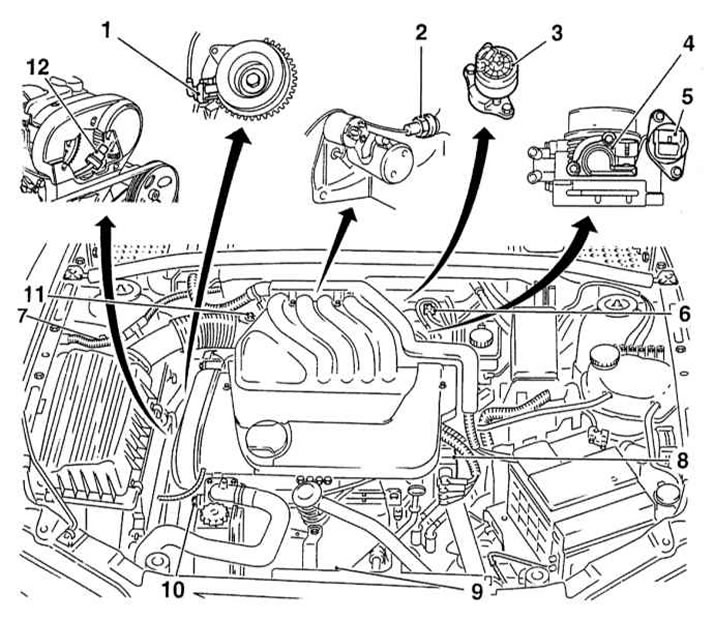
1 — Crankshaft position sensor (CKP)
2 — Knock sensor (KS)
3 — EGR valve
4 — Throttle Position Sensor (TPS)
5 — Stepper motor of the idle speed stabilization system
6 — Manifold Absolute Pressure (MAP) Sensor
7 — Carbon adsorber purge valve
8 — Ignition module
9 — Lambda probe
10 — Coolant Temperature Sensor (ECT)
11 — Intake air temperature sensor (IAT)
12 — Camshaft Position (CMP) Sensor
The main components of the Multec-S system (see illustration Main components of the Multec-S central injection system (1.4 and 1.6 l DOHC engines)) are: a closed-type catalytic converter, evaporative emission control (EVAP) and exhaust gas recirculation (EGR) systems. In terms of operating efficiency, the system meets all international standards. Below is a description of the operating principle of the engine part of the system responsible for fuel injection. Information on the operation of the ignition subsystem is provided in Chapter Engine electrical equipment.
The submersible fuel pump, located in the fuel tank, supplies fuel under pressure to the fuel line, passing it along the way through the fuel filter installed at the rear under the car. The fuel supply pressure is determined by the pressure regulator installed on the throttle body. Excess fuel is sent back to the fuel tank through the return line.
The electrical part of the control system consists of the electronic control module (ECM) and the following information sensors:
- Position sensor (potentiometer) throttle Position Sensor (TPS) informs the ECM of the throttle position;
- Coolant Temperature (ECT) Sensor informs the ECM of the engine coolant temperature;
- Intake Air Temperature (IAT) Sensor informs the ECM of the temperature of the air sucked into the intake manifold;
- Lambda probe (uK models) informs the ECM of the concentration of O2 molecules in the exhaust gases (for more details see. Exhaust and emission control systems);
- Crankshaft Position Sensor (CKP) informs the ECM of engine speed and crankshaft position;
- Camshaft Position (CMP) Sensor informs the ECM of the position and speed of the exhaust camshaft;
- Knock Sensor (KS) informs the ECM of signs of pre-ignition;
- Manifold Absolute Pressure (MAP) Sensor informs the ECM of engine load by monitoring the depth of vacuum in the intake manifold;
- Anti-lock brake system (ABS) control unit informs the ECM of the vehicle's speed;
- Air conditioning system switch sensor (with appropriate equipment) notifies the ECM that the air conditioner is turned on.
All incoming information is processed by the ECM, which then issues commands to control ignition and opening of the fuel injector. The injector is controlled by changing the width of the control electric opening pulse, which allows for adjustment of the air-fuel mixture composition with minimal delay when external factors change. Due to the possibility of such adjustments, engine output is maintained at the maximum level at any stage of the unit's operation: at start-up, during warm-up, during acceleration, deceleration and driving at a constant speed. Multec S is a sequential injection system in which each of the 4 injection injectors is triggered at the moment the corresponding intake valve begins to open.
The ECM also controls the idle speed. The necessary adjustments are made by activating a stepper motor mounted on the throttle body. The engine, on commands from the ECM, opens/closes the bypass channel, if necessary (for example, with the throttle valve closed or in the idle position) bypassing the throttle chamber.
In addition, the ECM controls the operation of the EVAP fuel vapor collection system (see Exhaust and emission control systems).
If the sensors receive information indicating the occurrence of an abnormal situation, the ECM switches to emergency operation, when the base values of the corresponding parameters are substituted for inadequate signals - the efficiency of the engine output in this mode is naturally reduced. The driver is warned about the ECM entering emergency mode by the activation of the failure indicator lamp on the vehicle instrument panel (see Chapter User manual), the corresponding diagnostic code is entered into the processor memory (see Chapter Engine electrical equipment).
If the warning light comes on, the vehicle should be taken to an authorized Opel service station as soon as possible for detailed diagnostics using special equipment and for the necessary repairs to be carried out.
Diagnostic equipment (scanner type reader) connects to the DLC connector located under the decorative trim in front of the parking brake lever (see illustrations The DLC diagnostic connector is located in the center console in front of the parking brake lever under the decorative cover and Location of DLC connector in console).
Distributed injection system Simtec-70 h
Main components of the Multec-S central injection system (1.8 and 2.0 L DOHC engines)
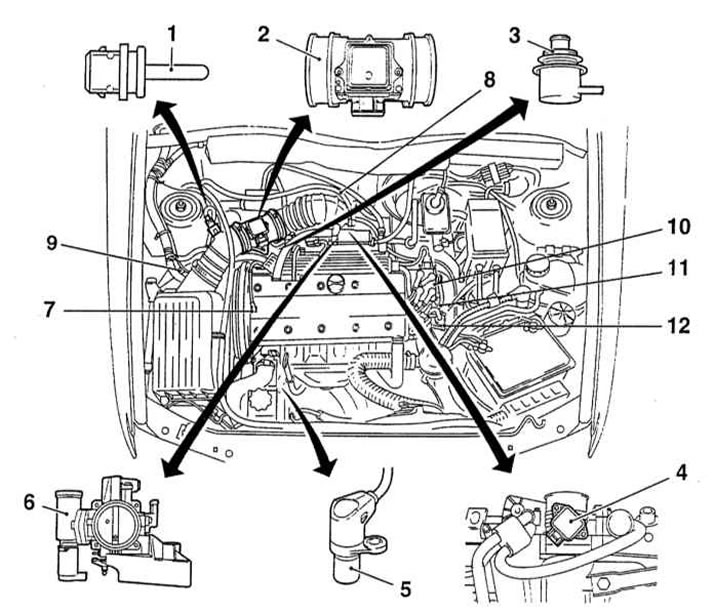
1 — Intake air temperature sensor (IAT)
2 — Mass Air Flow (MAF) Sensor
3 — Fuel pressure regulator
4 — Throttle Position Sensor (TPS)
5 — Crankshaft position sensor (CKP)
6 — Stepper motor of the idle speed stabilization system
7 — Camshaft Position (CMP) Sensor
8 — Knock sensor (KS)
9 — Carbon adsorber purge valve
10 — Ignition module
11 — Coolant Temperature Sensor (ECT)
12 — EGR valve
According to the operating principle of the Simtec-70 system (see illustration Main components of the Multec-S central injection system (1.8 and 2.0 L DOHC engines)) is almost identical to the Multec S system discussed above. The main difference is that instead of the MAP sensor, a film-type air mass sensor (MAF) is used in the intake air path. The Air mass sensor (MAF) informs the ECM about the amount of air entering the intake pipe.
Another feature of the system is the use of a variable-length intake manifold, which allows for an increase in the torque developed by the engine at low speeds. The intake manifold is equipped with a special valve, the operation of which is controlled by the ECM using an electromagnet and a diaphragm unit. At engine speeds below 3600 rpm, the valve remains closed - in this case, the air passes along a longer path, providing an increase in engine torque. At high speeds, the valve opens on command from the ECM, providing a vacuum supply to the diaphragm unit, which controls the operation of four valves, the operation of which allows for the required reduction in the length of the air path along the manifold in order to increase the traction characteristics of the engine at high speeds.
Visitor comments