


General information
Exhaust system design for 1.2L models
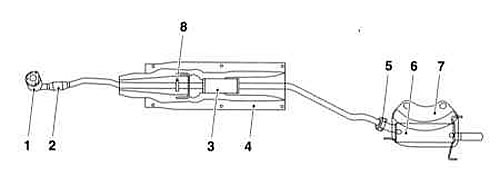
1 - Catalytic converter
2 - Flexible insert
3 - Intermediate muffler (resonator)
4 - Heat shield
5 - Flange connection
6 - Main muffler
7 - Heat shield
8 - Clamp connection
Exhaust system design for 1.4, 1.6 (SOHC) and 1.7L models
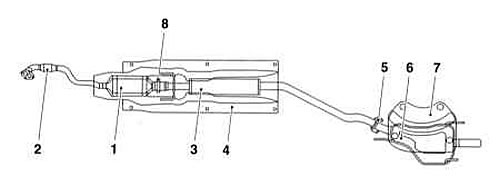
1 - Catalytic converter
2 - Flexible insert
3 - Intermediate muffler (resonator)
4 - Heat shield
5 - Flange connection
6 - Main muffler
7 - Heat shield
8 - Clamp connection
Exhaust system design for 1.6 (DOHC), 1.8 and 2.0 L models
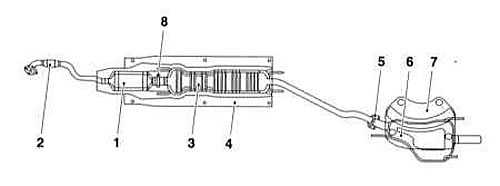
1 - Catalytic converter
2 - Flexible insert
3 - Intermediate muffler (resonator)
4 - Heat shield
5 - Flange connection
6 - Main muffler
7 - Heat shield
8 - Clamp connection
The exhaust system of all the models under consideration consists of three sections: intake, middle (intermediate) and rear. The main elements of the system are: the inlet pipe, the catalytic converter, the mufflers (intermediate and main), connecting tubular sections, mounting clamps, as well as support brackets and rubber loops by means of which the exhaust assembly is suspended from the underbody of the vehicle (see illustrations Exhaust system design for 1.2L models, Exhaust system design for 1.4, 1.6 (SOHC) and 1.7L models and Exhaust system design for 1.6 (DOHC), 1.8 and 2.0 L models). The sections of the system are connected to each other by means of a single clamp connection (front section with intermediate) and one flange (intermediate section with rear). The joint of the middle and rear sections of the system is spring-loaded, which allows to compensate for the play that occurs during the movement of the car; in order to reduce the level of vibrations, a flexible insert is usually included in the receiving section of the system. Incorrect installation of the components and sections of the system leads to an increase in the level of noise and vibration transmitted to the car body.
Regularly inspect the entire system for signs of corrosion, deformation and mechanical damage. Check the reliability of fastener tightening. A breach of the tightness of components and their joints is fraught with the ingress of exhaust gases into the car interior. Defective components and sections are subject to replacement.
If the system is severely damaged by corrosion, a gas cutter may be required to separate its sections (alternatively, you can use a hacksaw or a pneumatic chisel - don't forget to wear safety glasses and gloves).
The system repair should be carried out in the following order:
1. When removing components, move along the system path in the direction from the exhaust pipe to the engine.
Material copied from this portal (OPELBOOK.ru)
2. Pre-lubricate the fasteners to be released with penetrating oil.
3. Prepare the necessary replacement gaskets, hanging loops, clamps and fasteners in advance.
4. Before installation, lubricate the threaded part of the fastener with anti-seize sealant.
5. When installing components, ensure that there is sufficient clearance between the system sections and adjacent suspension/body components. Pay particular attention to the correct installation and secure fastening of the catalytic converter heat shield.
Removal
Each section of the system can be dismantled separately. It is also possible to remove the entire exhaust tract as a whole. Even if only a separate section needs to be replaced, it is easier to dismantle it after the entire assembly has been removed.
1. Jack up the front of the car and place it on supports (with the appropriate equipment of the site, it is possible to drive a car onto an overpass or inspection pit). If equipped, remove the crankcase guard.
Reception section
Petrol models
Models with SOHC engines
1. Unscrew the spring-loaded bolts of the flange securing the pipe to the exhaust manifold.
2. Loosen the clamp securing the inlet pipe to the center section. Remove the sealing gasket. Separate the pipe from the center section and remove it from under the vehicle.
Models with 1.4 and 1.6 l DOHC engines
1. Unscrew the bolts of the flange securing the pipe to the exhaust manifold.
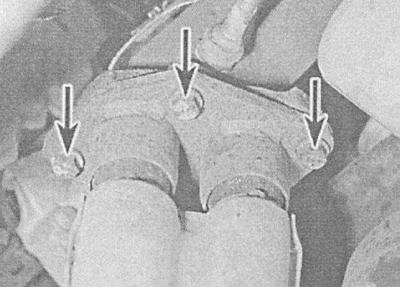
2. Loosen the nut securing the intake pipe to the support bracket, remove the washer, bushing and rubber support.
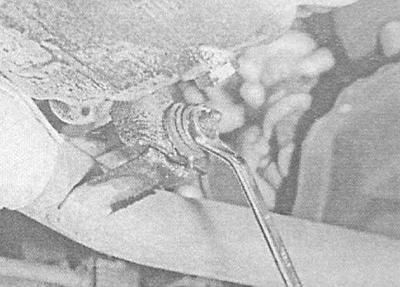
3. Loosen the fastening clamp, separate the inlet pipe from the intermediate section and remove it from under the car. Remove the sealing gasket of the flange joint with the exhaust manifold.
Models with 1.8 and 2.0 L DOHC engines
1. Follow the wiring from the lambda probe to the connector and disconnect the latter - try to remember the order of the harness routing. There is no need to remove the sensor - the pipe can be removed together with it.
2. Unscrew the bolts of the flange connection of the inlet pipe to the exhaust manifold.
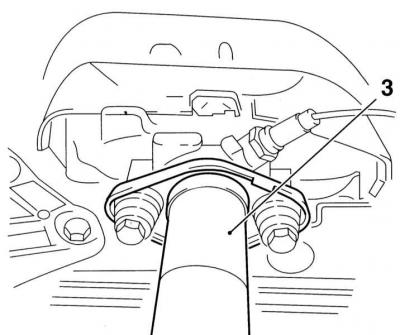
3. Loosen the nuts securing the intake pipe to the support bracket and remove the mounting plate.
4. Loosen the fastening clamp, separate the inlet pipe from the intermediate section and remove it from under the car. Remove the sealing gasket of the flange joint with the exhaust manifold.
Diesel models
The receiving section includes a catalytic converter.
1. Loosen the clamp securing the inlet pipe to the middle section of the exhaust system.
2. Separate the inlet pipe from the turbocharger assembly, remove the sealing gasket.
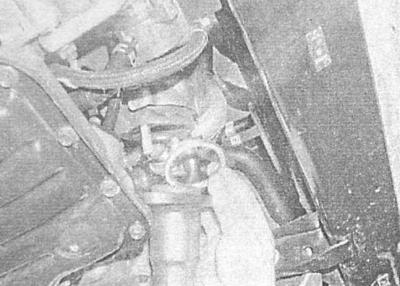
3. Separate the downpipe from the center section and remove it from under the vehicle.
Middle section
All models
1. Loosen the clamp securing the middle section to the exhaust pipe and loosen the spring-loaded bolts securing it to the rear section.
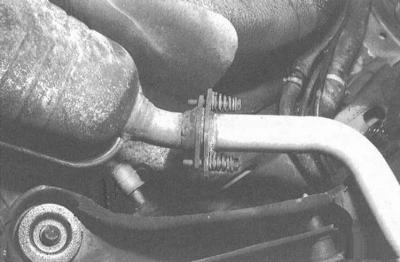
2. Remove the middle section from the rubber hangers, disconnect it from the downpipe and rear section and remove it from under the car.
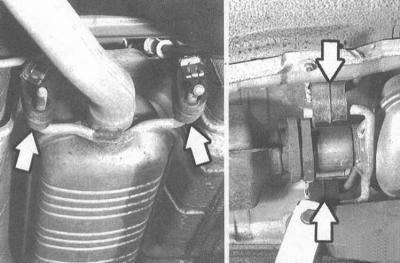
Rear section
All models
1. Unscrew the spring-loaded bolts of the flange connection of the rear section with the middle one.
A — Flange connection for fastening the middle section of the exhaust system to the rear section
B — Rubber hangers for the support brackets of the rear section of the exhaust system
A.
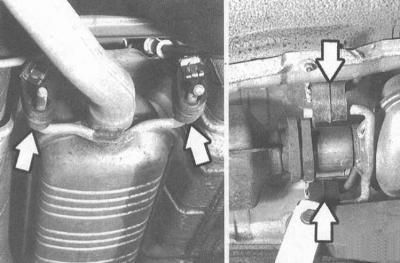
B.
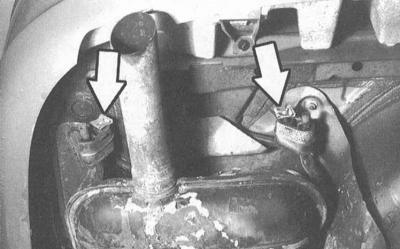
2. Remove the rear section from the rubber hangers and separate it from the intermediate section - the sealing gasket must be replaced without fail.
Exhaust system assembly
Models with SOHC engines
1. Unscrew the spring-loaded bolts of the flange connection of the inlet pipe to the exhaust manifold.
2. Remove the system from the rubber mounts and take it out from under the vehicle; the flange connection sealing gasket must be replaced without fail.
Models with 1.4 and 1.6 l DOHC engines
1. Loosen the nuts securing the intake pipe to the support bracket, remove the mounting plate/washer and rubber support.
2. Unscrew the bolts securing the inlet pipe to the manifold, remove the sealing gasket - the gasket must be replaced during assembly.
3. Remove the system from the rubber hangers, lower it and remove it from under the vehicle.
Models with 1.8 and 2.0 L DOHC engines
1. Follow the wiring from the lambda probe to the connector and disconnect the latter - try to remember the order of the harness routing. There is no need to remove the sensor - the pipe can be removed together with it.
2. Loosen the nuts securing the intake pipe to the support bracket, remove the mounting plate/washer and rubber support.
3. Unscrew the bolts of the flange connection of the inlet pipe to the exhaust manifold, remove the sealing gasket - during assembly the gasket must be replaced without fail.
4. Remove the system from the rubber hangers, lower it and remove it from under the vehicle.
Heat shields
The screens are attached to the bottom of the car with various nuts and bolts. The screens are removed after preliminary dismantling of the corresponding section of the exhaust system. If the removal is done to provide access to the element located underneath, it will be enough to simply release the fastener and lower the screen shield down.
Installation
Each section is installed in the reverse order of its dismantling. Please note the following:
1. Before installation, thoroughly clean the mating surfaces of the sections, prepare replacement sealing gaskets.
2. Check the condition of the rubber suspensions, replace defective components.
3. If the sections are joined without using sealing gaskets, coat the joint with a special sealant.
4. Before tightening the fasteners, make sure that the system is secured in all hangers and that its components do not come into contact with the body elements and suspension parts of the vehicle.
Visitor comments