


Like the Vectra before it, the Insignia is available in sedan and hatchback body styles. Traditionally, the station wagon stands apart from all other modifications, but the Caravan designation used for more than half a century no longer corresponds to the desired image, so the Vectra Caravan has been replaced by the Insignia Sports Tourer station wagon.
"Insignia" in English means "sign of distinction", which is very symbolic, since this car is the embodiment of the new concept of the Opel company, its new "face" in the 21st century. The design of the model is a complex combination of cheekbones of precision and German richness, voluminous forms and strict contours.
The interior of the car is distinguished by emotional architecture and meticulous attention to detail, as well as the quality of finishing materials and assembly. Everything is done at a high level in order to emphasize that the owner of the Opel Insignia belongs to the select circle of people who can afford to drive such a solid car. The instrument dials have "per-second" markings, like on expensive sports chronometers. All rotating knobs are equipped with rubberized notches and have verified switching efforts. The central console inclined at an angle of 30 degrees in combination with the front panel that goes onto the doors seems to create a real cockpit around the driver. At first glance, such a layout may seem cramped, but the Insignia is more spacious than many of its competitors. The range of adjustments of the driver's seat allows a driver of any height and build to get comfortable. The climate control system, electric windows, Infinity Sound System audio system and other pleasant little things create the comfort and cozy atmosphere typical of business class cars.
The sedan's luggage compartment volume is 500 liters, and a considerable part of this volume is accounted for by the foam insert hidden under the false floor with compartments for small items, but the rear seat backs folding in a ratio of 2:3 do not form a step. The Sports Tourer station wagon, although it does not differ from the sedan in the length of the wheelbase, but thanks to the rear body kit increased by 80 mm, can boast a luggage compartment with a volume of 540 liters, which is 10 liters more than even the station wagon-predecessor Vectra Caravan, famous for its spaciousness.
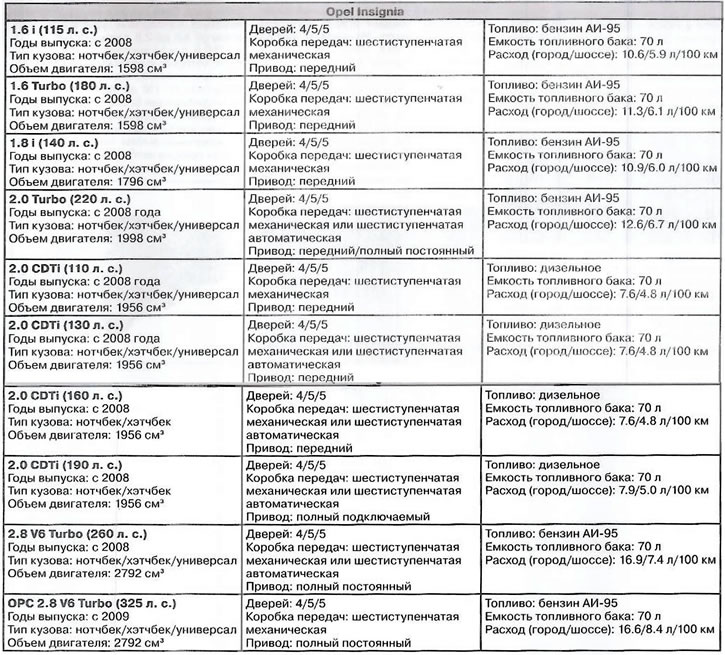
Under the hood of the Opel Insignia model range, petrol engines with a capacity of 1.6 to 2.8 liters and a power of 115 to 260 hp or two-liter turbodiesels, which, depending on the degree of boost, are capable of developing a power of 100 to 160 hp, and their Ecoflex modifications have low CO ₂ emissions, which in Europe will give the owners of such cars the right to tax benefits. Buyers are offered a choice of both manual and automatic transmissions.
The standard equipment of the car is front-wheel drive, while the more expensive version is equipped with an all-wheel drive transmission with two electronically controlled Haldex clutches responsible for distributing torque between the axles and locking the rear differential. All-wheel drive modifications are equipped with a unique multi-link rear suspension with articulated link-to-link levers to ensure better control. The optimal combination of ease and sensitivity of control is provided by power steering. The proprietary FlexRide system in accordance with the selected driving mode (Tour, Standard, Sport) changes not only the stiffness of the shock absorbers, but also the performance of the power steering, the intensity of the response to the gas pedal and even the instrument lighting - in Sport mode it turns red.
An optional extra is the Opel Eye system, which warns the driver about road signs and accidental crossing of lane markings.
The safety of the Opel Insignia deserves special attention. According to the results of tests conducted by the independent organization Euro NCAP, the car received a rating of five stars out of a possible five. Eight airbags, as well as active safety systems ABS, ESP and TCS ensure the safety of the driver and passengers in all driving conditions.
In 2009, the company presented sports versions of the Opel Insignia OPC and OPEL Insignia Sports Tourer OPC. These modifications differ in slightly modified appearance, thanks to sports body kits. The cars are equipped with a forced 325 hp six-cylinder petrol engine with a volume of 2.8 liters, which accelerates the car from 0 to 100 km in just six seconds.
Thanks to the combination of all its advantages, the Opel Insignia was awarded the title of "Car of the Year 2009", beating the Skoda Superb in this nomination, Volkswagen Golf and Ford Fiesta.
Traditionally for Opel cars, the Opel Insignia twin with right-hand control arrangement, the Vauxhall Insignia, is produced in England. In addition, the car is produced under various brands and names, because the Insignia is the first Opel, originally designed taking into account the requirements of markets around the world: in Australia, the car is known under the Holden brand, in China the car will be sold under the name Buick Regal, in the USA, Saturn Aura, and for Latin American countries, the Chevrolet Insignia is intended. This is due to the popularity of brands in a particular point of the globe, as well as the local preferences of car owners.
Opel Insignia is a car that very conditionally belongs to the middle class, because in terms of equipment level, controllability and dynamic characteristics it can confidently compete with many models of more prestigious premium classes.
Visitor comments