
OpelBook.ru
Cars AvtoVAZ Cars Mitsubishi Cars BMW Cars Mercedes Cars Nissan Cars Toyota Cars Chevrolet
English Русский
Български
Беларускі
Український
Српски
Hrvatski
Română
Polski
Slovenský
Magyar
 |  Sitemap  |  Contacts  |    


Main Astra Corsa Insignia Kadett Omega Vectra Zafira Others Articles
Insignia A (2008-2017)
  • Main
  • Insignia
  • Insignia A
  • Chassis
  • Brake system
  • Visual inspection of the performance of the hydraulic brake system components

Visual inspection of the performance of the hydraulic brake system components (Opel Insignia A)

            0

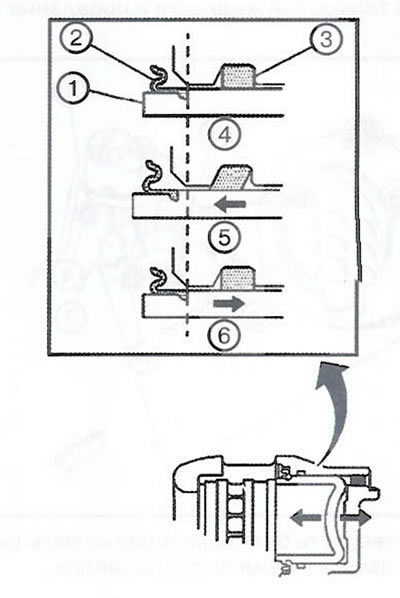
1. Remove the wheel from the vehicle and visually inspect the sealing area of the caliper piston boot (2) for brake fluid leaks.

1. Remove the wheel from the vehicle and visually inspect the sealing area of the caliper piston…


2. If traces of brake fluid leaks are detected, the brake caliper needs to be repaired or replaced.

3. Mark the position of the caliper piston (1) relative to the caliper body when the brake system is at rest (4).

4. Ask an assistant to press and release the brake pedal several times and observe the caliper piston:
  • Make sure that the piston (1) moves freely and smoothly each time the brakes (5) are activated.
  • Make sure that the piston (1) returns smoothly and without obstruction each time the brake pedal (6) is released.

5. If the caliper piston (1) does not move freely and smoothly in one direction or another, the square section seal (3) of the piston may be worn or damaged, so the brake caliper requires repair or replacement.


This article is available at russian, bulgarian, belarusian, ukrainian, serbian, croatian, romanian, polish, slovak, hungarian
Checking the article: Zinoviev Kirill

Share information:

Previous articles
Opel Insignia A: Brake system
Next articles

Checking brake lines and hoses
Checking for external brake fluid leaks
Checking the vacuum in the brake booster system
Checking the brake pedal travel
Parking brake system
Slope assist system
Bleeding the brake system
Replacing the pedal assembly
Replacing the master brake cylinder
Replacing the brake booster
Replacing the brake system expansion tank
Replacing the front brake line


See similar ones from other Opel car manuals:
▶ Checking the tightness of the hydraulic brake system Opel Astra J (2009-2015, petrol)
▶ Checking the brake fluid level in the hydraulic reservoir… Opel Corsa C (2000-2006, petrol)
▶ Bleeding the brake hydraulic system without special… Opel Kadett E (1984-1995)
▶ Brake hydraulic system — bleeding Opel Vectra A (1988-1995, petrol)
▶ Brake system Opel Omega A (1986-1993)
Link to this page in different formats

Visitor comments


No comments yet


How much will 45 + 50 =


Insignia A (2008-2017) 
  • General information
  • Repair on the road
  • Daily checks
  • Operation and maintenance
  • Safety and tool
  • Power unit
  • Petrol engines 1.6 l
  • Petrol engines 2.0 l
  • Diesel engines 2.0 l
  • Diesel engines 2.8 l
  • Cooling system
  • Lubrication system
  • Supply system
  • Engine management
  • Intake and exhaust system
  • Engine electrical equipment
  • Transmission
  • Clutch
  • Mechanical gearbox
  • Automatic gearbox
  • Transfer case
  • Drive shafts
  • Chassis
  • Wheel suspension
  • Brake system
  • Steering
  • Body
  • Exterior
  • Interior
  • Passive safety
  • Heater and air conditioner
  • Electrical equipment
  • Electrical circuits
OpelBook.ru © 2017–2026 · Mobile version · · Sitemap: EN BG BY UA RS HR RO PL SK HU · Feedback · Site search
Astra F, petrol · Astra G, petrol · Astra G · Astra H · Astra J, petrol · Corsa B · Corsa C, petrol · Corsa C · Insignia A · Kadett D · Kadett E · Omega A · Omega B · Omega B2 · Vectra A, petrol · Vectra A · Vectra B, petrol · Vectra B · Vectra C · Zafira A, petrol · Frontera A, petrol · Frontera B · Ascona C · Vivaro A ·
We want your visit to be comfortable 🤝! We use cookies 🍪 to make that happen.