
OpelBook.ru
Cars AvtoVAZ Cars Mitsubishi Cars BMW Cars Mercedes Cars Nissan Cars Toyota Cars Chevrolet
English Русский
Български
Беларускі
Український
Српски
Hrvatski
Română
Polski
Slovenský
Magyar
 |  Sitemap  |  Contacts  |    


Main Astra Corsa Insignia Kadett Omega Vectra Zafira Others Articles
Astra F (1991-1998, petrol) Astra G (1998-2004, petrol) Astra G (1998-2004) Astra H (2004-2009) Astra J (2009-2015, petrol)
  • Main
  • Astra
  • Astra G
  • Power unit
  • Supply system
  • Removal and installation air intake tract components

Removal and installation air intake tract components (Opel Astra G)

            0

Contents: Removal ⬇ Installation ⬇

Removal


Petrol models


Astra Models


1. Loosen the clamp securing the intake air duct to the throttle body. Release the latches securing the air duct to the air cleaner housing, loosen the mounting screw/nut and remove the air cleaner assembly from the engine compartment.
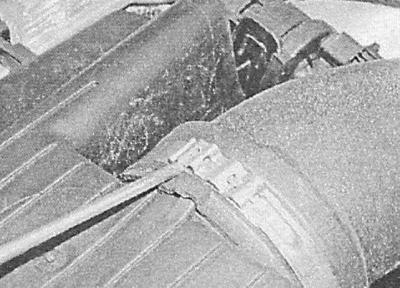
1. Loosen the clamp securing the intake air duct to the throttle body. Release the latches securing…


2. Release the carbon adsorber purge valve from the bracket on the air cleaner housing.
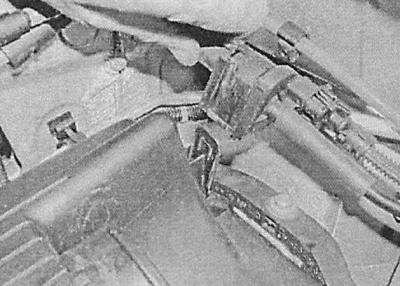
2. Release the carbon adsorber purge valve from the bracket on the air cleaner housing.


On models with central injection, you will also need to disconnect the vacuum hose and warm air supply hose from the air cleaner housing.
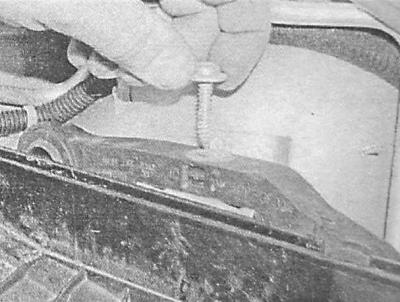
On models with central injection, you will also need to disconnect the vacuum hose and warm air…


3. In some cases, dismantling the air cleaner involves disconnecting the crankcase ventilation hoses and disconnecting the electrical wiring connectors. Sometimes the air duct is bolted to the bracket.
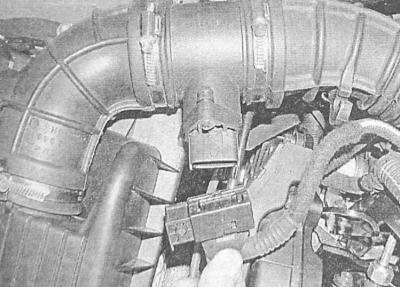


3. In some cases, dismantling the air cleaner involves disconnecting the crankcase ventilation…


Zafira Models


1. Remove the engine compartment sealing strip and the cowl cover installed under the lower edge of the windshield.

2. To gain access to the air intake duct, loosen the mounting nuts/bolts and remove the upper front panel cover.
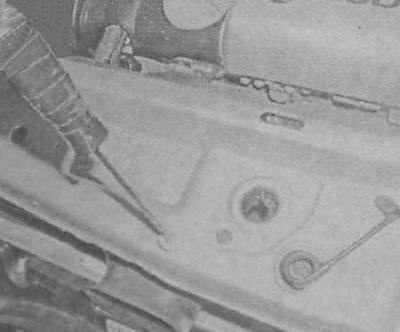
2. To gain access to the air intake duct, loosen the mounting nuts/bolts and remove the upper front…


3. Remove the air cleaner and air ducts (see above).

Diesel models


Models 1.7 l


Connection diagram of the components of the air intake tract (1.7L SOHC models)
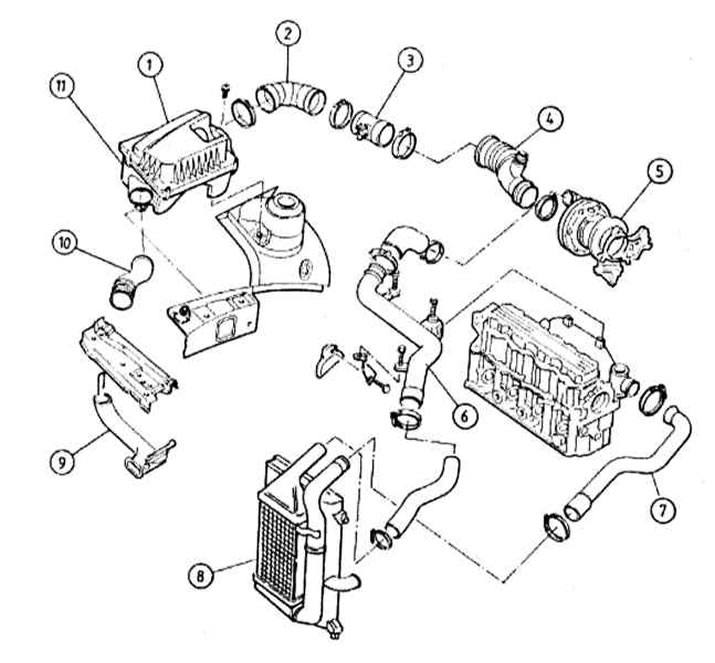
1 — Air cleaner housing cover

1 — Air cleaner housing cover

2 — Air intake duct

3 — Mass Air Flow (MAF) Sensor

4 — Air intake duct

5 - Turbocharger

6 — Pressurization sleeve

7 — Boost hose

8 — Intercooler

9 — Air intake duct

10 — Connecting sleeve

11 — Air cleaner housing


Connection diagram of the components of the air intake tract (1.7L DOHC models)
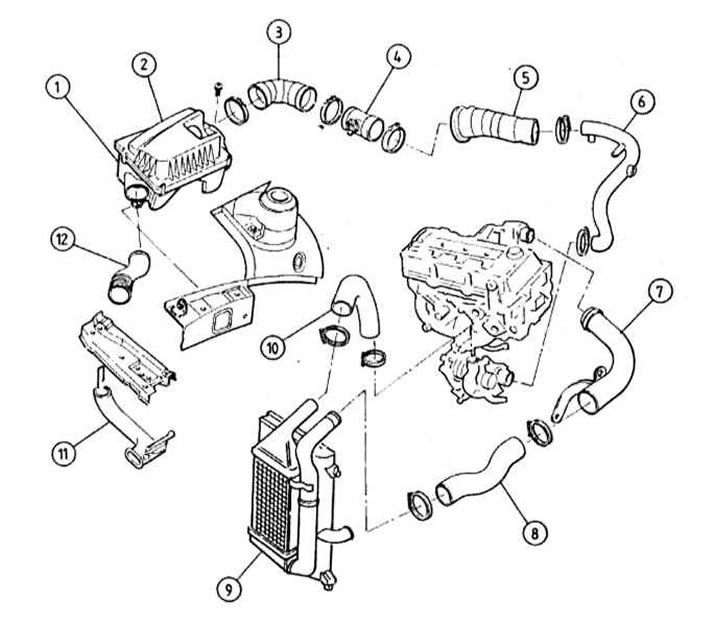
1 — Air cleaner housing

1 — Air cleaner housing

2 — Air cleaner housing cover

3 — Air intake duct

4 — Mass Air Flow (MAF) Sensor

5 — Air intake duct

6 — Inlet manifold

7 — Boost inlet pipe

8 - Connecting hose

9 — Intercooler

10 — Boost hose

11 — Pressurization sleeve

12 — Connecting sleeve


1. Loosen the clamp and remove the air intake duct from the rear of the air cleaner housing (see illustrations Connection diagram of the components of the air intake tract (1.7L SOHC models) and Connection diagram of the components of the air intake tract (1.7L DOHC models)).

2. Remove the screws (with TORX type heads) fastening the air cleaner bracket to the body and remove the air cleaner from the engine, - note that there is a protrusion at the bottom of the air cleaner housing, which during installation must be correctly aligned with the corresponding recess in the mudguard.

3. The other air ducts leading to the turbocharger, intercooler and intake manifold can be removed by loosening the corresponding clamps and unscrewing the mounting screws. Note that the air duct connecting the air cleaner housing to the intake jack has a built-in mass air flow (MAF) sensor - disconnect the wiring and remove the sensor before removing the intake duct.
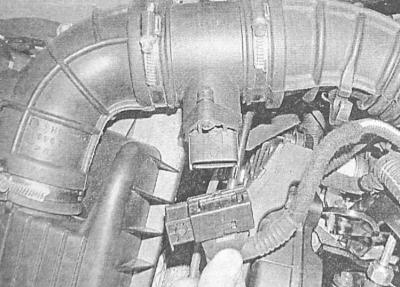


3. The other air ducts leading to the turbocharger, intercooler and intake manifold can be removed…


2.0L models


Connection diagram of the components of the air intake tract (2.0L low-pressure turbo models)
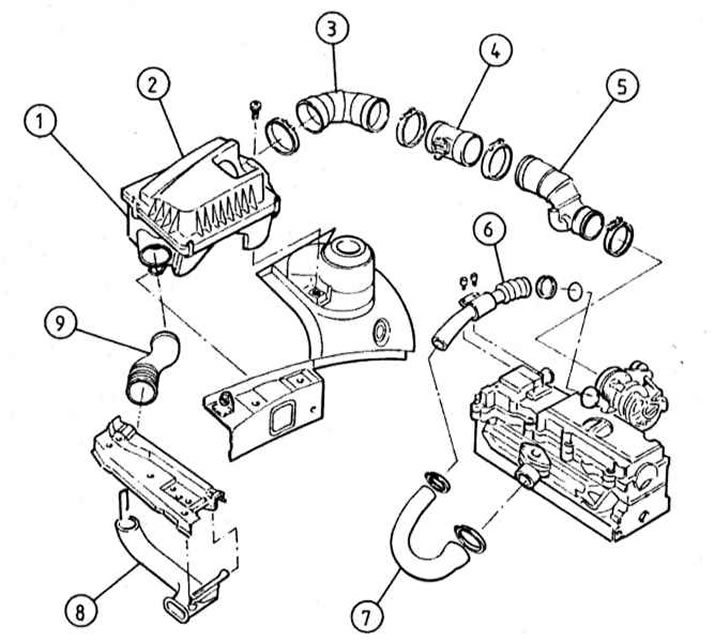
1 — Air cleaner housing

1 — Air cleaner housing

2 — Air cleaner housing cover

3 — Air intake duct

4 — MAF sensor

5 — Air intake duct

6 — Pressurization sleeve

7 - Connecting hose

8 — Air intake duct

9 — Connecting sleeve


Connection diagram of the components of the air intake tract (2.0L high-pressure turbo models)
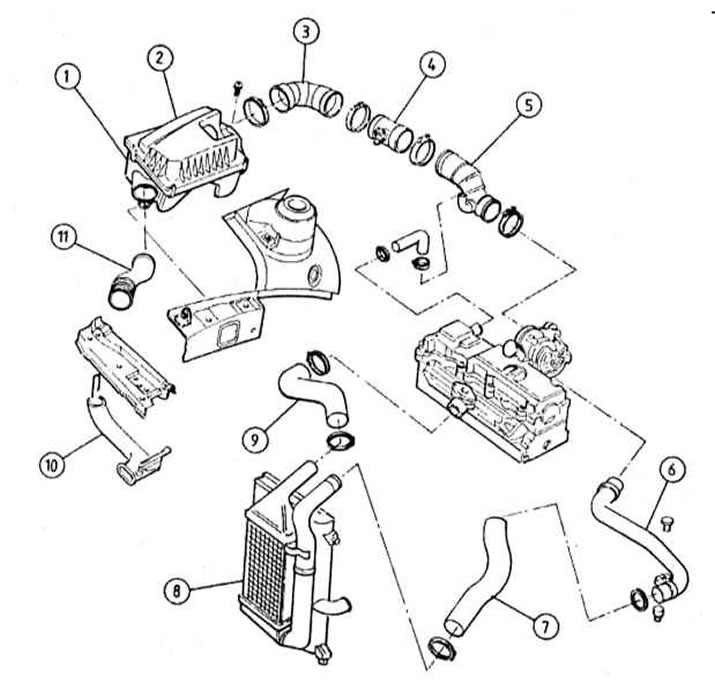
1 — Air cleaner housing

1 — Air cleaner housing

2 — Air cleaner housing cover

3 — Air intake duct

4 — MAF sensor

5 — Air intake duct

6 — Pressurization sleeve

7 — Boost hose

8 — Intercooler

9 — Boost hose

10 — Air intake duct

11 — Connecting sleeve


1. On Zafira models, remove the engine bay weather strip and the cowl cover located under the lower edge of the windscreen. To gain access to the air intake duct, loosen the retaining nuts/bolts and remove the upper front panel cover.

2. On all models, disconnect the negative wire from the battery, as well as the electrical wiring from the MAF sensors and, if installed, the intake air temperature (IAT).

(Material copied from this website: OpelBook)
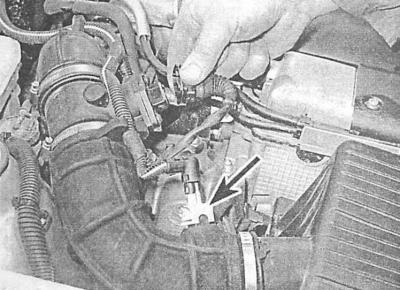
2. On all models, disconnect the negative wire from the battery, as well as the electrical wiring…


3. Disconnect the crankcase ventilation hose from the intake air duct, loosen the mounting clamp and remove the air duct assembly together with the air mass meter sensor and remove it from under the hood.

4. Release the clamps, remove the air cleaner housing cover and remove the filter element - try to remember the installation position of the components. Unscrew the mounting bolt and remove the air cleaner housing, disconnecting it from the air intake duct.

5. On models with low-pressure turbocharging (x20DTL/Y20DTL engines) (see illustration Connection diagram of the components of the air intake tract (2.0L low-pressure turbo models)) To remove the air ducts leading to the turbocharger and intake manifold, first unscrew the mounting screws and remove the plastic protective cover from the engine. Release the air duct fastening clamp connecting the metal sleeve to the pipeline. Unscrew the bolts securing the tube to the cylinder head cover, loosen the mounting clamp and disconnect the sleeve from the turbocharger. Remove the sleeve and air duct assembly from the top of the engine and remove the sealing ring installed between the sleeve and the compressor.


6. On models with high-pressure turbocharging (y2ODTH engine) (see illustration Connection diagram of the components of the air intake tract (2.0L high-pressure turbo models)) loosen the clamps/bolts and remove the air ducts connecting the intercooler and the intake manifold, as well as the turbocharger sleeve. To remove the metal sleeve, disconnect the air duct from it, then loosen the clamp securing the sleeve to the turbocharger. Unscrew the mounting bolt and remove the sleeve from the engine, - pay attention to the sealing ring installed.

Installation


All models


Installation is carried out in the reverse order of dismantling the components.

1. Make sure that the air duct clamps are tightened securely 2.0L diesel engines don't forget to replace the sealing ring at the junction of the metal sleeve with the turbocharger (if the sleeve was disconnected).


This article is available at russian, bulgarian, belarusian, ukrainian, serbian, croatian, romanian, polish, slovak, hungarian
Checking the article: Pavlovsky Nikolay

Share information:

Previous articles
Opel Astra G: Supply system
Next articles

Removal contaminants from the fuel system of a diesel engine
Removal air from the fuel system of a diesel engine
Checking the condition and replacing fuel lines and their fittings
Relieving pressure in the fuel system of gasoline engines
General information and precautions
Power and exhaust system specifications
Removal, installation and adjusting the throttle cable — petrol models
Removal and installation the accelerator pedal
Removal and installation the fuel pump — petrol models
Removal and installation the fuel level sensor
Removal and installation the fuel tank
Removal and installation the throttle body — petrol models


See similar ones from other Opel car manuals:
▶ Removal and installation air intake tract components Opel Corsa B (1993-2000)
▶ Removal and installation air intake tract components Opel Vectra C (2002-2008)
▶ Precautions to prevent the collapse of the vehicle or its… Opel Insignia A (2008-2017)
▶ Distinctive components of the Motronic ML4.1 system from… Opel Kadett E (1984-1995)
▶ Engine Components — Inspection and Refurbishment Opel Omega A (1986-1993)
Link to this page in different formats

Visitor comments


No comments yet


How much will 49 + 35 =


Astra J (2009-2015, petrol) 
  • General information
  • Vehicle device
  • User manual
  • Faults en route
  • Maintenance
  • Power unit
  • Engine repair
  • Cooling and lubrication system
  • Engine power system
  • Exhaust system
  • Transmission
  • Clutch
  • Car gearbox
  • Drive shafts
  • Chassis
  • Front suspension
  • Rear suspension
  • Steering
  • Brake system
  • Wheels and tires
  • Body
  • Exterior
  • Interior
  • Doors and windows
  • Body Care
  • Heating and air conditioning
  • Security systems
  • Electrical equipment
  • Equipment and devices
  • Lighting and signaling
  • Power devices
  • Electrical circuits
Astra H (2004-2009) 
  • General information
  • Introduction to the guide
  • Troubleshooting
  • User manual
  • Maintenance
  • Power unit
  • Engine repair
  • Cooling and heating
  • Power and exhaust system
  • Ignition system
  • Launch and charge system
  • Transmission
  • Mechanical gearbox
  • Automatic gearbox
  • Drive shafts
  • Chassis
  • Brake system
  • Car suspension
  • Steering
  • Body
  • Interior
  • Exterior
  • Electrical equipment
  • Equipment and devices
  • Electrical circuits
Astra G (1998-2004) 
  • General information
  • Introduction to manual
  • User manual
  • Maintenance
  • Power unit
  • SOHC gasoline engines
  • DOHC gasoline engines
  • Diesel engines 1.7 and 2.0
  • Engine repair
  • Cooling system
  • Supply system
  • Injection system (gasoline)
  • Injection system (diesel)
  • Exhaust system
  • Charge and launch system
  • Ignition system (gasoline)
  • Preheat system (diesel)
  • Transmission
  • Manual gearbox
  • Automatic gearbox
  • Clutch
  • Drive shafts
  • Chassis
  • Brake system
  • Wheel suspension
  • Steering
  • Body
  • Exterior
  • Interior
  • Doors and windows
  • Ventilation and heating
  • Electrical equipment
  • Equipment and devices
  • Electrical circuits
Astra G (1998-2004, petrol) 
  • General information
  • User manual
  • Car care
  • Maintenance
  • Power unit
  • Single shaft engines
  • Twin shaft engines
  • Engine repair
  • Cooling and heating
  • Fuel and exhaust systems
  • Starting and charging system
  • Ignition system
  • Transmission
  • Clutch
  • Mechanical gearbox
  • Automatic gearbox
  • Drive shafts
  • Chassis
  • Brake system
  • Car suspension
  • Steering
  • Body
  • Interior
  • Exterior
  • Electrical equipment
  • Equipment and devices
  • Wiring diagrams Opel Astra
  • Wiring diagrams Opel Zafira
Astra F (1991-1998, petrol) 
  • General information
  • Maintenance
  • Power unit
  • Engine in car
  • Engine removed
  • Cooling system
  • Heating and ventilation
  • Fuel supply (carburetor)
  • Fuel supply (injector)
  • Emission control
  • Ignition system
  • Transmission
  • Clutch
  • Mechanical gearbox
  • Automatic gearbox
  • Drive shafts
  • Chassis
  • Brake system
  • Car suspension
  • Steering
  • Body
  • Exterior
  • Interior
  • Electrical equipment
  • Equipment and devices
  • Electrical circuits
OpelBook.ru © 2017–2026 · Mobile version · · Sitemap: EN BG BY UA RS HR RO PL SK HU · Feedback · Site search
Astra F, petrol · Astra G, petrol · Astra G · Astra H · Astra J, petrol · Corsa B · Corsa C, petrol · Corsa C · Insignia A · Kadett D · Kadett E · Omega A · Omega B · Omega B2 · Vectra A, petrol · Vectra A · Vectra B, petrol · Vectra B · Vectra C · Zafira A, petrol · Frontera A, petrol · Frontera B · Ascona C · Vivaro A ·
We want your visit to be comfortable 🤝! We use cookies 🍪 to make that happen.