


All petrol engines and 1.7L diesel engine
Removal
Disconnect the connector from the oil pressure sensor.
Remove the timing belt.
Remove the camshaft pulley.
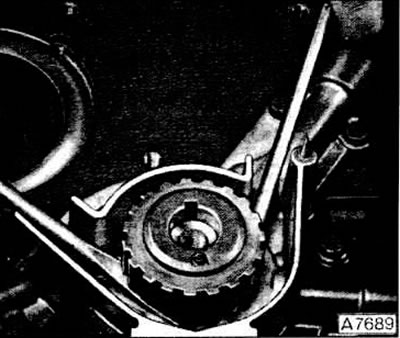
Remove the toothed pulley from the crankshaft using two screwdrivers. Remove the key from the crankshaft.
Remove the rear timing belt cover.
Remove the oil pan.
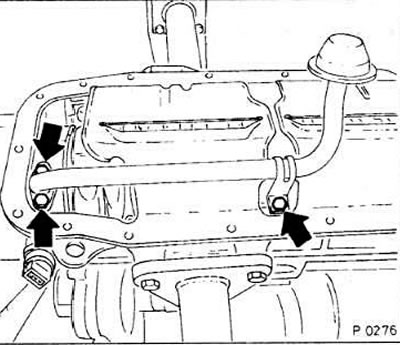
Remove the oil filter.
Remove the oil pressure sensor from the oil pump.
[Original source on the website: OPELBOOK]
Remove the oil pick-up from the oil pump.
Disconnect the oil pump from the cylinder block and remove it.
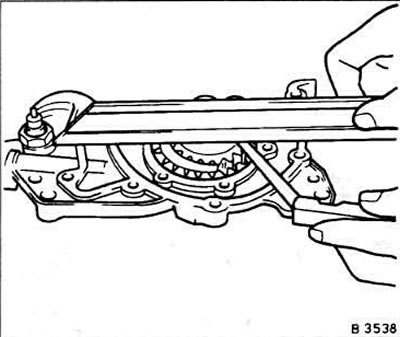
Remove the oil pump cover and measure the lateral clearance of its gears. It should be 0.1-0.2 mm. The distance between the pump body and the gears should be:
- for engines with a volume of 1.7, 1.8 and 2.0 l - 0.03-0.10 mm,
- for engines with a volume of 1.4 and 1.6 l - 0.08-0.15 mm.
Installation
Clean the mating surfaces.
Place the KM-417 bushing on the crankshaft to protect the sealing edges of the oil seal from damage.
Coat the new gasket with thick grease and place it on the pump body.
Install the pump and tighten its mounting screws to a torque of 6 Nm.
Remove the protective sleeve.
Tighten the sensor mounting bolts to a torque of 30 Nm.
Install the oil pan.
Secure the rear timing belt cover.
Install the key on the crankshaft, install the belt pulley. Secure the pulley with a new bolt:
- for 1.8 and 2.0 l engines - with a torque of 130 Nm, tightened with a rigid wrench at an angle of 45-50°,
- for 1.4 and 1.6 liter engines - 55 Nm.
Put on and tighten the timing belt.
For 1.8-2.0 L engines: install the tensioner so that its mark coincides with the pointer on the oil pump housing.
Secure the damper with bolts crosswise to a torque of 20 Nm.
Install the front timing belt cover.
Put on and tighten the V-belt.
Visitor comments