


Contents: Operating conditions of machine oil ⬇ Oil viscosity ⬇ All-season oil ⬇ Oils with improved lubricating…⬇ Characteristics of motor oil ⬇ Engine oil consumption ⬇
Despite all the design and technological improvements of Opel Vectra/Calibra cars, which contribute to increasing their service life, reliability and economy, regular lubrication and maintenance of the car are mandatory.
Operating conditions of machine oil
When operating a vehicle, engine oil operates under constantly changing conditions. Therefore, it is extremely difficult to accurately determine the influence of individual factors on the efficiency of the oil. In engines that operate for a long time at high speeds or at full load, the oil heats up to a high temperature. Under the influence of high temperatures and exposure to atmospheric oxygen, the oil begins to oxidize. Oxidation products lead to an increase in the density of the oil and can be deposited as a coating on the upper surface of the cylinders, in the grooves of the sealing rings and on the valve stems. This can lead to the formation of carbon deposits on the valve plates.
If the cylinders are supplied with an over-rich mixture and the engine rarely runs (or doesn't work at all) at full load or does not reach normal operating temperature (for example, when driving in the city), then the result is incomplete combustion of the combustible mixture. Soot, oil carbon, unburned fuel and condensed moisture form deposits, acids and resins. Unburned fuel condenses on the cold cylinder walls and flows into the oil pan, washing away the thin oil film from the surface of the cylinders and pistons. As a result, the lubrication of the working surfaces of the pistons deteriorates and the oil becomes diluted, which worsens its lubricating ability.
If the oil is too thin, it may need to be replaced earlier than the prescribed period. Since when driving fast (when the engine is hot) since gasoline evaporates from the oil, it is recommended to check the engine oil level more often in winter (more cold engine starts means more gasoline in the oil).
Oil viscosity
Viscosity characterizes the fluidity of the oil. It changes depending on the ambient temperature. When heated, the oil becomes more fluid. This worsens its ability to adhere and the stability of the oil film when the pressure increases. When cooled, the oil thickens, i.e. its fluidity decreases and internal friction increases. Because of this property, it is necessary to use motor oil with a viscosity that changes within the smallest limits when the temperature changes.
When starting a cold engine, the oil must be sufficiently liquid so as not to overload the engine excessively and so that after starting it can quickly penetrate all lubricated areas.
The viscosity of an oil is equivalent to its internal friction and is designated by SAE units (Society of Automotive Engineers - Association of Automotive Engineers), for example, SAE 30, SAE 10, etc. A high SAE rating means that the oil is thick, a low rating characterizes a thinner oil. However, viscosity alone does not provide information about the lubricating properties of the oil.
All-season oil
All-season oils are recommended for use in all Opel Vectra/Calibra engines. The advantage of all-season oils is that they do not need to be replaced due to the change of seasons (summer, winter)These oils are produced on the basis of liquid seasonal oil (for example, 15W). When heated, the oil is stabilized by so-called thickeners, which provides the appropriate lubricating properties at any ambient temperature. If all-season oil is used, then modern oils with a wide range of viscosity should be selected (for example, 15W40, 15W50).
(Material copied from the portal: «opelbook»)
Oils with improved lubricating properties
Oils with improved lubricating properties are all-season oils that, in addition to other additives, contain substances that reduce the coefficient of friction, which leads to a reduction in fuel consumption. Their production requires special starting components (synthetic oils).
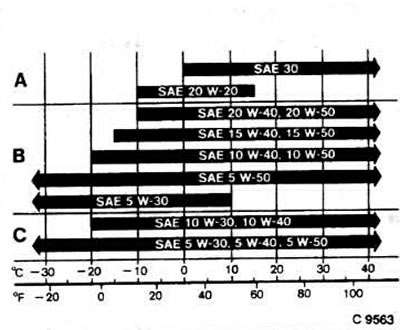
Application areas of oils of different viscosity
A - seasonal oils;
B - all-season oils;
C - all-season oils with improved lubricating properties
Since the limits of use of oils of adjacent SAE classes overlap, short-term temperature fluctuations can be ignored when selecting oil. If oil needs to be added, and the oil in the engine no longer corresponds to the outside air temperature, then it is permissible to mix oils of different viscosity classes with each other.
Attention! Additional additives of any type are not allowed to be mixed with either oils or fuel!
Characteristics of motor oil
Only HD quality oils may be used in modern engines. These are enriched oils whose lubricating properties have been significantly improved by the addition of various chemically active additives. These additives provide anti-corrosion protection of lubricated parts, increase oil resistance to oxidation, reduce the formation of sediments inside the engine, have a more stable viscosity, and also have detergent and solvent properties. Detergent and solvent additives not only reduce the formation of sediments (deposits) in the engine, but also at the same time have the ability to dissolve them and disperse them together with other contaminants, which makes it possible to remove these contaminants when changing the oil.
The quality of engine oil is indicated in accordance with the API system (American Petroleum Institute — American Petroleum Institute). The symbol consists of two letters. The first letter indicates the application area (S (Service) - for gasoline engines (Commercial) — for diesel engines). The second letter characterizes the quality of the oil (in alphabetical order). According to the API system, the highest quality oil is SH for gasoline engines and CF for diesel engines.
Attention! CF quality motor oils, which are intended for diesel engines, are not suitable for petrol engines.
There are oils that can be used in both types of engines. In this case, two symbols are indicated on the oil container (for example, SG/CD).
For Opel Vectra/Calibra cars with petrol engines, API SG or SH oils must be used, and for diesel engines, CD oils must be used.
European oil manufacturers use the CCMC designation system. It is used by European engine manufacturers and is becoming increasingly popular. Depending on the quality, oils for gasoline engines have designations from G1 to G5, and for diesel engines - PD1 and PD2.
For its petrol engines, Opel recommends using all-season oils of at least G4 quality. Class G5 consists of all-season oils with improved lubricating properties and low viscosity. Both classes roughly correspond to API SF, ensuring compliance with additional European requirements. The CCMC PD2 oil recommended by Opel for diesel engines has a slightly higher quality than CD oil according to the API system.
Engine oil consumption
Oil consumption in an internal combustion engine is understood as the amount of oil consumed by the engine during operation. Oil consumption should not be understood as the amount of oil that leaks out through leaks in connections (i.e. leaks).
Engine oil is consumed when fuel is burned in the cylinders (a small amount) and is carried away with combustion and wear products. Oil is also consumed as a result of high temperatures and pressures in the engine. Oil consumption is affected by the operating conditions of the vehicle and the wear of engine parts. Under normal operating conditions, oil consumption is so insignificant that between two oil changes either one small top-up is required or none at all.
Oil must be topped up if its level is below the specification.
Visitor comments