
OpelBook.ru
Cars AvtoVAZ Cars Mitsubishi Cars BMW Cars Mercedes Cars Nissan Cars Toyota Cars Chevrolet
English Русский
Български
Беларускі
Український
Српски
Hrvatski
Română
Polski
Slovenský
Magyar
 |  Sitemap  |  Contacts  |    


Main Astra Corsa Insignia Kadett Omega Vectra Zafira Others Articles
Omega A (1986-1993) Omega B (1993-1999) Omega B2 (1999-2003)
  • Main
  • Omega
  • Omega B2
  • Power unit
  • Diesel engines 2.5 l
  • Connecting rod and piston group — removal and installation

Connecting rod and piston group — removal and installation (Opel Omega B2)

            0

Contents: Removal ⬇ Piston rings - removal and…⬇ Piston - replacement ⬇

Removal


1. Remove the cylinder head (see the relevant chapter).

2. Remove the oil pump 2 (see the relevant chapter) and strengthening of 1 cylinder block (see illustration).
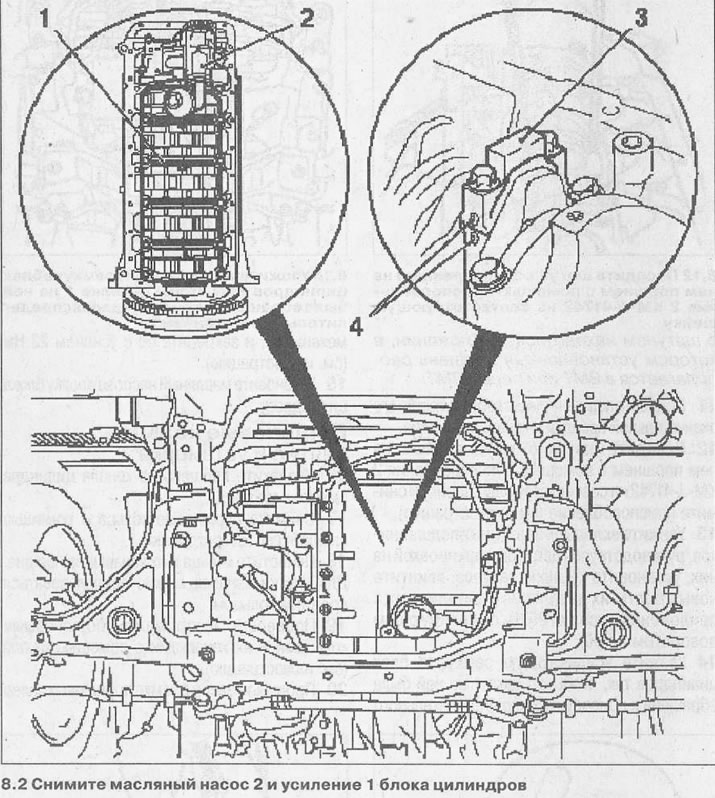
2. Remove the oil pump 2 (see the relevant chapter) and strengthening of 1 cylinder block (see…


3. Mark the mounting position of the pistons, caps and connecting rod bearing shells 3. Connecting rods 4 and their caps have the same markings (see illustration 8.2).

4. Remove carbon deposits from the top of the cylinders and remove the corresponding piston together with the connecting rod.

5. Unscrew the mounting bolts and remove the 2 connecting rod caps 3 (see illustration).
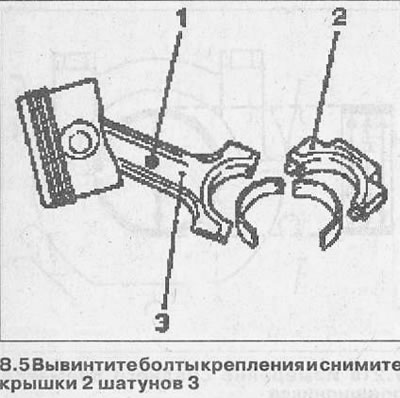
5. Unscrew the mounting bolts and remove the 2 connecting rod caps 3 (see illustration).


6. Place the removed connecting rod caps together with the liners so that you can later install them in their original places.


Attention! According to the color marking 1, one bearing shell with red marking and one shell with blue marking must be installed in each bearing. The shell with the marking "S" is the upper shell.


7. Install tool 4 KM-J-41742 into the connecting rod (see illustration).
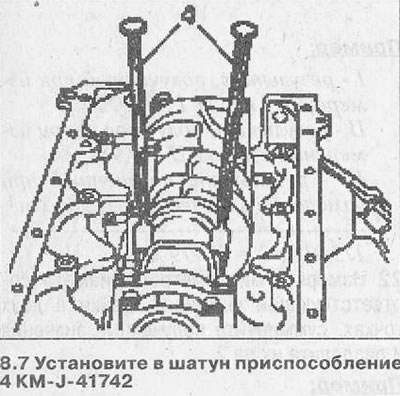
7. Install tool 4 KM-J-41742 into the connecting rod (see illustration).


8. Lubricate the pistons and their rings with a thin layer of motor oil.

9. Install the rings on the pistons, positioning their locks at 120° relative to each other.

10. Compress the rings with a special device 1 and insert the piston with the connecting rod into the cylinder bore. The arrow on the piston bottom should be facing the valve timing drive (see illustration).
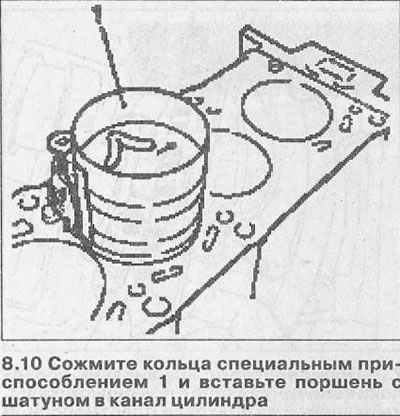
10. Compress the rings with a special device 1 and insert the piston with the connecting rod into…


Attention! When installing the piston with the connecting rod, the corresponding connecting rod journal must be in a position in which the installed piston is located at TDC or before TDC.


11. Tap the piston with the handle of a hammer until it is completely seated in the cylinder bore.

12. Place the connecting rod with the piston secured to it using the tool 2 KM-J-41742 on the corresponding journal and remove the tool (see illustration).
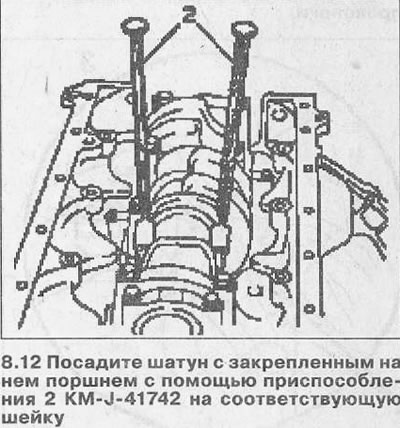
12. Place the connecting rod with the piston secured to it using the tool 2 KM-J-41742 on the…


13. Place the connecting rod bearing shells, following the color markings on them, install the connecting rod caps, screw in the new bolts for fastening them and tighten them with a force of 20 Nm, followed by an additional turn of 60°.

14. Place the reinforcing frame on the cylinder block so that arrow 1 on it faces the timing drive, and secure it with a force of 22 Nm (see illustration).
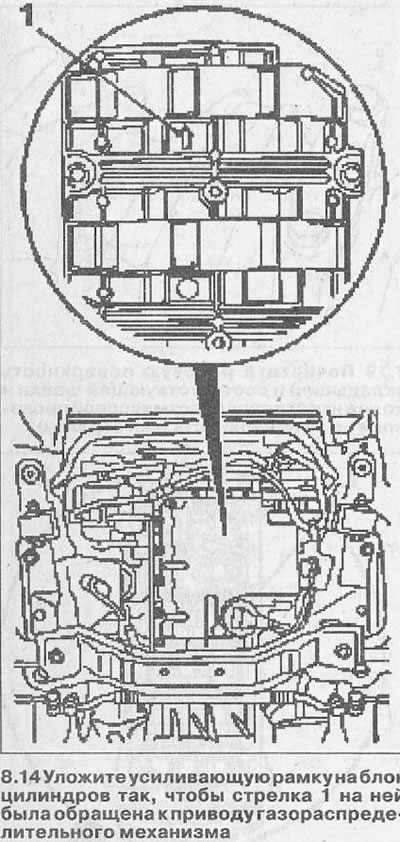
14. Place the reinforcing frame on the cylinder block so that arrow 1 on it faces the timing drive,…


15. Install the oil pump and cylinder head.

Piston rings - removal and installation


16. Remove the piston from the cylinder bore together with the connecting rod.


17. Remove the piston rings using pliers (see illustration).
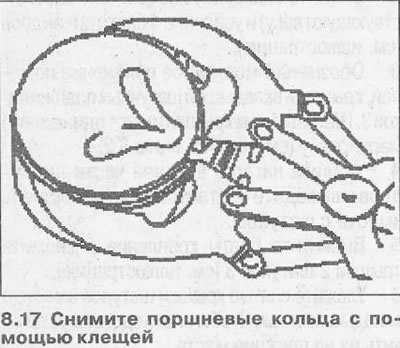
17. Remove the piston rings using pliers (see illustration).


18. Clean the rings and their grooves on the piston. You can use the old ring to clean the grooves.

19. Check the clearance between the piston rings and their grooves using feeler gauges (see illustration).
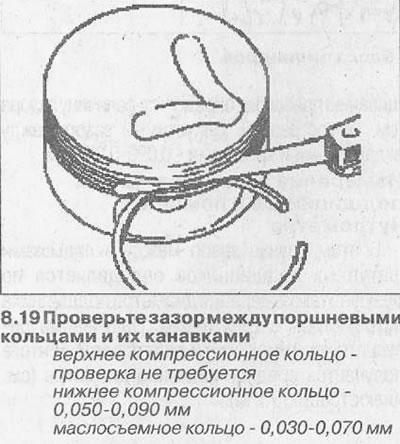
19. Check the clearance between the piston rings and their grooves using feeler gauges (see…


20. Check the gap in the piston ring lock using feeler gauges by inserting the rings into the gauge (see illustration).
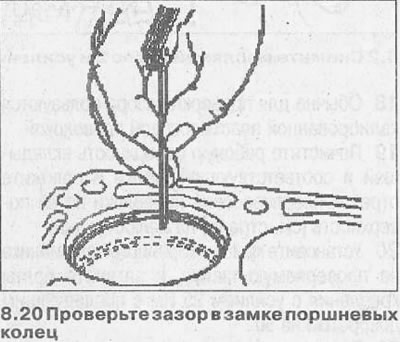
20. Check the gap in the piston ring lock using feeler gauges by inserting the rings into the gauge…


Permissible clearance in the piston ring lock:


  • upper compression ring - 0.20-0.40 mm,
  • lower compression ring - 0.40-0.65 mm,
  • oil scraper ring - 0.25-0.45 mm.

21. Install the piston rings into the grooves using pliers so that the "TOP" inscription on them faces up (see illustration), and their locks were located at 120° relative to each other.
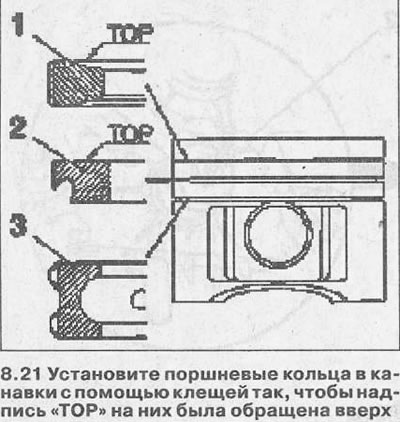
21. Install the piston rings into the grooves using pliers so that the «TOP» inscription on them…


Piston - replacement


22. Remove the piston from the cylinder bore together with the connecting rod.

23. Remove thrust ring 1 from the piston pin using pointed pliers or another suitable tool and press out the pin (see illustration). Attention! The piston and piston pin are matched to each other and their rearrangement is not allowed.
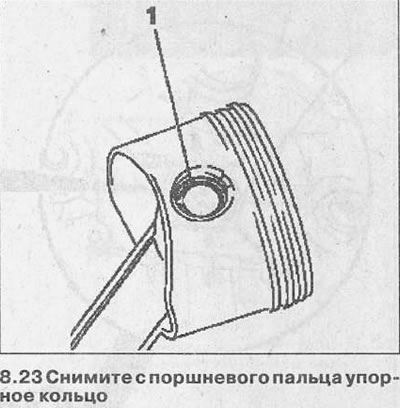
23. Remove thrust ring 1 from the piston pin using pointed pliers or another suitable tool and…


24. Before installing the piston, measure the calculated clearance between the piston and the cylinder by measuring the piston diameter with a micrometer at several points at a distance of 90° from each other, stepping back from its skirt by 7 mm (see illustration).
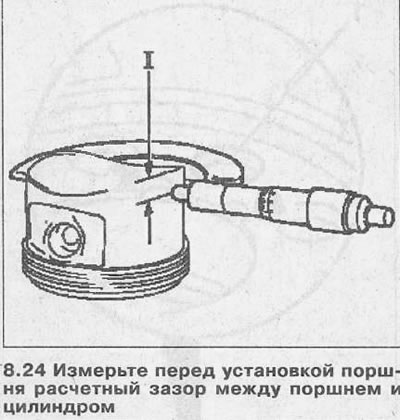


24. Before installing the piston, measure the calculated clearance between the piston and the…


25. Measure the cylinder bore diameter using a bore gauge in three zones (see illustration).

25. Measure the cylinder bore diameter using a bore gauge in three zones (see illustration).
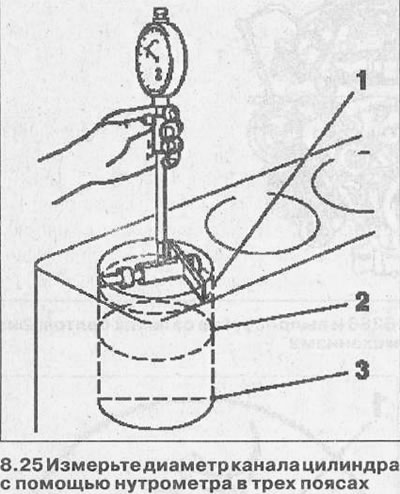

The gap between the piston and the cylinder in new engines is 0.031-0.063 mm, while in used engines it can reach 0.15 mm.

Example of measurements:
  • cylinder bore diameter - 80,000mm
  • piston outer diameter - 79.955mm
  • gap 0.045 mm

26. Install the connecting rod head into the piston, following mark 1 on the connecting rod and the arrow on the piston bottom, which should face the timing drive after installing the connecting rod and piston group into the cylinder block (see illustration).
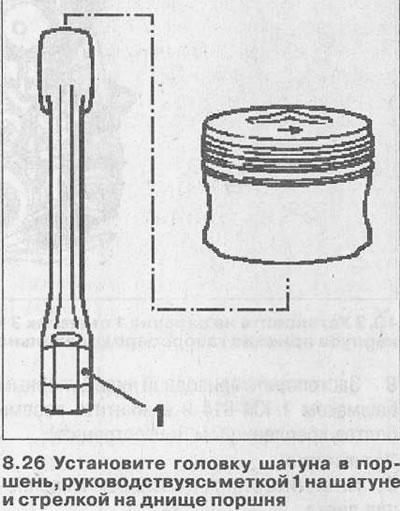
26. Install the connecting rod head into the piston, following mark 1 on the connecting rod and the…


27. Lubricate the piston pin with engine oil and press it in by hand up to the thrust ring seat groove.


Material provided by this website [OPELBOOK.ru]

28. Lock the piston pin with thrust ring 2. The ends of the ring should rest against the corresponding protrusion (see arrow in illustration).
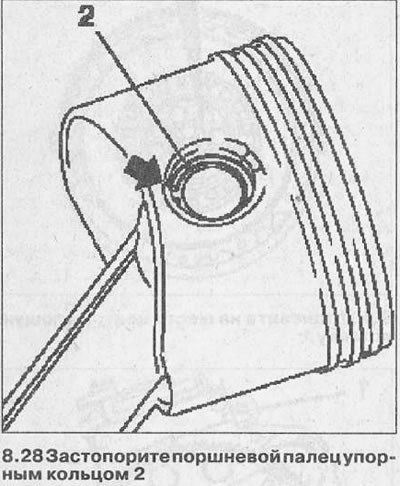
28. Lock the piston pin with thrust ring 2. The ends of the ring should rest against the…


This article is available at russian, bulgarian, belarusian, ukrainian, serbian, croatian, romanian, polish, slovak, hungarian
Checking the article: Shapovalov Yaroslav

Share information:

Previous articles
Opel Omega B2: Diesel engines 2.5 l
Next articles

Crankshaft — removal and installation
Vacuum pump — removal and installation
Cylinder head — overhaul
Cylinder head — removal and installation
TDC of piston of cylinder No. 1 — installation
Cylinder Head Cover — Removal and Installation
Flywheel — removal and installation
Front Crankshaft Oil Seal — Replacement
Rear Crankshaft Oil Seal — Replacement
V-ribbed auxiliary drive belt — removal and installation
Oil pan — removal and installation
Oil pump — removal and installation


See similar ones from other Opel car manuals:
▶ Checking the condition of the connecting rod and piston… Opel Astra G (1998-2004)
▶ Checking the condition of the connecting rod and piston… Opel Corsa B (1993-2000)
▶ Visual inspection and cleaning of the connecting rod and… Opel Insignia A (2008-2017)
▶ Assembly of the connecting rod and piston group Opel Kadett E (1984-1995)
▶ Connecting rod and piston groups — removal and installation Opel Ascona C (1981-1988)
Link to this page in different formats

Visitor comments


No comments yet


How much will 30 + 38 =


Omega B2 (1999-2003) 
  • General information
  • User manual
  • Maintenance
  • Troubleshooting
  • Power unit
  • Petrol 4-cylinder
  • Petrol 6-cylinder
  • Engine overhaul
  • Diesel engines 2.0 l
  • Diesel engines 2.5 l
  • Cooling and heating
  • Injection system (gasoline)
  • Fuel system (diesel)
  • Fuel system
  • Exhaust system
  • Ignition system
  • Transmission
  • Clutch
  • Mechanical gearbox
  • Automatic gearbox
  • Main gear and shafts
  • Chassis
  • Brake system
  • Car suspension
  • Steering
  • Body
  • Body elements
  • Electrical equipment
  • Equipment and devices
  • Electrical circuits
Omega B (1993-1999) 
  • General information
  • User manual
  • Tips for the car owner
  • Maintenance (gasoline)
  • Maintenance (diesel)
  • Power unit
  • Petrol engine SOHC 2.0 l
  • Petrol engine DOHC 2.0 l
  • Petrol engines 2.5 and 3.0 l
  • Repair of gasoline engines
  • Diesel engine 2.0 l
  • Diesel engine repair 2.0 l
  • Diesel engine 2.5 l
  • Cooling and heating
  • Power system (petrol)
  • Emission reduction
  • Fuel system (diesel 2.0 l)
  • Fuel system (diesel 2.5 l)
  • Launch system
  • Ignition system
  • Transmission
  • Clutch
  • Mechanical gearbox
  • Automatic gearbox
  • Drive shafts
  • Chassis
  • Brake system
  • Wheel suspension
  • Steering
  • Body
  • Exterior
  • Interior
  • Doors and windows
  • Electrical equipment
  • Equipment and devices
  • Wiring diagrams (early)
  • Wiring diagrams (late)
Omega A (1986-1993) 
  • General information
  • User manual
  • Maintenance
  • Changes and additions
  • Troubleshooting
  • Power unit
  • Gasoline engines
  • Diesel engines
  • Cooling system
  • Fuel system (gasoline)
  • Fuel system (diesel)
  • Ignition system
  • Transmission
  • Clutch
  • Mechanical gearbox
  • Automatic gearbox
  • Cardan shaft
  • Drive shafts
  • Chassis
  • Brake system
  • Car suspension
  • Steering
  • Body
  • Exterior
  • Interior
  • Electrical equipment
  • Power devices
  • Lighting and appliances
  • Electrical circuits
OpelBook.ru © 2017–2026 · Mobile version · · Sitemap: EN BG BY UA RS HR RO PL SK HU · Feedback · Site search
Astra F, petrol · Astra G, petrol · Astra G · Astra H · Astra J, petrol · Corsa B · Corsa C, petrol · Corsa C · Insignia A · Kadett D · Kadett E · Omega A · Omega B · Omega B2 · Vectra A, petrol · Vectra A · Vectra B, petrol · Vectra B · Vectra C · Zafira A, petrol · Frontera A, petrol · Frontera B · Ascona C · Vivaro A ·
We want your visit to be comfortable 🤝! We use cookies 🍪 to make that happen.