


Removal camshafts
1. Remove the alternator drive belt.
2. Remove the cylinder head cover (see the relevant chapter).
3. Remove the vacuum pump (see the relevant chapter).
4. Disconnect the cooling hose from the cylinder head.
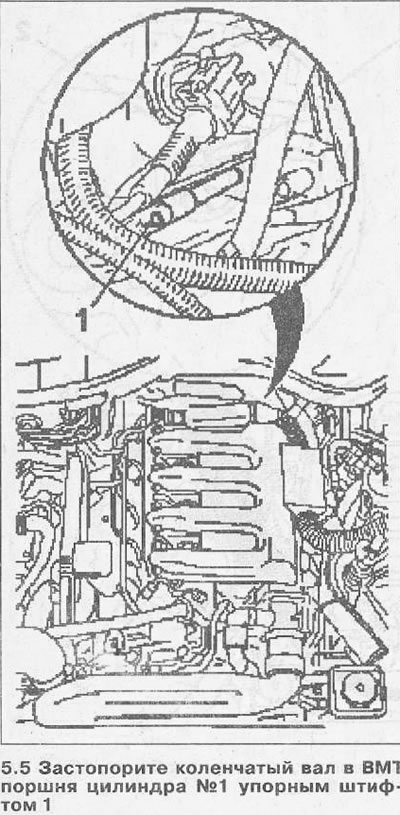
5. Unscrew the plug from the cylinder block and lock the crankshaft at TDC of the piston of cylinder No.1 with stop pin 1, turning the crankshaft by the bolt securing the vibration damper to the belt pulley (see illustration).
At TDC of the piston of cylinder No.1, the cams of the piston valve drive must be facing each other (see arrows in illustration 5.6).
6. Remove chain tensioner 1 and plug 2 from the timing gear housing (see illustration).
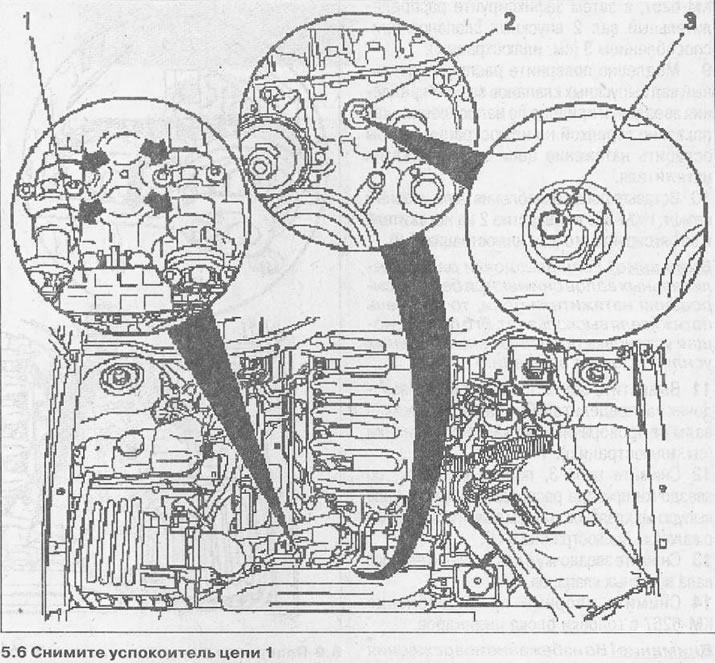
7. Loosen bolt 3 of the hydraulic chain tensioner (see illustration 5.6).
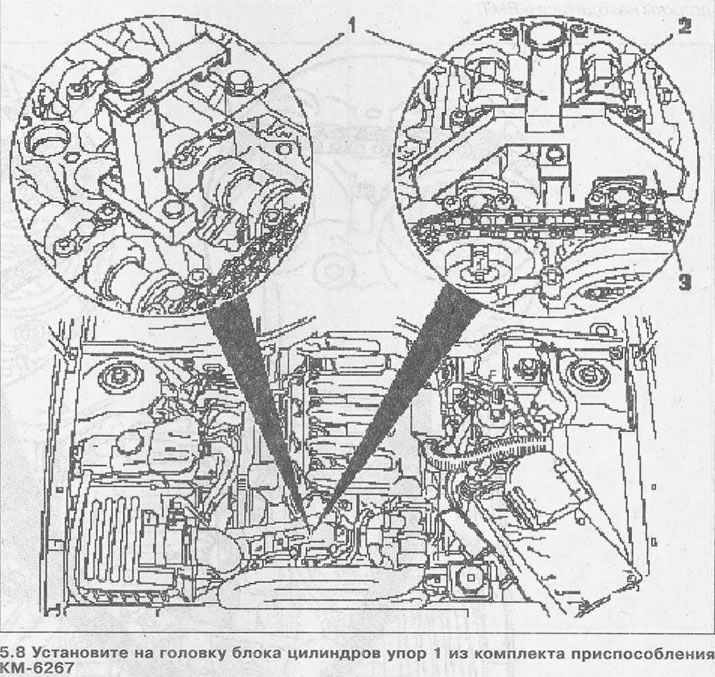
8. Install stop 1 from the KM-6267 tool kit on the cylinder head, and then secure camshaft 2 of the inlet valves with tool 3 (see illustration).
9. Slowly turn the exhaust camshaft by the drive sprocket mounting bolt in the direction shown by the arrow in the illustration to relieve the chain tension by compressing the tensioner.
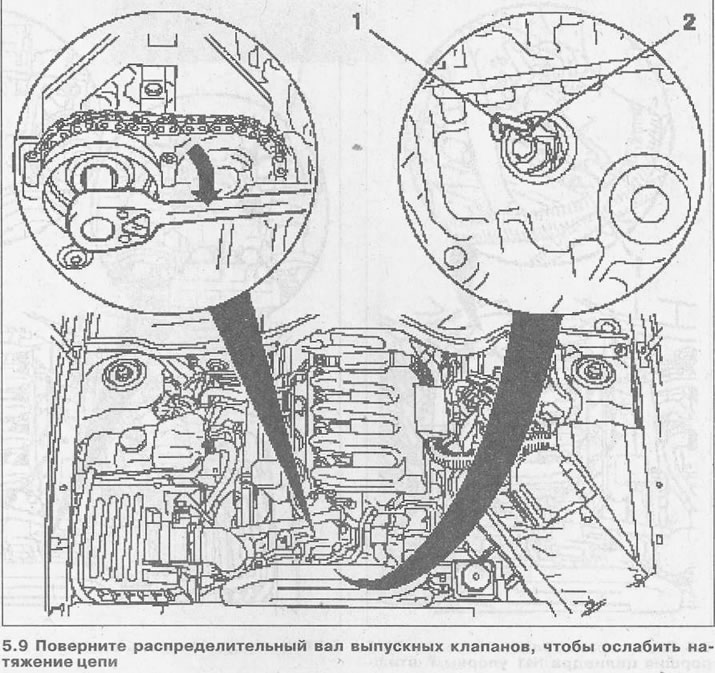
10. After loosening the chain, insert the stop pin 1 KM-823 into the hole 2 on the tensioner and fix it (see illustration 5.9).
Caution! If the camshaft sprockets are removed without securing the chain tensioner, the tensioner piston will slip out. Its subsequent installation will require considerable effort and time.
11. Unscrew bolts 1 and 2 securing the camshaft sprockets, holding the shafts from turning by the hexagons (see illustration).
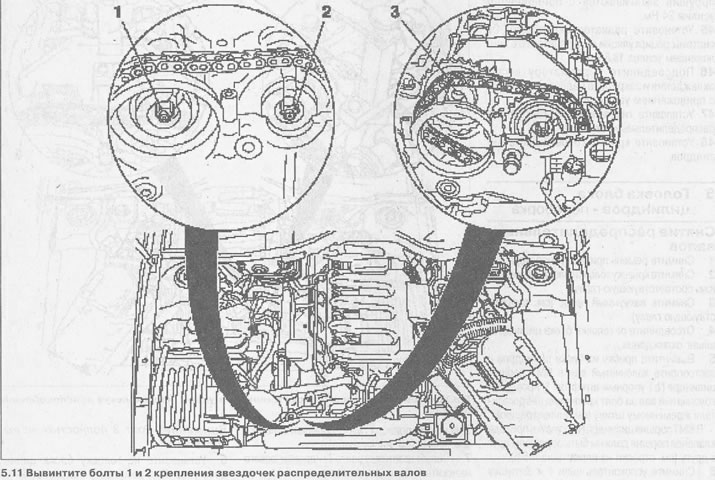
12. Remove chain 3 by lifting it upwards from the exhaust camshaft drive sprocket, and then remove the sprocket from the shaft (see illustration 5.11).
(Text copied from a web portal OpelBook.ru)
13. Remove the sprocket from the intake camshaft.
14. Remove the KM-6267 thrust devices from the cylinder head.
Attention! To avoid damage to the valves when installing the camshafts, the cylinder pistons must not be at TDC.
15. Remove the thrust pin 1 KM-813 and turn the crankshaft 90° in the direction of engine rotation using the vibration damper mounting bolt on the belt pulley (see arrow in illustration). While doing this, keep the timing chain taut.
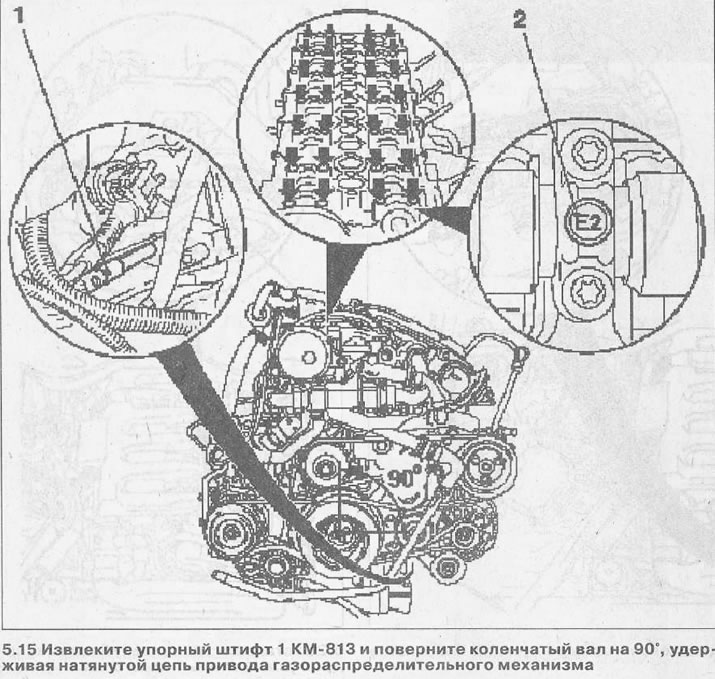
16. Unscrew the camshaft bearing cap mounting bolts, having first loosened them by 1/2 turn and marked the caps (see arrows in illustration 5.15).
17. Remove the camshaft bearing caps and place them so that they can be installed in their original positions during assembly. The caps are also marked 2 (see illustration 5.15).
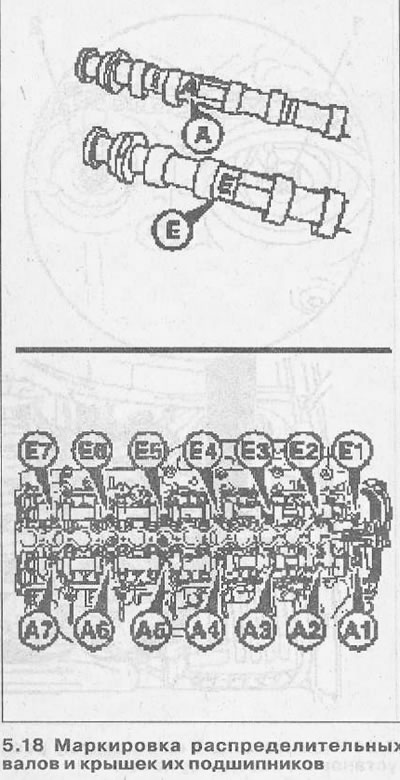
18. Remove the camshafts. When installing the shafts, follow the marks stamped on them. The letter E is on the intake camshaft, and A is on the exhaust camshaft (see illustration). The corresponding marking is also on the camshaft bearing caps. The inlet camshaft caps are marked E1-E7, and the outlet camshaft caps are marked A-A7 (see illustration).
19. Lubricate the camshaft bearing journals with engine oil and place them in their mounting locations.
Lubricate the working surfaces of the camshaft bearing caps and install the camshaft bearing caps, observing the markings made before removal or their markings.
Caution! To ensure the correct position of the camshafts, tighten the cover mounting bolts as shown below.
20. Screw in and tighten the cover bolts by hand, then tighten them ½ turn, working from the center to the ends.
21. Perform a second pass and tighten the bolts to 10 Nm.
22. Turn the camshafts by the hexagons so that the cams of the valve drive of cylinder No.1 are facing each other (see arrows in the illustration).
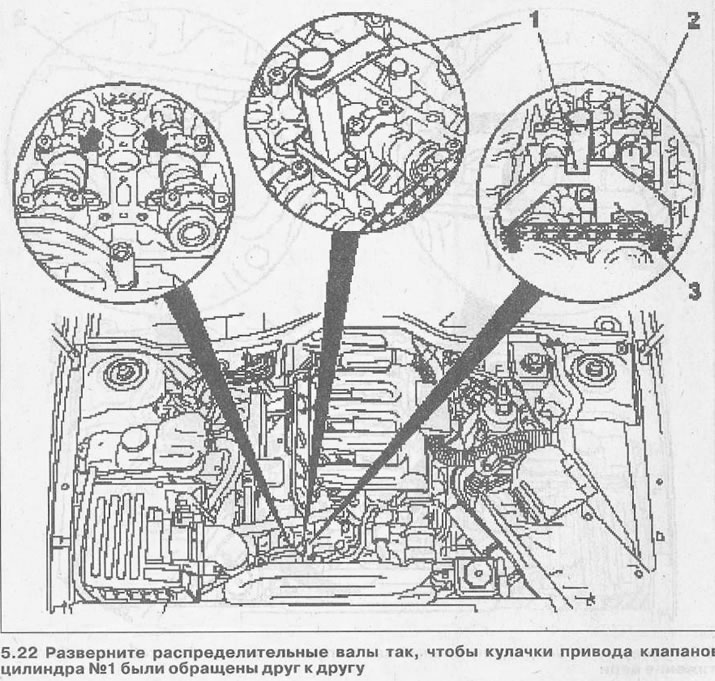
23. Install stop 1 from the KM-6267 tool kit on the cylinder head, and then secure camshaft 2 of the inlet valves with tool 3 (see illustration 5.22).
24. Place chain 3 on the intake camshaft sprocket and install the sprocket on the shaft (see illustration).
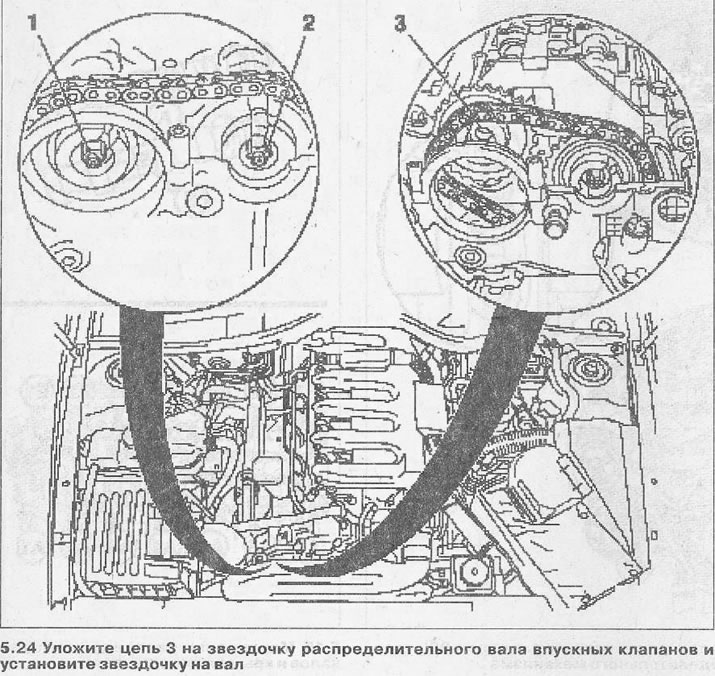
25. Screw in the new bolt 2 securing the sprocket to the shaft, tighten it, and then tighten it an additional ½ turn (see illustration).
26. Move the camshaft sprocket down, put the chain on it and secure the sprocket with the chain on the exhaust camshaft.
27. Screw in the new bolt 1 securing the sprocket to the exhaust camshaft, but do not tighten it (see illustration 5.24).
28. Install chain guide 1 with a new sealing gasket onto the cylinder head and secure with bolts applying a force of 9.9 Nm (see illustration).
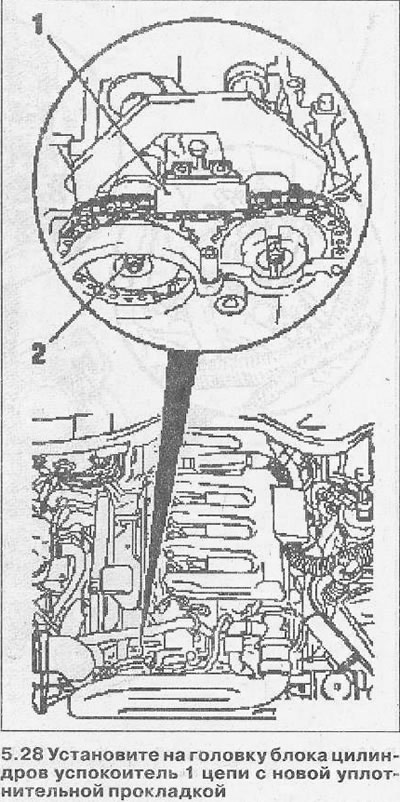
29. Tighten bolt 2 of the sprocket on the exhaust valve shaft with a force of 15 Nm, holding the shaft from turning by the hexagon (see illustration 5.28).
30. Slowly turn the exhaust camshaft by the drive sprocket mounting bolt in the direction shown by the arrow in the illustration to relieve chain tension by compressing the tensioner.
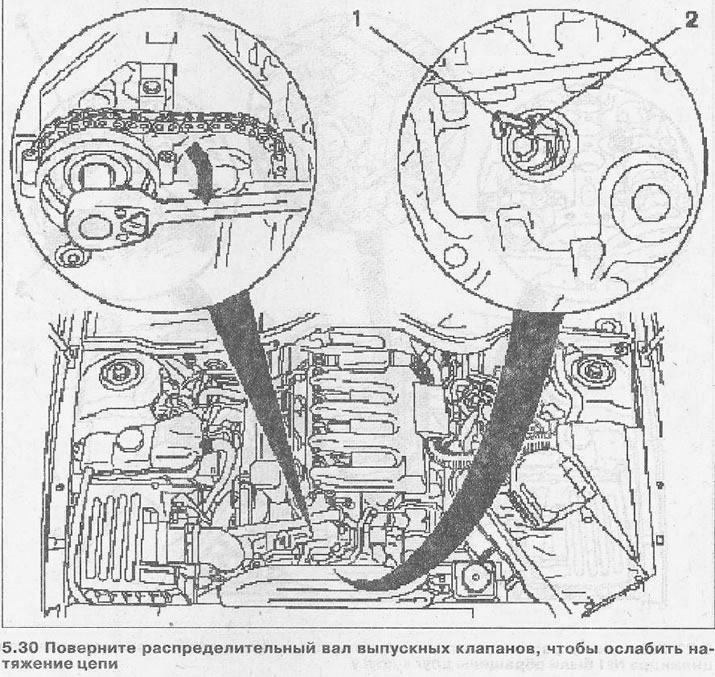
31. After loosening the chain, insert the stop pin 1 KM-823 into the hole 2 on the tensioner and fix it (see illustration 5.30).
32. Loosen the bolt securing the sprocket to the exhaust camshaft by ½ turn.
33. Tighten bolt 1 of the hydraulic chain tensioner to 16 Nm (see illustration).
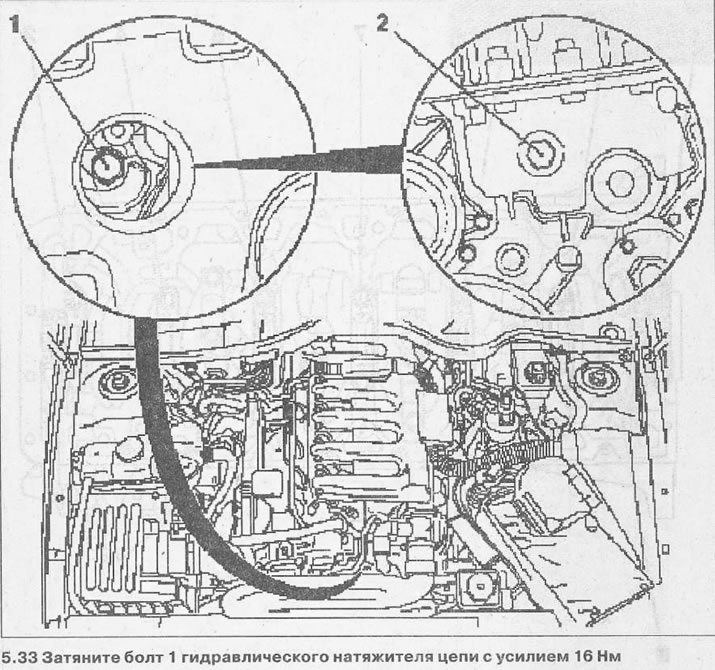
34. Place a sealing gasket on plug 2 and screw it into the timing gear housing using a force of 30 Nm (see illustration 5.33).
35. Lock the crankshaft at TDC of the piston of cylinder No.1 with the KM-813 thrust pin, turning the crankshaft by the bolt securing the vibration damper to the belt pulley (see illustration 5.6).
36. Tighten bolt 3 of the intake camshaft sprocket with a torque of 20 Nm, and then turn it by 35°, while holding the camshaft from turning (see illustration).
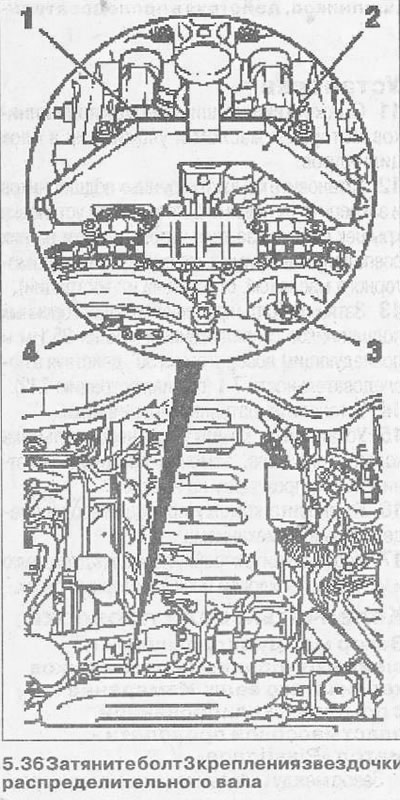
37. Install stop 2 from the KM-6267 tool kit on the exhaust camshaft 1 and ensure that the support surfaces of the tool are tightly seated on the cylinder head (see illustration 5.36).
38. Tighten bolt 4 of the sprocket on the exhaust camshaft with a force of 20 Nm, then turn the bolt by 35° (see illustration 5.36).
39. Remove the thrust device from the exhaust camshaft and remove the KM-813 pin from the hole on the flywheel drive disk.
40. Turn the crankshaft by the vibration damper mounting bolt on the accessory drive belt pulley by two turns (720°) in the direction of engine rotation and secure the crankshaft with the KM-813 thrust pin, inserting it into the hole on the flywheel/drive disk.
41. Install the KM-6267 thrust devices on the intake and exhaust camshafts. The devices must fit tightly to the sealing surfaces of the cylinder head. If this is not the case, the camshaft installation must be repeated.
Installation of parts removed from the cylinder head is performed in the reverse order of removal.
Visitor comments