OpelBook.ru
Cars AvtoVAZ Cars Mitsubishi Cars BMW Cars Mercedes Cars Nissan Cars Toyota Cars Chevrolet
English Русский
Български
Беларускі
Український
Српски
Hrvatski
Română
Polski
Slovenský
Magyar
 |  Sitemap  |  Contacts  |    


Main Astra Corsa Insignia Kadett Omega Vectra Zafira Others Articles
Corsa B (1993-2000) Corsa C (2000-2006, petrol) Corsa C (2000-2006)
  • Main
  • Corsa
  • Corsa C
  • Transmission
  • Automatic gearbox
  • Checking oil pressure (AF13-II)

Checking oil pressure (AF13-II) (Opel Corsa C)

            0

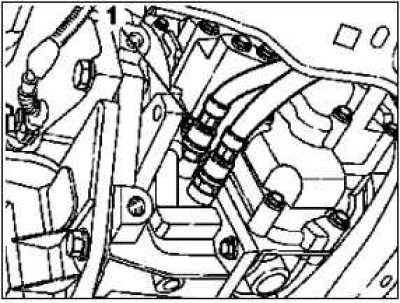
Caution! Rule out control faults. When checking with a full load, pull the parking brake lever and press the brake pedal. Due to the risk of overheating at full load, do not perform the check for longer than 5 s. Introduce a cooling pause. Only the main pressure is checked.

Caution! Rule out control faults. When checking with a full load, pull the parking brake lever and…


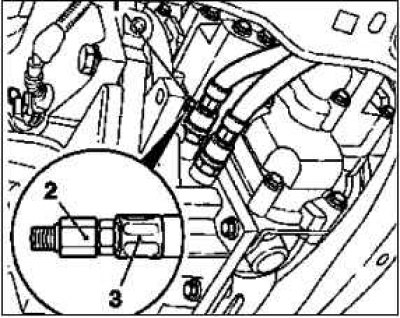
Remove plug 1.

Remove plug 1.


Install the oil pressure gauge KM-498-B 3 with the adapter KM-580 2.

Check the transmission oil level.

Check the main pressure.

Install plug 1 with a new seal on the gearbox, tightening torque – 8 Nm.

Check the transmission oil level.

Checking and adjusting the transmission oil level (AF13-II)


Text copied from this portal [www.opelbook.ru]

Measure the transmission oil temperature with the TECH 2 device.

Note: Before checking the oil level: Run the engine at idle speed with the gearshift lever in the "P" position. Move the lever once through all positions from "P" to "1" and back.


Note: Before and during checking the oil level, the gearshift lever must be in the "P" position with the engine running.

Note: Before and during checking the oil level, the gearshift lever must be in the «P» position…


Add transmission oil to the appropriate upper mark.

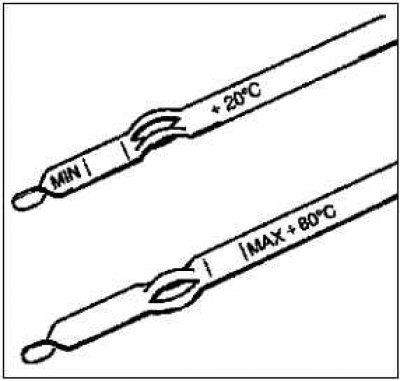
When the gearbox is cool (oil temperature below +35°C, for one minute of engine idling), the oil level will be correct if it is on the side of the dipstick marked "MIN +20°C", between the corresponding marks.

When the gearbox is warmed up (about 80°C, after the car has travelled about 20 km), the oil level will be correct if it is on the side of the dipstick marked "MAX +80°C", between the corresponding marks.


This article is available at russian, bulgarian, belarusian, ukrainian, serbian, croatian, romanian, polish, slovak, hungarian
Checking the article: Kornev Georgy

Share information:

Previous articles
Opel Corsa C: Automatic gearbox
Next articles

Checking the condition of the transmission oil (AF13-II)
Automatic transmission designation (AF 13-II)
Adjusting the Automatic Transmission Shift Selector Cable
Main gear — general information
Torque Converter — General Information
General information about automatic transmission
Checking the gearshift lever position switch (AF13-II)
Unlocking the gearshift lever lock if it malfunctions
Adjusting the gear shift lever position switch (AF13-II)
Adjusting the gear shift cable system (AF13-II)
Replacing the gear shift cable system (AF13-II)
Replacing the gear shift lever locking device switch


See similar ones from other Opel car manuals:
▶ Checking the condition of the tires and tire pressure Opel Astra G (1998-2004, petrol)
▶ Checking the opening pressure of the steam valve Opel Insignia A (2008-2017)
▶ Checking oil pressure Opel Kadett E (1984-1995)
▶ Checking the compression pressure Opel Omega B (1993-1999)
▶ Checking tire pressure Opel Vectra A (1988-1995)
Link to this page in different formats

Visitor comments


No comments yet


How much will 32 + 45 =


Corsa C (2000-2006) 
  • General information
  • Introduction to guide
  • Troubleshooting
  • Vehicle device
  • User manual
  • Maintenance
  • Power unit
  • Engine repair
  • Cooling system
  • Power and exhaust system
  • Control system
  • Engine electrical equipment
  • Transmission
  • Clutch
  • Mechanical gearbox
  • Automatic gearbox
  • Drive shafts
  • Chassis
  • Brake system
  • Wheel suspension
  • Steering
  • Body
  • Exterior
  • Interior
  • Doors and windows
  • Heating and air conditioning
  • Electrical equipment
  • Equipment and devices
  • Lamps and lighting
  • Electrical circuits
Corsa C (2000-2006, petrol) 
  • User manual
  • Car access
  • Governing bodies
  • Seat control
  • Heating and air conditioning
  • Driving and maintenance
  • Engines 1.0 and 1.2 l
  • Engine repair
  • Cooling and lubrication system
  • Injection system
  • Engines 1.4, 1.6 and 1.8 l
  • Engine repair
  • Cooling and lubrication system
  • Injection system
  • Transmission
  • Clutch
  • Mechanical gearbox
  • Automatic gearbox
  • Drive shafts
  • Chassis
  • Wheels and tires
  • Wheel suspension
  • Steering
  • Brake system
  • Body
  • Exterior
  • Doors and windows
  • Electrical equipment
  • Equipment and devices
  • Lighting system
  • Electrical circuits
Corsa B (1993-2000) 
  • General information
  • Introduction to guide
  • User manual
  • Maintenance
  • Power unit
  • SOHC gasoline engines
  • DOHC gasoline engines
  • Diesel engines
  • Engine repair
  • Cooling system
  • Supply system
  • Injection system (gasoline)
  • Injection system (diesel)
  • Exhaust systems
  • Control system (gasoline)
  • Preheat system (diesel)
  • Charge and launch system
  • Transmission
  • Mechanical gearbox
  • Automatic gearbox
  • Clutch and drive shafts
  • Chassis
  • Brake system
  • Front suspension
  • Rear suspension
  • Steering
  • Body
  • Ventilation and heating
  • Exterior
  • Interior
  • Doors and windows
  • Electrical equipment
  • Equipment and devices
  • Lamps and lighting
  • Electrical circuits
OpelBook.ru © 2017–2026 · Mobile version · · Sitemap: EN BG BY UA RS HR RO PL SK HU · Feedback · Site search
Astra F, petrol · Astra G, petrol · Astra G · Astra H · Astra J, petrol · Corsa B · Corsa C, petrol · Corsa C · Insignia A · Kadett D · Kadett E · Omega A · Omega B · Omega B2 · Vectra A, petrol · Vectra A · Vectra B, petrol · Vectra B · Vectra C · Zafira A, petrol · Frontera A, petrol · Frontera B · Ascona C · Vivaro A ·
We want your visit to be comfortable 🤝! We use cookies 🍪 to make that happen.