


4. When operating the vehicle in conditions of low outside air temperatures, the air temperature inside the cylinders after compression may be insufficient for the fuel to ignite spontaneously. In this case, it is necessary to preheat the incoming air flow. For this purpose, glow plugs are installed in the combustion chambers, heating them to the required temperature. The duration of the preheating depends on the outside air temperature and is regulated by the engine management system via the preheating relay. When the glow plugs are activated, the corresponding indicator lamp lights up on the instrument panel (see Chapter "Controls and operating techniques").
5. There are three fuel injection methods for diesel engines: swirl injection, pre-chamber injection and direct injection.
6. In the swirl-chamber and pre-chamber methods, fuel is injected into the pre-chamber (fort chamber) the corresponding cylinder where it mixes with air and creates a ready working mixture, while part of the fuel immediately ignites and burns. Due to the swirls of the air flow and heating during combustion of part of the fuel, the working mixture becomes more homogeneous and heated. This ensures complete combustion of the fuel when it enters the cylinder and "softer" engine operation. The main disadvantage of these injection methods is the complication of the engine design. Direct injection continues to be the most common and most economical.
7. With direct injection, fuel enters directly into the combustion chamber through the nozzle atomizer. Each atomizer usually has 4-6 very fine holes drilled at different angles, through which fuel is sprayed in specially specified directions. Usually, there is a swirl chamber in the piston crown. Swirl chambers can have different shapes, which correspond to the directions of fuel spraying, promote better mixture formation and more efficient combustion of the working mixture. This method is used on all diesel engines discussed in this Manual.
8. On Y17DT(L) engines, fuel is sucked from the fuel tank by a high-pressure fuel pump (HPFP). The HPFP creates the high pressure required for injection (about 900 bar) pressure and supplies fuel through the injectors to the engine cylinders in the order of cylinder operation. First, a preliminary injection of a small amount of fuel is performed, which, burning, prepares the conditions for the injection of the main portion of fuel. Due to this, a "softer" and more uniform combustion of fuel occurs, as in engines with a swirl-chamber injection method.
9. On Z13DT/Z17DTH engines, a direct injection system is used "Common Rail" - common fuel distribution line for all cylinders (see accompanying illustration). Fuel is sucked from the fuel tank by an electric fuel pump and supplied to the high-pressure fuel pump (HPFP). This system relieves the HPFP of the fuel distribution function, which allows the pump to create a very high (approximately 1400 bar) pressure, - this promotes a finer atomization of the fuel, due to which the process of mixture formation in the cylinders improves and the efficiency of combustion of the working mixture increases. Fuel distribution line (Common Rail) it is designed as a manifold, from which fuel is supplied to individual injectors.
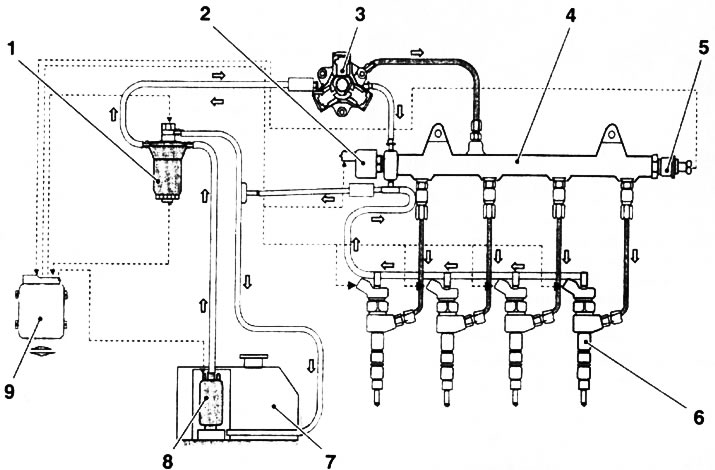
15.9. Common Rail Injection System (using the example of Z13DT engines): 1. Fuel filter; 2. Pressure regulator; 3. High pressure fuel pump; 4. Fuel distribution line (Common-Rail); 5. Pressure sensor; 6. Nozzle; 7. Fuel tank; 8. Electric fuel pump; 9. Electronic module of the engine management system; Dotted arrows indicate the direction of electrical signals; Short arrows indicate the direction of fuel flow
10. On all engines, before fuel enters the high-pressure fuel pump, it is cleaned in the fuel filter from dirt and water. The engines are equipped with injectors with electromagnetic control elements that receive signals from the engine management system, which regulates the amount of fuel supplied to the cylinder.
11. The high-pressure fuel pump does not require any special maintenance work. All moving elements of the fuel system are lubricated with diesel fuel. The high-pressure fuel pump is driven by the crankshaft via a toothed timing belt or chain.
Visitor comments